Smart contracts execute code automatically on blockchain. Or find out how they power DeFi, NFTs, and what risks they pose.
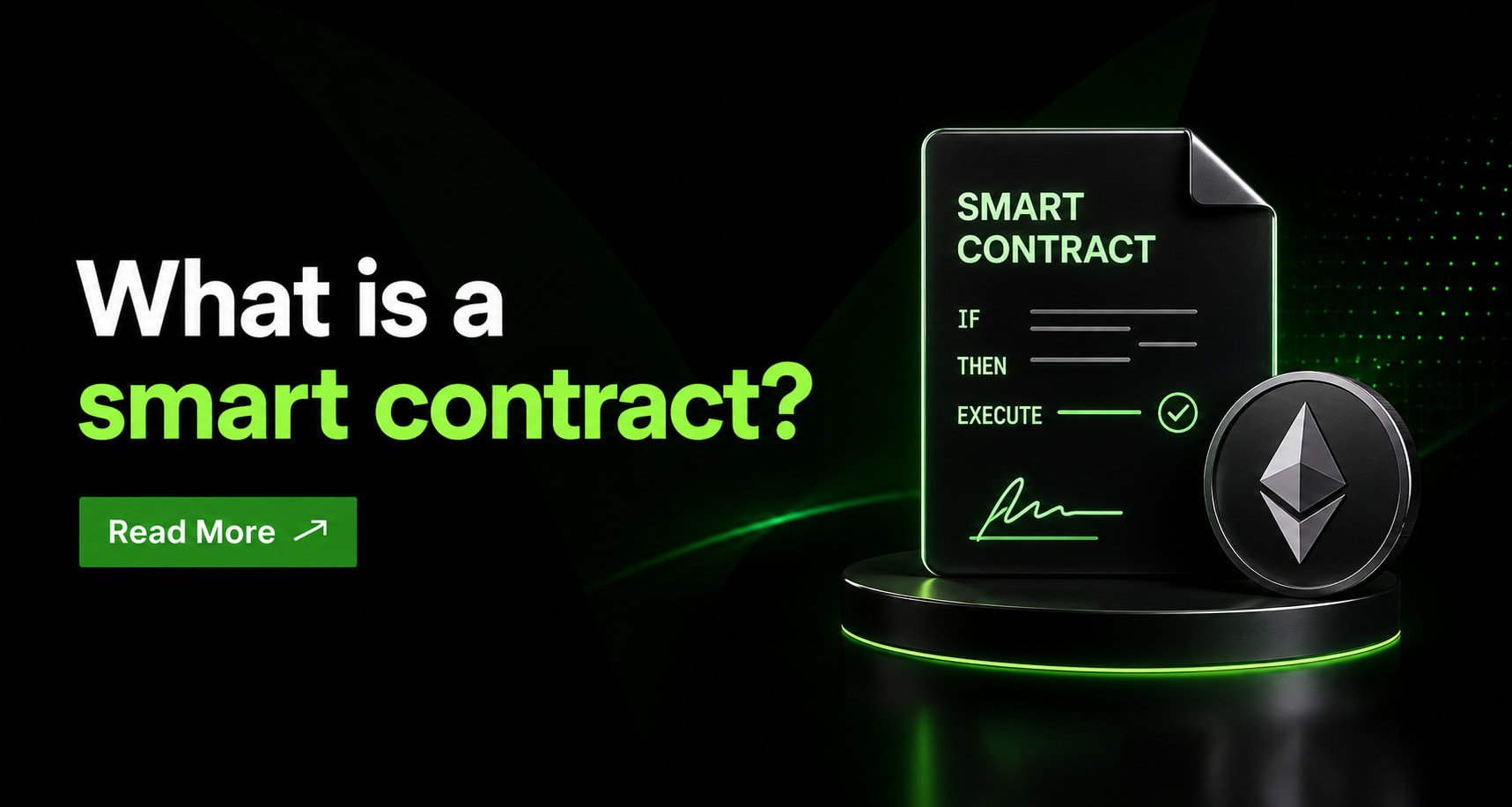
What is a smart contract? Despite the name, it is neither especially clever nor a legal document in the usual sense. A smart contract is a piece of code stored on a blockchain that runs automatically when certain conditions are met. Think of it as a digital agreement that enforces itself, with no lawyer, bank, or middleman needed to make sure both sides hold up their end.
Smart contracts are the engine behind much of what happens in crypto, from decentralized finance to NFTs. This guide explains what a smart contract is, how it works, where it is used, and the risks worth knowing, in plain language for beginners.
A smart contract is a program stored on a blockchain that runs automatically when certain conditions are met. Despite the name, the word smart has nothing to do with artificial intelligence, and it is not a legal document in the traditional sense. At its core, a smart contract is a set of rules written as code, following plain if-this-then-that logic: if a condition is met, the code acts.
The idea predates modern crypto. The computer scientist Nick Szabo described it in the 1990s, long before blockchains existed to run it. His comparison still works best: a vending machine. You put in the right money, select an item, and the machine dispenses it automatically. No shopkeeper is deciding whether to serve you, and no way to take your money without giving you the product. A smart contract does the same with digital agreements, enforcing the rules itself rather than relying on a person or company to follow through.
A smart contract starts with a developer writing the rules as code. That code is deployed to a blockchain, where it is copied across the network of computers, or nodes, that maintain the ledger, and given its own address. From then on, anyone can interact with it by sending a transaction to that address.
When a transaction arrives, the network checks whether the contract's conditions have been met. If they have, every node runs the same code, agrees on the result, and records it on the blockchain. If they have not, nothing happens. The contract runs exactly as written, the same way on every computer, which is what lets it work without anyone in charge.
Imagine buying a digital item from a stranger online. A smart contract could hold your payment and release it to the seller only once the item is delivered, and refund you automatically if it is not. Neither side has to trust the other, because the code, not a person, decides the outcome.
Smart contracts need a blockchain built to run them, and this is where Ethereum comes in. When Ethereum launched in 2015, it was the first network designed as a general-purpose platform for smart contracts, and it remains the most widely used. Developers write Ethereum smart contracts in a language called Solidity, and running one costs a small fee known as gas.
Bitcoin, by contrast, was built mainly to move money and has only limited scripting, so it is not a general home for complex smart contracts. That is a large part of what sets the two networks apart, which we cover in our comparison of Bitcoin and Ethereum. Other blockchains, including Solana and Cardano, also support smart contracts, but Ethereum is where most of the activity has happened.
Smart contracts are the building blocks of what people call decentralized applications, or dApps, and they power a large share of crypto. Here are the main areas where they are used.
The biggest use is decentralized finance, or DeFi, where smart contracts run lending, borrowing, and trading with no bank or broker in the middle. Decentralized exchanges use them to let people swap tokens directly, with the code setting the terms rather than a company.
Smart contracts issue and manage NFTs, which record ownership of digital items such as art, and stablecoins, which are tokens designed to hold a steady value by tracking a currency like the US dollar. In both cases, the contract keeps track of who owns what and enforces the rules automatically.
A decentralized autonomous organization, or DAO, runs its rules through smart contracts. Members vote on proposals, and approved decisions are executed on their own, without a central manager. The code, rather than a boardroom, carries out what the group agrees to.
Beyond crypto, smart contracts can automate insurance payouts and track goods through supply chains. A flight-delay policy, for example, could pay out the moment a trusted data feed confirms the delay, with no claim to file. Anywhere an agreement can be reduced to clear rules, a smart contract can potentially automate it.
To see why smart contracts matter, it helps to compare one with a traditional agreement. A normal contract relies on people and institutions, such as lawyers, banks, or courts, to enforce it, which takes time and money and requires trusting the other side. A smart contract shifts that job to code running on a network no single party controls.
| Aspect | Traditional agreement | Smart contract |
|---|---|---|
| Who enforces it | Courts, lawyers, or a trusted third party | The code itself, run by the blockchain |
| Speed | Can take days or longer | Executes in seconds once conditions are met |
| Cost | Fees for intermediaries | Mainly network (gas) fees |
| Can it be changed | Yes, by agreement | Generally, no, once deployed |
| Trust | You trust the other party or a middleman | You trust the code and the network |
| Records | Held privately by each party | Public and auditable on the blockchain |
That shift brings a few clear benefits. Because the contract enforces itself, there is no middleman to pay or wait for, which can make things faster and cheaper. Two parties who do not know or trust each other can still transact safely, since the network guarantees the code runs as written. And because the code is public on most blockchains, anyone can check exactly what it does before using it.
For all their promise, smart contracts carry real risks, and it would be a mistake to treat them as flawless. Four are worth understanding before you rely on one.
A smart contract does exactly what it is programmed to do, so a bug or an oversight can be exploited, and large sums have been lost this way. Because deployed contracts usually cannot be changed, a flaw can be very hard to fix afterward. This is why careful testing and independent audits matter so much.
A smart contract cannot see the outside world on its own. It needs a trusted data source, called an oracle, to feed it real-world information like prices or flight times, and that source has to be reliable. If the data is wrong, the contract will act on it anyway.
Transactions are generally final. A mistaken payment, or interacting with a faulty or malicious contract, usually cannot be undone. That makes it worth double-checking what a contract does before you confirm anything.
A smart contract is not automatically a legal contract. The code will run as written, but whether a court would recognize or enforce it is a separate question that the law is still working out. None of this makes smart contracts a bad idea, only one to approach with clear eyes.
A smart contract is a piece of code stored on a blockchain that runs by itself when certain conditions are met. It follows if-then rules, so when the conditions are satisfied, it carries out an action automatically, such as releasing a payment or transferring ownership. It works without a middleman because the network enforces the code rather than a person or company.
Not in the way the name suggests. There is no artificial intelligence involved. A smart contract simply follows the rules it was given, using plain if-then logic. The word smart refers to the fact that it executes and enforces itself automatically, not that it thinks or makes judgments.
Ethereum is the most widely used platform for smart contracts, and the first designed as a general-purpose home for them. Other blockchains, including Solana and Cardano, also support them. Bitcoin has more limited scripting and was built mainly for payments, so it is not a general platform for complex smart contracts in the way Ethereum is.
The most common examples are in decentralized finance, where smart contracts power lending, borrowing, and decentralized exchanges that let people trade without a middleman. They also issue NFTs and stablecoins, run decentralized organizations, and are used for things like automatic insurance payouts and supply chain tracking.
Smart contracts are secure by design, in that they run exactly as written and are hard to tamper with. The catch is that they are only as good as their code. Bugs and exploits are a real risk, and because deployed contracts usually cannot be changed, flaws can be hard to fix. They also rely on trusted data sources and are not always legally binding. This is general information, not advice.
The technology beneath crypto is easier to make sense of with guidance behind you. UpTrade is a dedicated crypto brokerage built around real relationships, not a self-serve app you navigate alone.
UpTrade is an AUSTRAC-registered digital currency exchange provider (DCE100856266-001). You can read more about registered providers at austrac.gov.au.
General information only. This article is for educational purposes and does not constitute financial, investment, legal or tax advice, nor a recommendation to buy, sell or hold any asset. Cryptocurrency is a high-risk asset and you should consider your own circumstances and seek independent advice before making any decision. UpTrade does not make price predictions.

Market updates, new explainers and the occasional Alpha Pro report, sent once a week. Unsubscribe anytime.