Bitcoin vs Ethereum is the first comparison almost every newcomer to crypto runs into, and for good reason. They are the two largest cryptocurrencies.
By the UpTrade content team. Reviewed by a licensed broker. Last updated: June 2026.
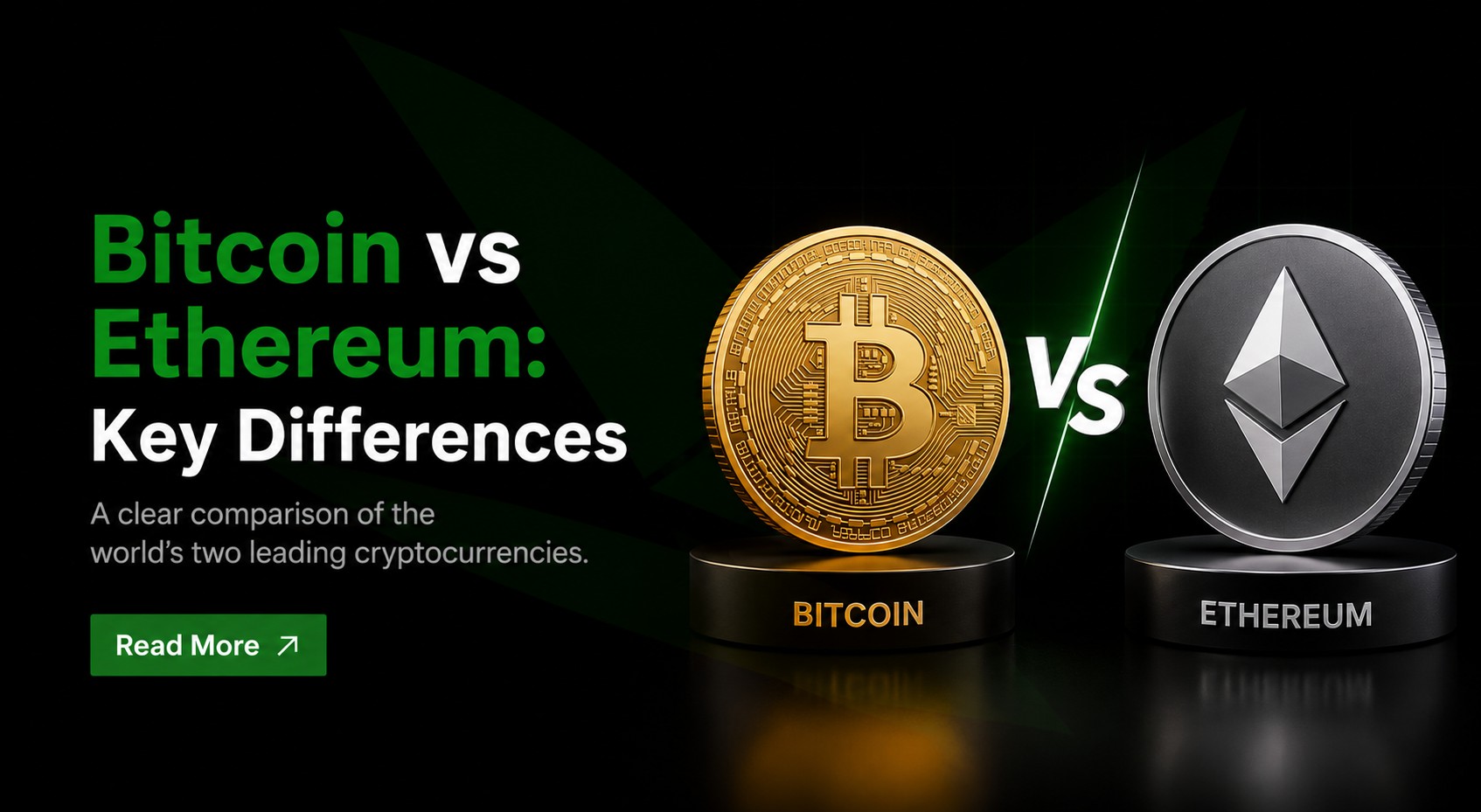
Bitcoin vs Ethereum is the first comparison almost every newcomer to crypto runs into, and for good reason. They are the two largest cryptocurrencies by far, they often move together, and they are easy to lump into one category. Under the hood, though, they were built to do very different things.
This guide explains the key differences between Bitcoin and Ethereum in plain language: what each was made for, how they work, how their supply and energy use differ, and where each one fits. No price predictions and no recommendations, just a clear, balanced comparison so you can understand BTC and ETH for what they are.
Bitcoin is digital money. It was built to be a secure, scarce store of value that no government or company controls, which is why it is often called digital gold. Ethereum is a platform. It was built to run code, in the form of smart contracts, so that developers can create applications on top of it. Its native token, ether (ETH), is the fuel that pays for that activity.
Put simply, Bitcoin aims to be the best form of digital money, and Ethereum aims to be a global computer for decentralized apps. They are not really rivals so much as two different bets on what blockchains are for, which is why many people hold both.
Bitcoin launched in 2009, created by the pseudonymous Satoshi Nakamoto, as a way to send money person to person without banks or middlemen. It runs on the Bitcoin network, secured by mining, and its supply is capped at 21 million coins. That fixed limit is central to its appeal as a store of value, since no one can print more.
Bitcoin is deliberately simple and slow to change, which supporters see as a feature, not a flaw. To go deeper on how its price has moved in long cycles tied to the halving, see our guide to the bitcoin cycle and halving.
Curious how to get Bitcoin? Get started here.
Ethereum launched in 2015, led by Vitalik Buterin and a group of co-founders. It is a programmable blockchain: as well as moving value, it can run smart contracts, which are self-executing pieces of code that carry out an agreement automatically when conditions are met. That single capability is what makes Ethereum a platform rather than just a currency.
On top of Ethereum sit decentralized finance apps, NFT marketplaces, stablecoins, and much of what people call Web3. Ether (ETH) is the token used to pay for all of this, often described as gas. See our how to buy ethereum page to learn how to own your first ETH.
Both are blockchains, but almost everything about how they work and what they are for differs. Here is a side-by-side look.
| Feature | Bitcoin (BTC) | Ethereum (ETH) |
|---|---|---|
| Launched | 2009, by Satoshi Nakamoto | 2015, by Vitalik Buterin and others |
| Main purpose | Digital money and store of value | Platform for apps and smart contracts |
| Often called | Digital gold | The world computer |
| Consensus | Proof of Work (mining) | Proof of Stake (staking, since 2022) |
| Energy use | High, energy-intensive mining | Far lower since 2022, about a 99.95% cut |
| Supply | Capped at 21 million coins | No hard cap; can shrink via fee burning |
| Block time | About 10 minutes | About 12 seconds |
| Smart contracts | Limited scripting only | Full smart contracts via the EVM |
| Common uses | Store of value, payments | DeFi, NFTs, stablecoins, apps, staking |
The biggest difference is purpose, and most of the others flow from it. Because Bitcoin only needs to be sound money, it keeps things minimal: a fixed supply, a slow and steady block every ten minutes or so, and a scripting system too limited to build complex apps on. That restraint is what makes it predictable.
Ethereum needs to do more, so it is built differently. Blocks arrive every twelve seconds or so, and its move to Proof of Stake in 2022, an upgrade known as the Merge, cut its energy use by about 99.95% and swapped miners for validators who lock up ETH to help secure the network. Its supply has no fixed ceiling, but a fee-burning mechanism can reduce the amount of ETH in circulation when the network is busy, which sets it apart from both Bitcoin's hard cap and traditional inflation.
For all those differences, Bitcoin and Ethereum share a foundation, which is part of why they are so often mentioned together.
Bitcoin's uses are narrow by design. It is held mainly as a long-term store of value, used for payments, and increasingly treated as a hedge against inflation. Its simplicity is the point, and that focus is a large part of why it has the longest track record and the deepest institutional support of any cryptocurrency.
Ethereum's range is wider because it is a platform. On top of it sit decentralized finance apps for lending and trading, marketplaces for NFTs, stablecoins, and a growing effort to tokenize real-world assets. Holders can also stake ETH to help secure the network and earn rewards, something Bitcoin does not offer natively. That breadth brings more potential uses, and also more moving parts that can go wrong, from smart-contract bugs to higher fees when the network is congested
Working out how assets like Bitcoin and Ethereum fit your goals is easier with someone to talk it through. At UpTrade, clients work with a dedicated broker and have access to research from an in-house team, so you can weigh the options with a real person rather than alone. You can book a free consultation to see how that works.
You may come across the term the flippening, which describes a hypothetical moment when Ethereum's total market value overtakes Bitcoin's. It has been discussed for years and has not happened. As of the time of writing, Bitcoin remains the largest cryptocurrency by a wide margin, with Ethereum in second place. Both have launched regulated spot ETFs in the United States, both pulled back from their 2025 highs, and Ethereum continues to roll out upgrades aimed at making it faster and cheaper to use.
Whether the gap between them narrows or widens is not something anyone can reliably predict, and this article makes no attempt to. These details also change over time, so treat this as a snapshot and check current sources for the latest.
Neither is better in any absolute sense, because they were built to do different things. Comparing them is less like choosing between two phones and more like comparing a vault to a workshop. One is built to hold value securely and simply, the other to build and run things. Each does its own job well, and each has a different risk profile.
Many investors who want exposure to crypto hold both, treating Bitcoin as the store-of-value anchor and Ethereum as the bet on programmable blockchains. That said, both are volatile and carry real risk, and this is not a recommendation to buy either. The more useful question is not which one wins, but which role, if any, each might play for you, weighed against your own goals and research.
Bitcoin is digital money, built to be a secure, scarce store of value. Ethereum is a programmable platform that runs smart contracts and applications, with its token ether used to pay for that activity. In short, Bitcoin is mainly something you hold, while Ethereum is something you also build on and use. They serve different purposes rather than competing directly.
Neither is objectively better. They were designed for different jobs, so the comparison depends on what you value. Bitcoin offers simplicity, a fixed supply, and the longest track record. Ethereum offers programmability, a wider range of uses, and staking. This is not a recommendation, and both carry the risks common to all cryptocurrencies.
Yes. When Ethereum moved from Proof of Work to Proof of Stake in 2022, it cut its energy use by roughly 99.95%, because it no longer relies on energy-intensive mining. Bitcoin still uses Proof of Work, so it consumes considerably more energy. This is one of the clearest practical differences between the two networks.
Not natively. Ethereum uses Proof of Stake, so holders can stake ETH to help secure the network and earn rewards. Bitcoin uses Proof of Work, which is secured by mining rather than staking, so there is no built-in way to stake it. Some third-party services advertise Bitcoin yield, but these carry their own risks and are not the same as native staking.
No one knows. The idea of Ethereum's market value passing Bitcoin's, known as the flippening, has been discussed for years without happening. It would require either strong Ethereum growth or significant Bitcoin underperformance. This article makes no prediction either way, and you should treat confident forecasts with caution.
Understanding how Bitcoin and Ethereum differ is the first step. Acting on that understanding is easier with a dedicated expert behind you. UpTrade is a dedicated crypto brokerage built around real relationships, not a self-serve app you navigate alone.
UpTrade is an AUSTRAC-registered digital currency exchange provider (DCE100856266-001). You can read more about registered providers at austrac.gov.au.
General information only. This article is for educational purposes and does not constitute financial, investment, legal or tax advice, nor a recommendation to buy, sell or hold any asset. Cryptocurrency is a high-risk asset and you should consider your own circumstances and seek independent advice before making any decision. UpTrade does not make price predictions.

Market updates, new explainers and the occasional Alpha Pro report, sent once a week. Unsubscribe anytime.