Distributed ledger technology keeps a shared record across many computers, with no one in charge. Here's how it differs from blockchain.
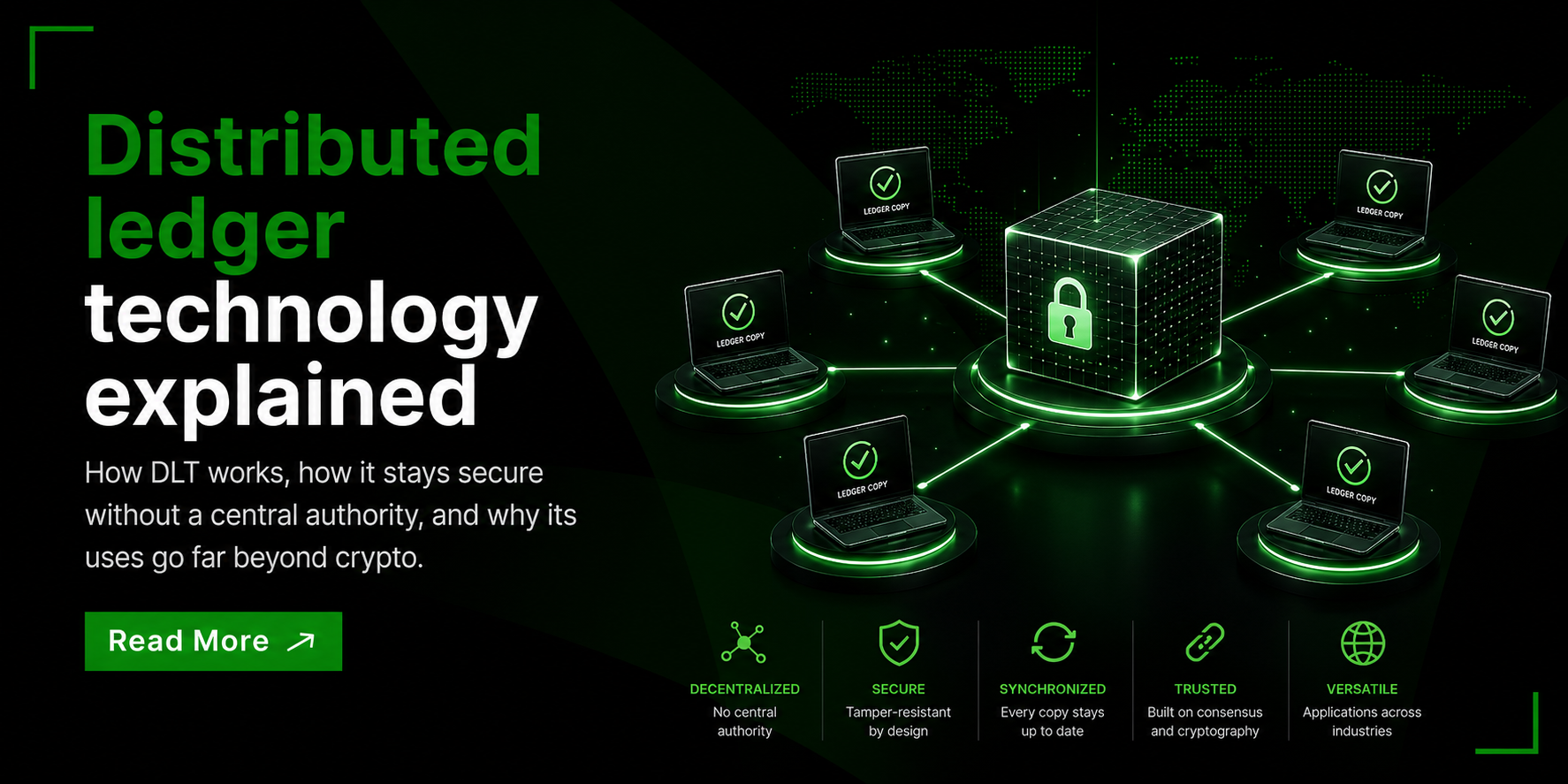
Distributed ledger technology, usually shortened to DLT, is the idea sitting underneath cryptocurrencies, blockchains, and a growing amount of the financial world. If you have heard the term used interchangeably with blockchain, you are not alone, and the mix-up is worth clearing up.
In short, distributed ledger technology is a way of keeping a shared record across many computers at once, with no central authority in control. Blockchain is the best-known form of it, but not the only one. This guide explains what DLT is, how it works, how it relates to blockchain, and where it is used, in plain language for beginners.
Distributed ledger technology is a way of recording and sharing data across many computers at the same time, with no single organization in charge of it. The word ledger simply means a record of transactions. What makes it distributed is that the record does not live in one place. Copies are held and kept in sync across a network of computers, often called nodes, which may sit in different companies, cities, or countries.
This is a departure from how records have usually been kept. A normal database sits on a single server owned by one organization, which creates a single point of failure: if that server is hacked or goes down, the data is at risk. A distributed ledger has no such central point, so to change the record you would need to alter copies held across the whole network at once, which consensus and cryptography make extremely hard.
So how does a shared record stay accurate when no one is in charge of it? The answer is consensus. When someone wants to add a new entry, such as a transaction, the request is sent out to the network. The nodes check it against agreed rules and come to agreement on whether it is valid. Once they agree, the entry is added, and every copy of the ledger updates to match.
Because every node holds its own copy, there is no central version to attack or quietly edit. If someone tried to change an entry on one copy, it would no longer match the rest, and the network would reject it. That is what makes a distributed ledger tamper-resistant: not that changes are impossible, but that they cannot be hidden.
The terms distributed ledger technology and blockchain are often used to mean the same thing, but they are not equal. Blockchain is a type of distributed ledger technology, the most common one by far, but only one of several. A useful way to remember it: all blockchains are distributed ledgers, but not all distributed ledgers are blockchains.
Blockchain gets used for the whole category a bit like calling every adhesive bandage a Band-Aid. What makes it specific is its structure: data is grouped into blocks, each linked to the one before it in a fixed chronological chain. Other forms of DLT do not organize data that way. Some, like the networks behind Bitcoin and Ethereum, use blocks; others use entirely different structures. The table below sums up the relationship.
| Aspect | Distributed ledger technology (DLT) | Blockchain |
|---|---|---|
| What it is | The broad category of shared, decentralized ledgers | One specific type of DLT |
| Data structure | Can be organized in various ways | Data grouped into blocks, chained in order |
| Relationship | The umbrella term | A subset that sits under it |
| Tokens | Not always involved | Usually involves a token |
| Examples | Blockchain, DAG, hashgraph, Holochain | Bitcoin, Ethereum, the XRP Ledger |
Distributed ledgers can be sorted two ways: by how they store data, and by who is allowed to take part.
The main difference here is how entries are organized.
Distributed ledgers can be public and open to anyone, or private and restricted to approved members. This is the same permissionless-versus-permissioned split that shapes blockchains, which we cover in our guide to permissionless blockchains. The XRP Ledger is one well-known example of a public distributed ledger.
Distributed ledgers share a handful of qualities that explain why so many industries are interested in them.
Because there is no central authority, the system has no single point of failure. That makes it resilient and hard to take down, since the ledger does not depend on any one server or company staying online.
The shared, synchronized copies make records transparent to participants and easy to audit. Everyone sees the same history, which reduces disputes about what actually happened.
Cryptography and consensus keep the record tamper-resistant. Altering it would mean changing copies across the whole network at once, which the design makes extremely difficult.
By removing the middleman that usually sits between parties, a distributed ledger can cut out slow, costly steps like reconciling two separate sets of books, which can make settlement faster and cheaper.
None of this makes distributed ledgers a fix for everything. They come with real challenges too.
Scaling a distributed ledger to handle very high volumes of activity can be difficult, and some, particularly those using proof of work, consume a lot of energy.
Different systems often do not work well together, which makes connecting one distributed ledger to another, or to existing infrastructure, a hurdle of its own.
Regulation is still catching up in many places, and the technology can be complex to build and adopt. For plenty of everyday uses, a traditional database is still simpler and perfectly adequate.
Cryptocurrency is the most visible use of distributed ledger technology, but it is far from the only one. The same qualities suit any setting where several parties need to trust the same set of data.
Banks and markets use DLT to speed up settlement and cut the cost of reconciling records, including for cross-border payments that traditionally take days to clear.
A shared ledger can track goods as they move through a supply chain, giving every party the same trusted record of where a product has been and when.
DLT is also used or trialed for digital identity, health records, voting, and central bank digital currencies. In crypto specifically, it is the foundation beneath the digital assets people trade every day. The common thread is trust in shared data, without a single party holding all the control.
Distributed ledger technology, or DLT, is a shared record of data that is copied and kept in sync across many computers at once, with no single authority in charge. Everyone on the network holds the same version, and new entries are added only when the network agrees they are valid. This makes the record hard to tamper with and removes the need for a central middleman.
No, though the two are closely related. Blockchain is one type of distributed ledger technology, and the most widely used. DLT is the broader category that blockchain belongs to. Put simply, all blockchains are distributed ledgers, but not all distributed ledgers are blockchains, since other types organize their data differently.
A normal database is usually stored in one place and controlled by a single organization, which creates a single point of failure and requires you to trust that one party. A distributed ledger spreads copies across many computers with no central owner, keeps them in sync through consensus, and is tamper-resistant by design. The trade-off is that it is more complex than a simple central database.
The best-known examples are blockchains such as Bitcoin and Ethereum. Beyond blockchain, other forms of DLT include directed acyclic graphs, used by networks like Hedera and IOTA, and approaches such as Holochain. Distributed ledgers are also used behind the scenes in finance, supply chains, and other industries, not only in cryptocurrencies.
No. Cryptocurrency is the most visible use, but distributed ledger technology reaches much further. It is used or being tested for supply chain tracking, faster financial settlement, health records, digital identity, and central bank digital currencies. Anywhere several parties need to trust a shared set of records, DLT can play a role.
The technology beneath crypto is easier to make sense of with guidance behind you. UpTrade is a dedicated crypto brokerage built around real relationships, not a self-serve app you navigate alone.
UpTrade is an AUSTRAC-registered digital currency exchange provider (DCE100856266-001). You can read more about registered providers at austrac.gov.au.
General information only. This article is for educational purposes and does not constitute financial, investment, legal or tax advice, nor a recommendation to buy, sell or hold any asset. Cryptocurrency is a high-risk asset and you should consider your own circumstances and seek independent advice before making any decision. UpTrade does not make price predictions.

Market updates, new explainers and the occasional Alpha Pro report, sent once a week. Unsubscribe anytime.