XRP and XLM share a common history, but they were built for different purposes. Here's how the two networks compare.
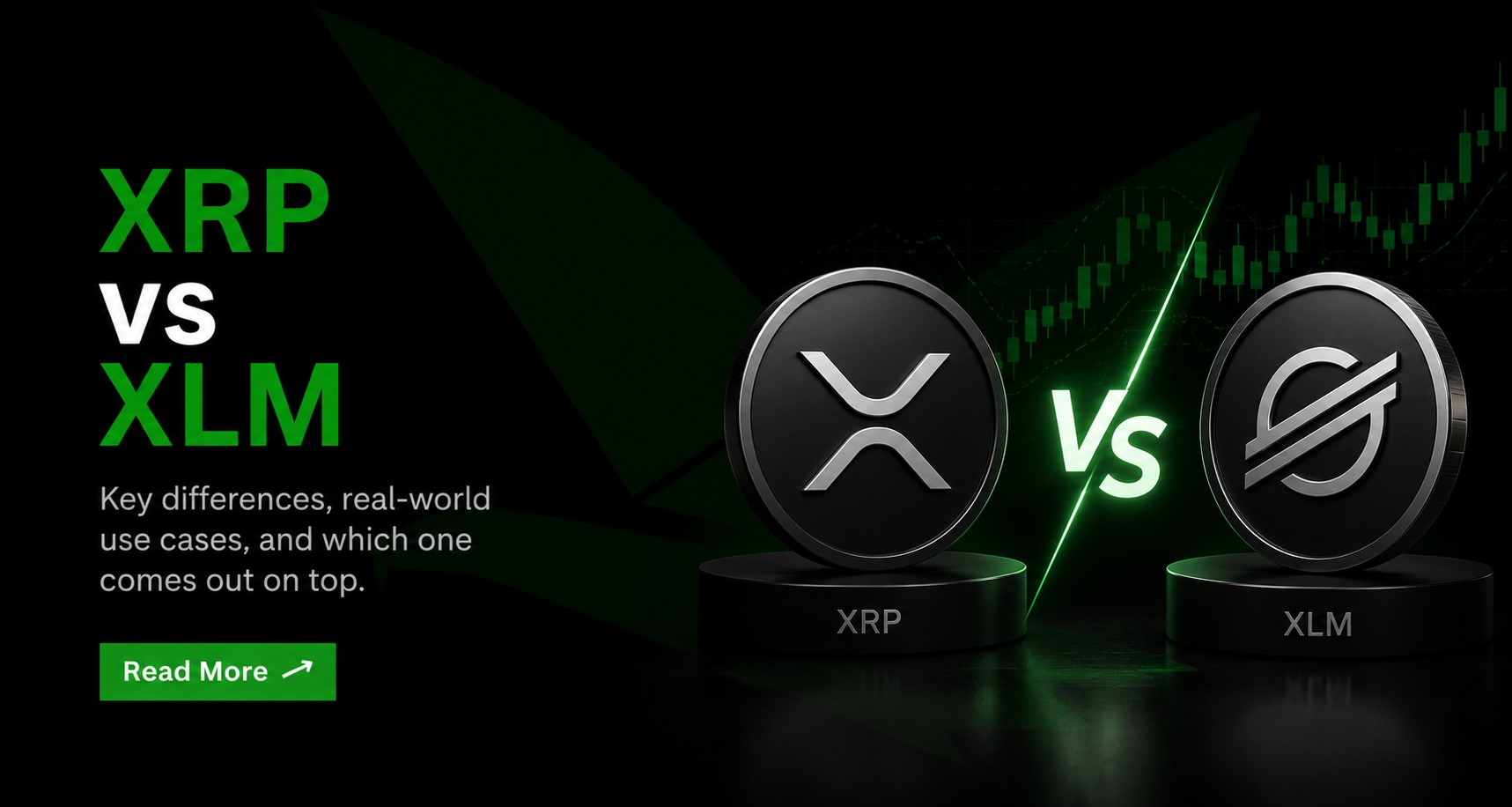
XRP and XLM look almost like twins at first glance. Both are payment-focused cryptocurrencies, both settle transactions in seconds for a tiny fee, and both were built to move money across borders faster than the traditional banking system. That resemblance is not a coincidence.
This guide breaks down XRP vs XLM, the tokens behind Ripple and Stellar, so you can see how they are related, where they differ, and which problems each one was built to solve. No price predictions and no recommendations, just a clear and balanced comparison. By the end you will understand the shared history, the structural differences, and how to think about the two without the hype that usually surrounds them.
To understand why XRP and XLM feel so similar, start with the person behind both. Jed McCaleb co-founded Ripple in 2012, the project that created XRP. Two years later, after disagreements over the company's direction, he left and co-founded Stellar with Joyce Kim.
Stellar began as an offshoot of Ripple's technology, then went its own way with a different design and a different mission. That shared DNA is why the two networks still resemble each other today. The split also set their paths. Ripple grew into a commercial company focused on banks, while Stellar became a non-profit project focused on everyday people. Almost every difference below traces back to that fork in the road.
XRP is the native token of the XRP Ledger, an open-source blockchain that anyone can use. The company most associated with it, Ripple, is the main contributor to the ledger and uses XRP across its enterprise products. The best known of those is On-Demand Liquidity, part of RippleNet, which uses XRP as a bridge between two currencies so banks can settle cross-border payments in seconds rather than days.
XRP has a fixed supply of 100 billion tokens, all created at launch. A tiny amount is destroyed with every transaction, so the supply slowly shrinks over time.
Want to own XRP? Learn here.
XLM, also called Lumen, is the native token of the Stellar network. Stellar is steered by the Stellar Development Foundation, a non-profit whose stated mission is to widen access to the financial system. Where Ripple points at banks, Stellar points at individuals, small businesses, and people in regions where banking is limited. It is built for remittances, small payments, and the issuing of digital tokens that represent real currencies.
Stellar launched with 100 billion XLM, but in 2019 the foundation burned roughly half of the supply, bringing it down to about 50 billion, and removed the network's inflation mechanism
Discover how to buy XLM here.
The two networks rhyme, but they differ in several ways that matter. Here is a side-by-side look.
| Feature | XRP (Ripple) | XLM (Stellar) |
|---|---|---|
| Launched | 2012 | 2014, by a Ripple co-founder |
| Behind it | Ripple, a for-profit company | Stellar Development Foundation, a non-profit |
| Main focus | Banks and financial institutions | Individuals, remittances, financial inclusion |
| Network | XRP Ledger (XRPL) | Stellar network |
| Consensus | XRP Ledger Consensus Protocol | Stellar Consensus Protocol |
| Total supply | 100 billion (pre-mined, fixed) | About 50 billion (after a 2019 burn) |
| Supply trend | Slightly deflationary; a tiny amount burns per transaction | Fixed since inflation was removed in 2019 |
| Smart contracts | Limited natively; an EVM sidechain has been added | Soroban platform, live since 2024 |
The clearest divide is purpose. Ripple was built as a commercial tool to move large sums between financial institutions, so XRP is positioned as a bridge asset for banks. Stellar was built to serve people the banking system often overlooks, so XLM is positioned for small, everyday transfers.
Governance is another key difference between the two. Ripple is a private company that generates revenue and is accountable to its shareholders, whereas the Stellar Development Foundation operates as a non-profit organization funded by its allocation of XLM. Their approaches to transaction validation also differ. While neither network relies on energy-intensive mining, XRP uses the XRP Ledger Consensus Protocol, whereas Stellar operates on the Stellar Consensus Protocol, which enables a network of trusted validators to reach agreement on each batch of transactions.
For all their differences, XRP and XLM still share a lot, which is what makes them so easy to confuse.
Because they were built for different jobs, the two tend to shine in different places.
XRP fits high-volume cross-border corridors, where banks and payment companies need to move large amounts quickly and predictably. Its institutional partnerships and bank-facing tools are the focus of Ripple's business.
XLM fits smaller, person-to-person transfers, remittances, and payments in emerging markets, along with apps built by fintech developers who want low-cost rails. Its open, low-barrier design suits reaching people directly. The two do overlap, since both move money across borders, but the emphasis is different at each end.
Trying to decide how an asset like XRP or XLM fits your goals is easier with someone to talk it through. At UpTrade, clients work with a dedicated broker and have access to research from an in-house team, so you can weigh the options with a real person. You can book a free consultation to see how that works.
Both projects have moved well beyond their early payments focus. At the time of writing, the XRP Ledger has added an EVM-compatible sidechain to support smart contracts, and Stellar runs Soroban, a smart-contract platform live since 2024. Both networks are also being used to tokenize real-world assets.
On the regulatory side, the long-running case between Ripple and the United States Securities and Exchange Commission, filed in 2020, reached a turning point with a 2023 court ruling that XRP sold on exchanges was not a security, and the matter has since been resolved. For broader context on how the whole market moves in waves, read our guide to the bitcoin cycle and halving.
These details change over time, so treat this section as a snapshot rather than the final word, and check current sources for the latest.
There is no single answer, because the two were built for different jobs. Asking whether XRP or XLM is better is a bit like asking whether a freight train is better than a delivery van. One is suited to moving large loads between major hubs, the other to reaching individual doorsteps.
If the comparison is about institutional settlement and bank partnerships, that frames XRP's strengths. If it is about reaching individuals, remittances, and financial inclusion, that frames Stellar's. Both are also volatile, like any cryptocurrency, and both carry real risk. This is not investment advice or a recommendation to buy either one. The useful question is not which token wins, but which approach matches what you are trying to do, weighed against your own research and goals.
No. XRP is the native token of the XRP Ledger, closely tied to the company Ripple, and aimed at banks and institutions. XLM is the native token of the Stellar network, run by the non-profit Stellar Development Foundation, and aimed at individuals and financial inclusion. They share a common origin and a similar design, but they are separate networks with separate goals.
Yes, in its early days. Stellar launched in 2014 based on Ripple's technology, after Ripple co-founder Jed McCaleb left to start it. Stellar later moved to its own consensus protocol and its own design, so the two have diverged over time. The shared starting point is why XRP and XLM still resemble each other.
Both settle transactions in a few seconds, and both cost a fraction of a cent per transaction. The difference in speed between them is small and rarely matters for everyday use. Both are far quicker than a traditional bank transfer, which can take one to several business days to clear.
Both run on distributed networks of validators rather than relying on mining, and both have a prominent central organization behind them, Ripple for XRP and the Stellar Development Foundation for XLM. Each holds a meaningful share of its token's supply. How decentralized each is in practice is debated, so it helps to look at the validator setup and supply distribution yourself.
Neither is universally better. They were built for different purposes, so the right one depends on the use case. XRP is geared toward institutional and bank settlement, while XLM is geared toward individuals, remittances, and financial inclusion. This is not a recommendation to buy either, and both carry the risks common to all cryptocurrencies.
| Feature | XRP (Ripple) | XLM (Stellar) |
|---|---|---|
| Launched | 2012 | 2014, by a Ripple co-founder |
| Behind it | Ripple, a for-profit company | Stellar Development Foundation, a non-profit |
| Main focus | Banks and financial institutions | Individuals, remittances, financial inclusion |
| Network | XRP Ledger (XRPL) | Stellar network |
| Consensus | XRP Ledger Consensus Protocol | Stellar Consensus Protocol |
| Total supply | 100 billion (pre-mined, fixed) | About 50 billion (after a 2019 burn) |
| Supply trend | Slightly deflationary; a tiny amount burns per transaction | Fixed since inflation was removed in 2019 |
| Smart contracts | Limited natively; an EVM sidechain has been added | Soroban platform, live since 2024 |
This article is for general informational purposes only and does not constitute financial, investment, or tax advice. Cryptocurrency investments carry significant risk, including the possible loss of principal. Past performance is not indicative of future results. UpTrade does not make investment recommendations based on your personal financial circumstances. You should conduct your own research and seek independent financial advice before making any investment decisions.
General information only. This article is for educational purposes and does not constitute financial, investment, legal or tax advice, nor a recommendation to buy, sell or hold any asset. Cryptocurrency is a high-risk asset and you should consider your own circumstances and seek independent advice before making any decision. UpTrade does not make price predictions.

Market updates, new explainers and the occasional Alpha Pro report, sent once a week. Unsubscribe anytime.