
Weekly Market Update: 24 December 2025


A Santa Rally —Just Not for Crypto
No Santa rally for crypto this year, at least not yet. Markets traded in a tight range this week, with Bitcoin chopping between roughly $86K and $90K and continuing to take out both longs and shorts on either side. This kind of compression typically builds pressure for a sharper move, though direction remains unresolved for now. Ethereum followed a similar pattern, trading between $2.8K and $3.1K, while most major assets showed the same sideways behaviour. Confidence remains muted across crypto, with fear still elevated, even as equities and gold/silver pushed to fresh highs and enjoyed their own seasonal tailwinds.
Trump Media disclosed the purchase of 451 BTC (~$40.3M), adding Bitcoin exposure during a period of subdued price action rather than strength. While modest in size relative to ETF and corporate treasury flows, the timing naturally raises eyebrows, do they know something we don't? It doesn’t suggest inside knowledge but it fits a broader pattern this cycle, longer-term allocators appearing more comfortable stepping in during periods of uncertainty rather than chasing rallies.
2025 Performance Recap
Looking across asset classes, 2025 has been defined by dispersion rather than broad risk-on behaviour. Commodities led on a relative basis, with gold up roughly 70% YTD, outperforming both equities and crypto as investors leaned into defensive and macro-hedge positioning. Equities delivered well but more measured returns, with the S&P 500 up around 18–22%, while crypto-adjacent equities significantly outperformed. Robinhood (HOOD) rose over 220% YTD, and Coinbase (COIN) posted strong gains despite periods of crypto market weakness, highlighting how operating leverage and business exposure to trading activity drove equity-side performance more than spot crypto prices themselves.
Gold Price Performance 2025
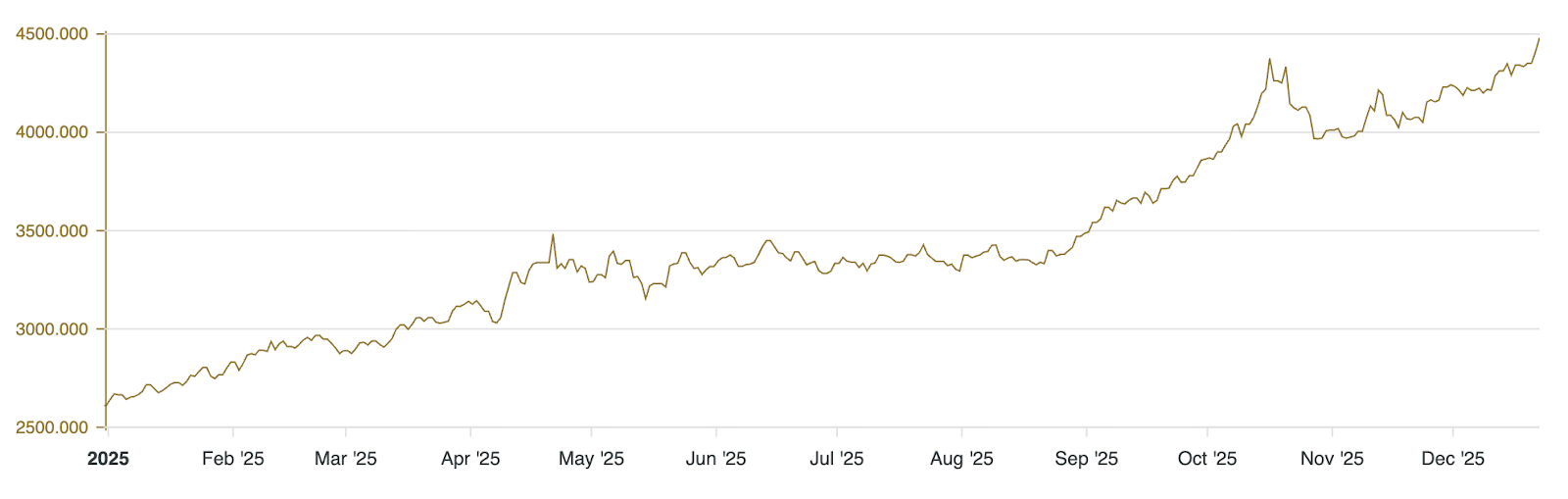
In contrast, major crypto assets lagged in pure return terms. Bitcoin is down approximately 7.7% YTD, while Ethereum is down around 10%. Notably, this underperformance occurred alongside record ETF inflows into crypto products, reinforcing a key theme of the year: capital allocation and price performance diverged meaningfully, with flows reflecting longer-term positioning rather than short-term momentum.
2025 Crypto Sector Performance
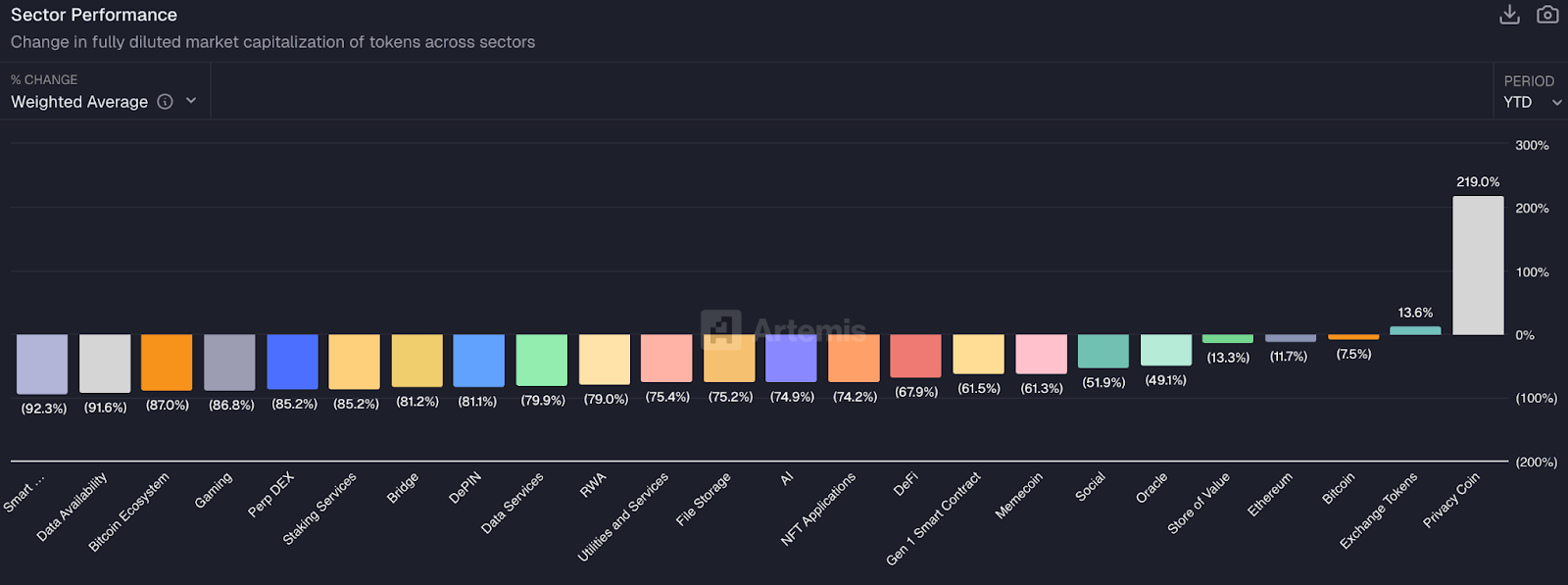
At the sector level within crypto, performance was highly selective. Privacy coins were the clear standout, up over 200% year to date, supported by renewed demand for censorship-resistant assets. Exchange tokens also outperformed on a relative basis, backed by strong fee generation and sustained trading activity despite largely sideways spot markets. Bitcoin DeFi, gaming, DePIN, and RWA were among the weakest performers, declining roughly 79–90% on a fully diluted basis. Overall, 2025 rewarded Bitcoin and a small subset of revenue-generating altcoins, while the majority of the market struggled to sustain rallies.
Bitcoin ETF Flows Signal Conviction Beyond Price Action
Bitcoin ETF flows continue to tell a more important story than short-term performance. BlackRock’s IBIT currently sits as the only ETF on the 2025 leaderboard with a negative YTD return (-9.6%), yet it still ranks 6th overall by net inflows, with more than $25B added year to date. That places IBIT ahead of several strong performing equity ETFs and even ahead of GLD, despite gold being up over 60% YTD. In other words, capital allocation has persisted even while returns have lagged.
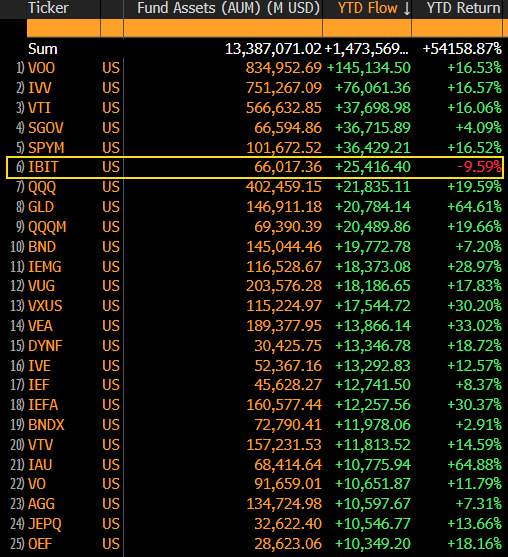
From a market structure standpoint, this suggests Bitcoin exposure is increasingly being treated as a strategic allocation rather than a momentum trade. Flows don’t time tops or bottoms, but they do reveal conviction and time horizon. The fact that roughly $25B has entered Bitcoin ETFs in a year of underperformance highlights the durability of institutional demand. If this level of capital can be absorbed during weaker conditions, it highlights the asymmetric potential of flows when broader risk appetite and price trends eventually improve.
Crypto Legislation Progress Update
Momentum is building around U.S. crypto regulation, with President Trump’s crypto czar David Sacks saying the country is “closer than ever” to passing the Digital Asset Market Clarity Act, with Senate markup now expected in January. The bill has already passed the House on a bipartisan basis and would establish a clear federal framework for crypto markets, marking a major shift away from years of regulatory uncertainty and enforcement-led policy.
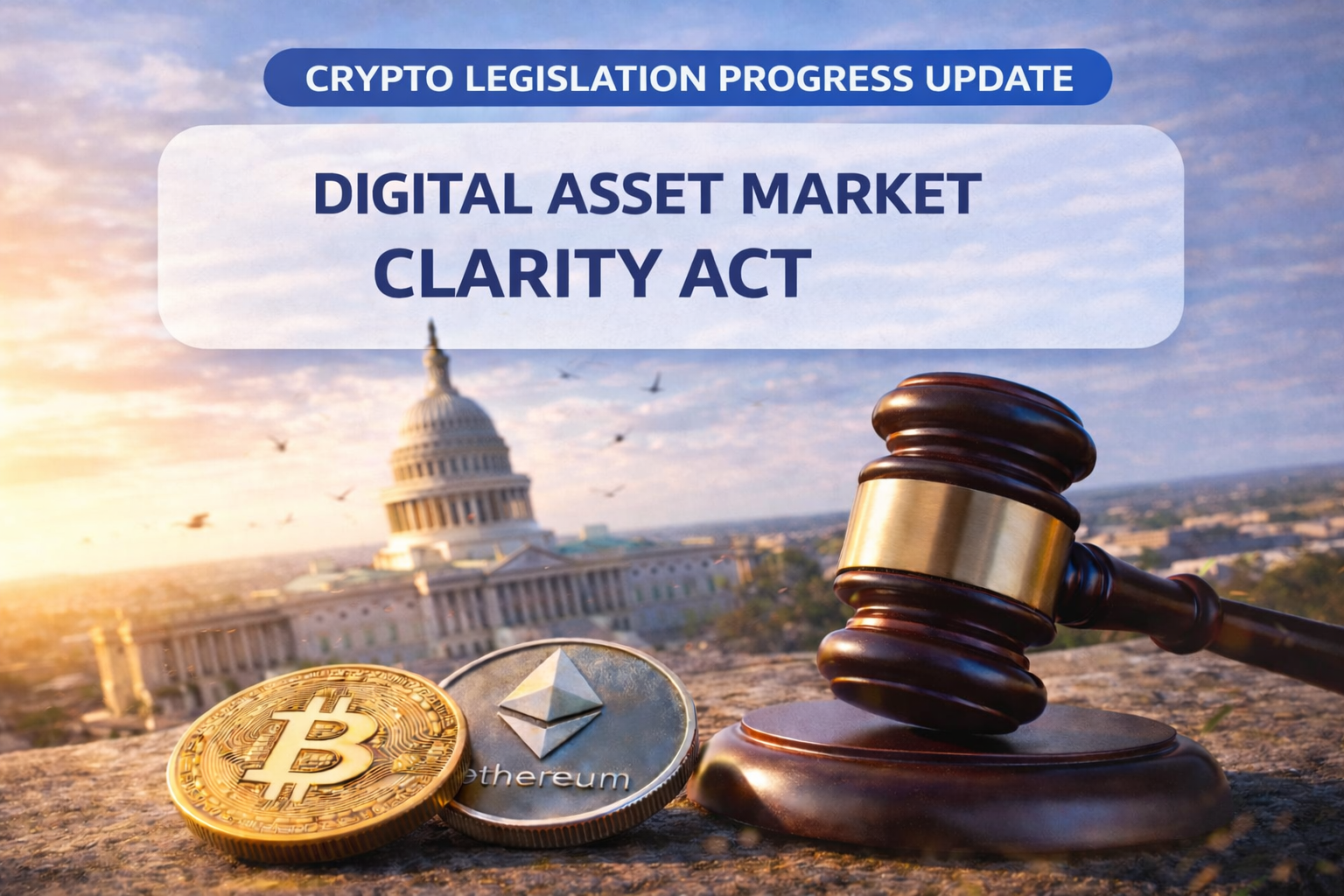
The Clarity Act is designed to clearly define how digital assets are regulated by drawing firm lines between the SEC and CFTC, including what qualifies as a security versus a commodity. If passed, it would provide the legal certainty institutions and companies have been waiting for, reducing risk, unlocking capital, and accelerating adoption. Combined with growing momentum around stablecoins and on-chain financial products, this legislation could become a key catalyst for stronger market conditions and deeper institutional participation heading into 2026.
US Inflation Falls Below Expectations
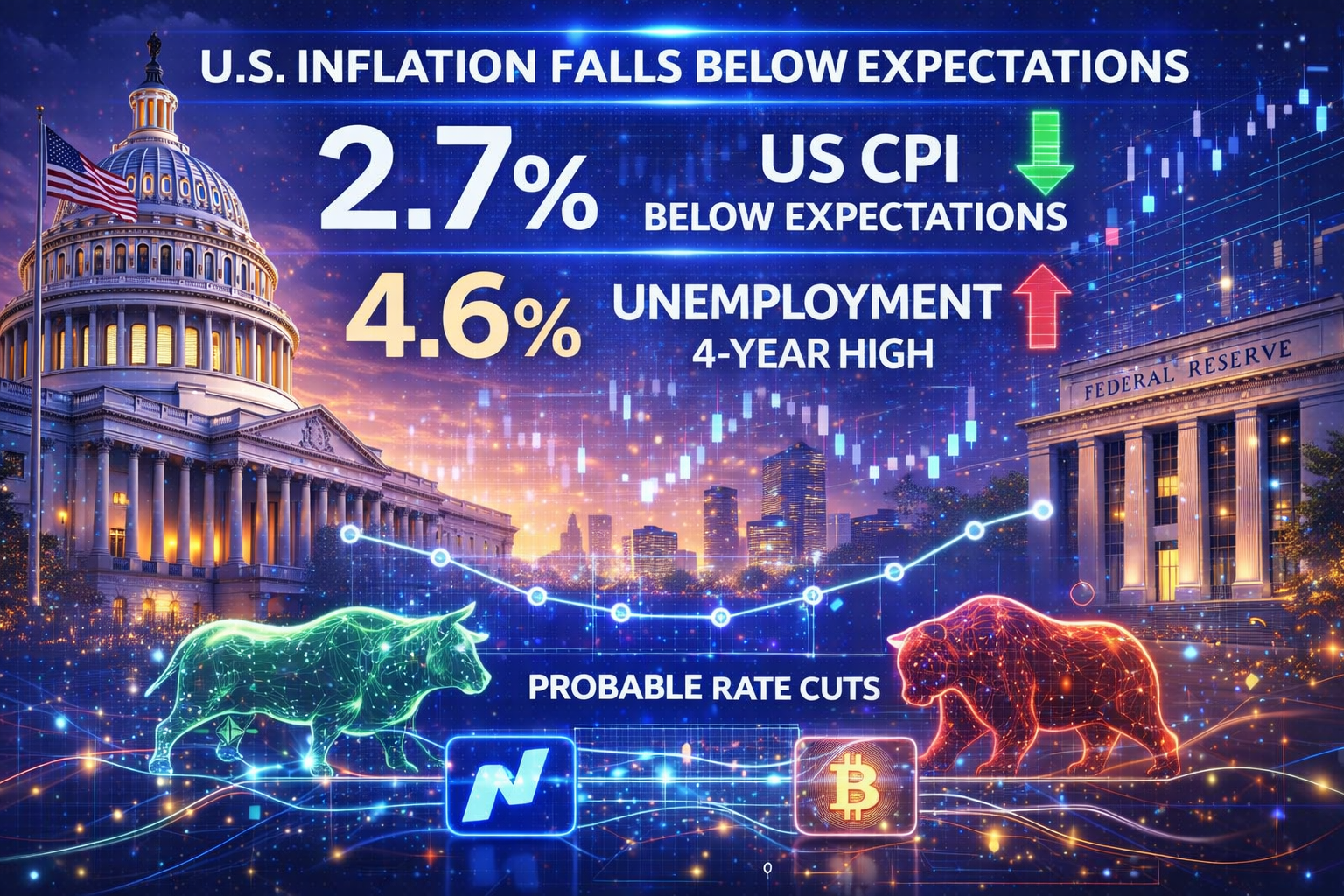
US CPI printing 2.7% (below expectations) is exactly the kind of data that pushes markets back into “Fed can cut” mode. When inflation surprises to the downside, the Fed gets more room to ease without looking like it’s reigniting price pressures, and that’s why rate-cut odds tend to rise immediately after a softer CPI.
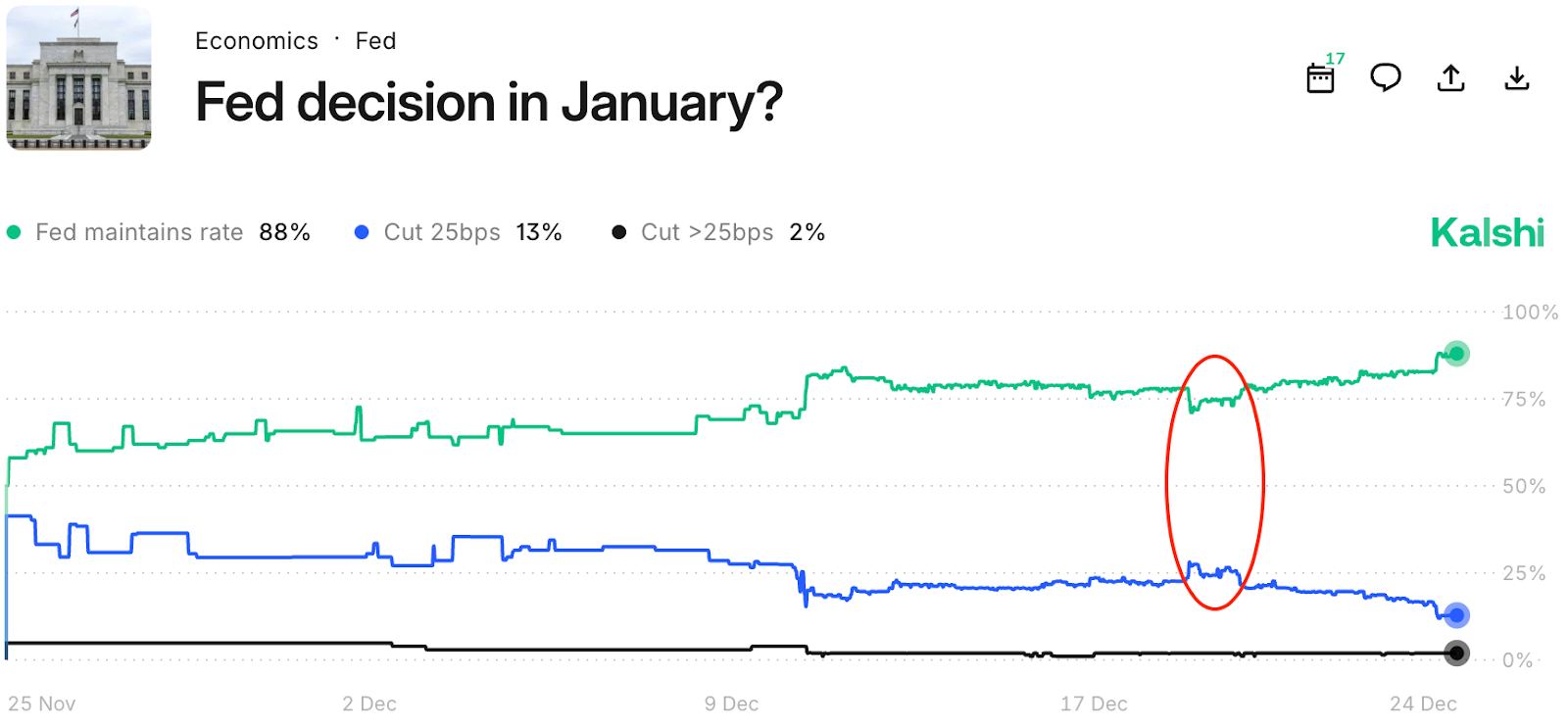
The other half of the story is the labour market. Last week unemployment data came back at 4.6% (a ~4-year high) signals cooling demand and increasing downside risk. That matters because the Fed’s other mandate is employment, so when jobs weaken while inflation is drifting lower, the bias shifts toward cuts in 2026 to stabilise growth. For risk-on assets such as equities and crypto, this is usually supportive as lower expected rates reduce the discount rate, improve liquidity conditions, and increase investor appetite for higher beta assets.
Trump to Announce New Fed Chair in January
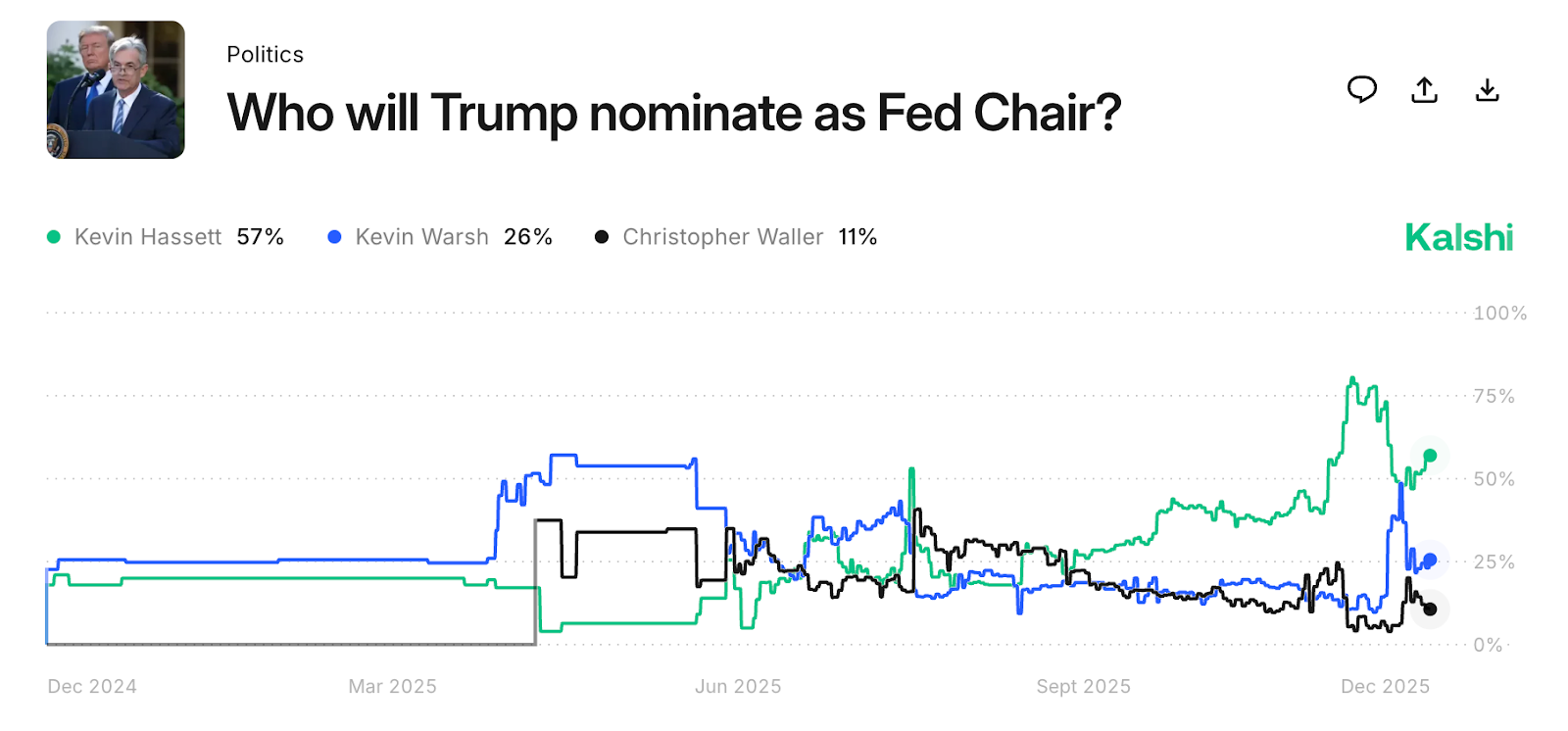
Markets are increasingly focused on Federal Reserve leadership following comments from President Trump today, where he stated that “anybody that disagrees with me will never be the Fed Chairman.” Trump reiterated that a replacement for Jerome Powell is expected to be announced in early January, reinforcing expectations that alignment with the administration’s economic agenda will be a key factor in the decision. Prediction markets currently place Kevin Hassett as the frontrunner, holding roughly 58% odds overall. Hassett is generally viewed as more open to faster rate cuts and a growth-supportive policy stance. While leadership changes don’t guarantee immediate shifts in policy, the rhetoric and probabilities are shaping expectations for a potentially more accommodative Fed backdrop heading into 2026.
General information only. This article is for educational purposes and does not constitute financial, investment, legal or tax advice, nor a recommendation to buy, sell or hold any asset. Cryptocurrency is a high-risk asset and you should consider your own circumstances and seek independent advice before making any decision. Uptrade does not make price predictions.
Kane leads our international research division, delivering clear, actionable insights into crypto markets and emerging investment opportunities. A true “crypto native,” he has over seven years of hands-on experience, formal qualifications in finance and economics, and has worked across Web3 hedge funds, venture capital, and leading incubators.
View all articles by Kane