
Weekly Market Update: 11 March 2026


Chaos in the Strait, Calm in the Charts
As geopolitical tensions show low signs of easing, with Polymarket pricing in just a 31% chance of a ceasefire in March, the crypto market has remained relatively steady, with volatility coming from commodities rather than digital assets. Oil has been the standout story, surging almost 30% to four-year highs as fears mount over disrupted supply through lower Iranian production and the effective closure of the Strait of Hormuz. Bitcoin climbed to a high of $74k, with other major assets also closing slightly green. Away from the conflict, the Clarity Act hit a speed bump this week, with odds of passage dropping from 80% to 60%, a reminder that regulatory tailwinds can't be taken for granted either.
.png)
Hyperliquid — The Data, The Metrics, and Arthur Hayes' $150 Target
Arthur Hayes published an article this week laying out his bull case for Hyperliquid, disclosing that $HYPE has become Maelstrom's largest liquid non-Bitcoin holding, accumulated in the mid-$20s. His thesis is in a sideways or bearish crypto market, exchange tokens outperform because they generate fees regardless of price direction, and Hyperliquid is the highest quality exchange in all of crypto by that measure. The platform returns 99% of revenue directly to $HYPE holders via token buybacks, a model no other project in crypto matches. Hayes sets a price target of $150 by August 2026, roughly 5x from current levels, requiring Hyperliquid to grow its 30-day annualised revenue run rate back to $1.4B, driven primarily by HIP-3 expansion and modest market share gains from centralised exchanges.
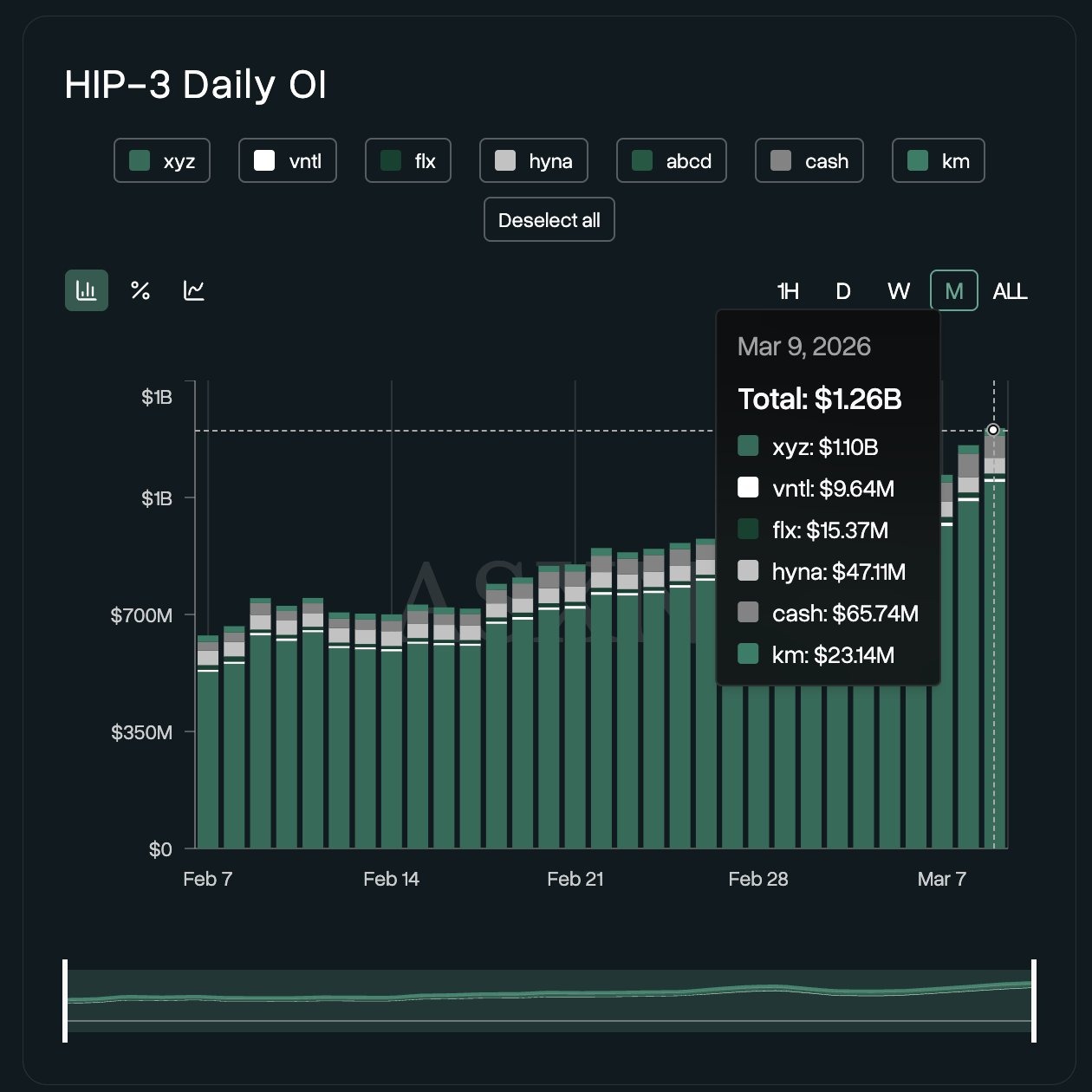
The on-chain data this week validated exactly why. HIP-3 open interest just hit a new all-time high of $1.26B, up from $500M just one month ago. During the Iran conflict weekend, a single Oil/HIP-3 pair processed $1B in 24-hour volume, with Hyperliquid handling 100% of global oil perpetual volume while the CME sat dark, Bloomberg used it for risk assessment pricing. TradFi perpetuals now represent 31.6% of total platform volume, up from just 5% in January. And across all protocol holders, Hyperliquid leads revenue generation by nearly 2x,$15.3M over 7 days versus the next best at $8.8M. The infrastructure is real, the revenue is real, and the institutional attention is following.

Kraken Becomes America's First Crypto Bank
Kraken, the crypto exchange, has become the first digital asset company in US history to gain direct access to the Federal Reserve's payment infrastructure through its Wyoming-chartered bank, Kraken Financial. Until now, every crypto firm had to rely on traditional banks as middlemen to move US dollars, creating delays, extra costs, and dangerous exposure to third parties, a risk that became very real when several crypto-friendly banks collapsed in 2023. This approval cuts out the middleman entirely. Kraken can now settle payments directly, the same way JP Morgan and Bank of America do. The account comes with limitations, no interest on reserves, no access to emergency Fed lending, but that misses the bigger picture. The Federal Reserve has formally recognised a crypto-native institution as part of the US financial system. It is a landmark moment, and every other crypto firm will now be racing to follow.
US-Iran War — Latest Developments
Eleven days in, the US-Iran conflict shows no sign of resolution. Strikes have now hit at least 26 of Iran's 31 provinces, with Tehran the most heavily targeted, and Mojtaba Khamenei installed as supreme leader following his father's death. Iran has made its position clear, the Revolutionary Guard stating that Tehran will determine when the war ends, with the foreign minister ruling out any talks with Washington. Trump's public statements have oscillated between declaring near-victory and acknowledging the job isn't done. Seven US soldiers have been killed, Iranian casualties exceed 1,200, and the Strait of Hormuz remains the critical flashpoint, with reports of Iranian mine-laying adding fresh risk to global energy supply. The market priced in the worst on day one, but with no negotiation on the table and no clear endpoint in sight, the tail risk hasn't gone away.

How Global Markets Reacted to War
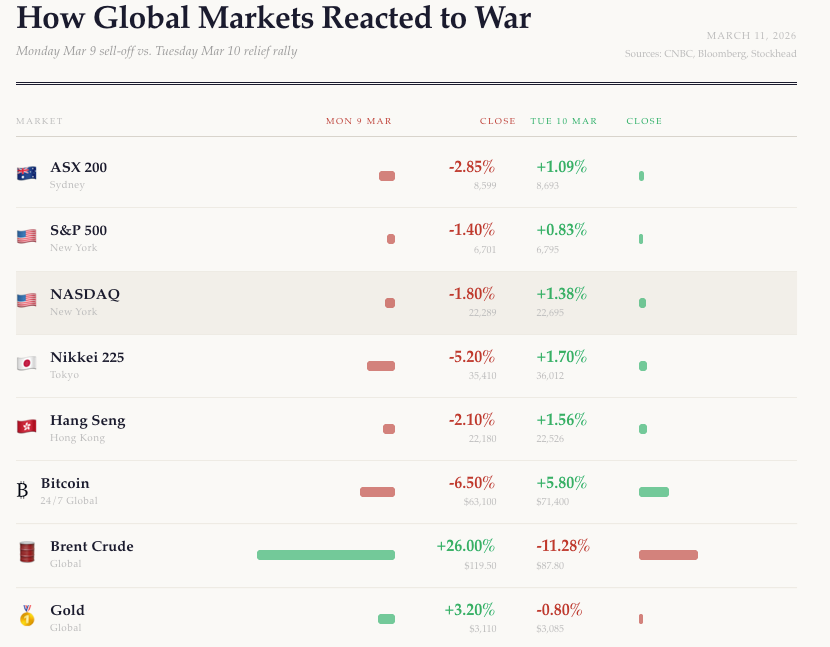
Global markets have been entirely headline-driven since the conflict began. The ASX 200 fell 2.85% on Monday, its worst session since April 2025, before recovering roughly 1% Tuesday, led by gold and materials. On Wall Street, the S&P 500 rose 0.83% and the Nasdaq jumped 1.38%, clawing back most of the prior week's losses.
Bitcoin has recovered strongly since invasion day, climbing from $63,000 toward $74,000, a $10,000 move in a matter of days. With oil surging, bond yields climbing from 3.96% to 4.12%, and inflation fears returning, the macro backdrop is arguably the most favourable environment the digital gold narrative has ever had. Gold is making its case loudly. And for the first time in a while, Bitcoin may be quietly making the same one.
What stands out, however, is that Bitcoin found a floor and held on the most acute fear days. Relative strength in a risk-off environment does more for the digital gold narrative than any theoretical argument ever could, and whether Bitcoin is a credible inflation hedge remains genuinely contested, moments like this are exactly where that debate gains the most traction.
Altcoin Selection Masterclass: How to Find Quality Before It Trends
Are you tired of discovering altcoins after they've already made their move? This is the challenge most crypto investors face, and it's exactly what our upcoming free webinar is designed to solve.
On Thursday, 26 March at 10:00 AM AEST, UpTrade and Mastering the Markets are teaming up to deliver a live 60-minute masterclass focused on one of the most valuable skills in crypto investing: identifying quality altcoins before the crowd catches on.
What to Expect
This isn't a hype session. Our speakers will walk you through a practical, research-driven framework for evaluating altcoins, cutting through the noise to focus on what actually matters when separating long-term winners from short-lived pumps.
You'll come away with a clearer understanding of what signals to look for, how to assess a project's fundamentals, and how to build a more disciplined approach to altcoin selection.
Meet Your Speakers
- David Bird — Founder & Head of Education at Mastering the Markets, bringing years of experience breaking down complex market concepts into actionable strategies.
- George Kaltekis — Broker Team Lead at UpTrade, with deep expertise in market execution and crypto trading dynamics.
- Kane Bisogni — Head of Research & Analytics at UpTrade, specialising in on-chain data and project evaluation frameworks.
Who Should Attend?
Whether you're new to crypto and want to build solid research habits from the start, or you're an experienced investor looking to sharpen your altcoin selection process, this session is designed to deliver real, practical value.
It's completely free, sign up at uptradealpha.com to reserve your spot
Oil Hits 4-Year High
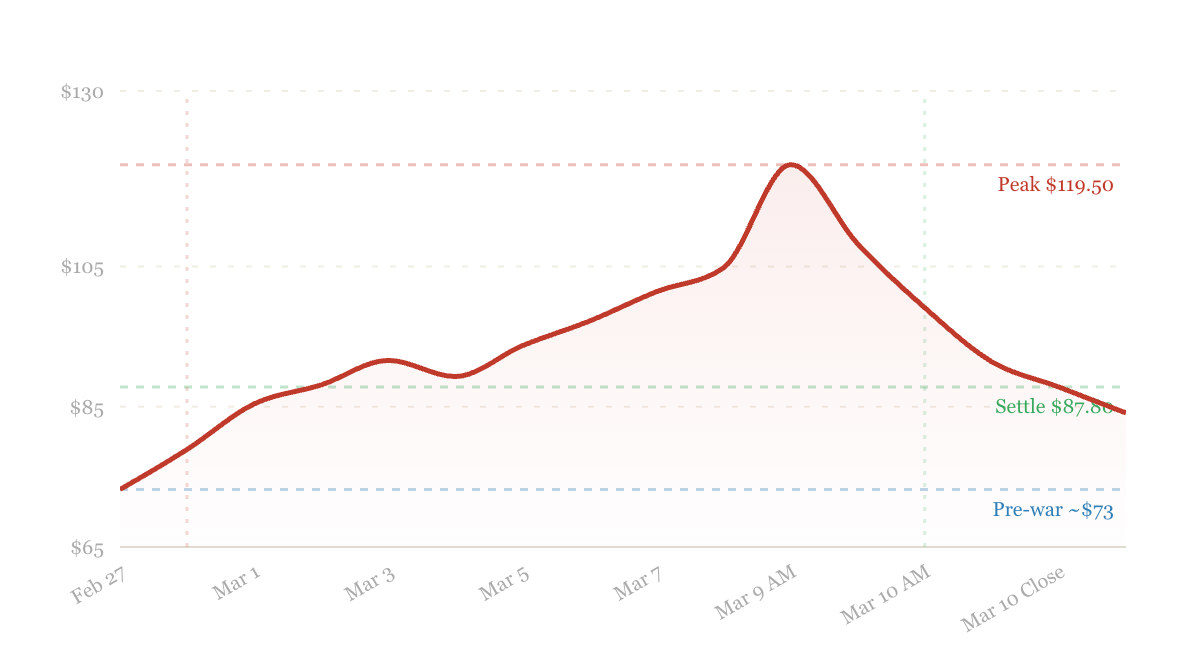
No market captured the chaos of the past two weeks more starkly than crude. Brent was trading around $73 per barrel before the strikes began, surging to nearly $120 by Monday March 9th, crossing $100 for the first time since Russia's invasion of Ukraine in 2022. The reversal came just as fast. Trump told CBS the war was "very complete, pretty much," and Brent fell over 11% to settle at $87.80 by Tuesday's close. A false post from Energy Secretary Chris Wright claiming the Navy had escorted a tanker through the Strait of Hormuz briefly pushed prices down another 15% before the White House retracted it, a reminder of just how thin the market's nerves are right now.
Despite the pullback, oil remains around 20% above pre-war levels. The Strait of Hormuz is effectively choked, Gulf producers can only replace a fraction of disrupted flows, and every headline carries the potential to move the market 10% in either direction. For crypto, Brent holding above $85 keeps stagflation risk firmly on the table and stagflation is not the clean macro backdrop that a durable Bitcoin rally needs.
One Million Left. One Hundred Years to Go
Yesterday, the 20 millionth Bitcoin was mined, a historic milestone that marks one of the most significant moments in Bitcoin's 16-year history. Of the 21 million Bitcoin that will ever exist, only one million remain to be mined. What makes this remarkable is the timeline, that final million will take over 100 years to enter circulation, a function of Bitcoin's halving mechanism, which cuts the block reward in half approximately every four years, progressively slowing new supply. Each halving has historically been a major price catalyst, but as the reward approaches zero, the halving itself becomes less of an event and more of a formality.
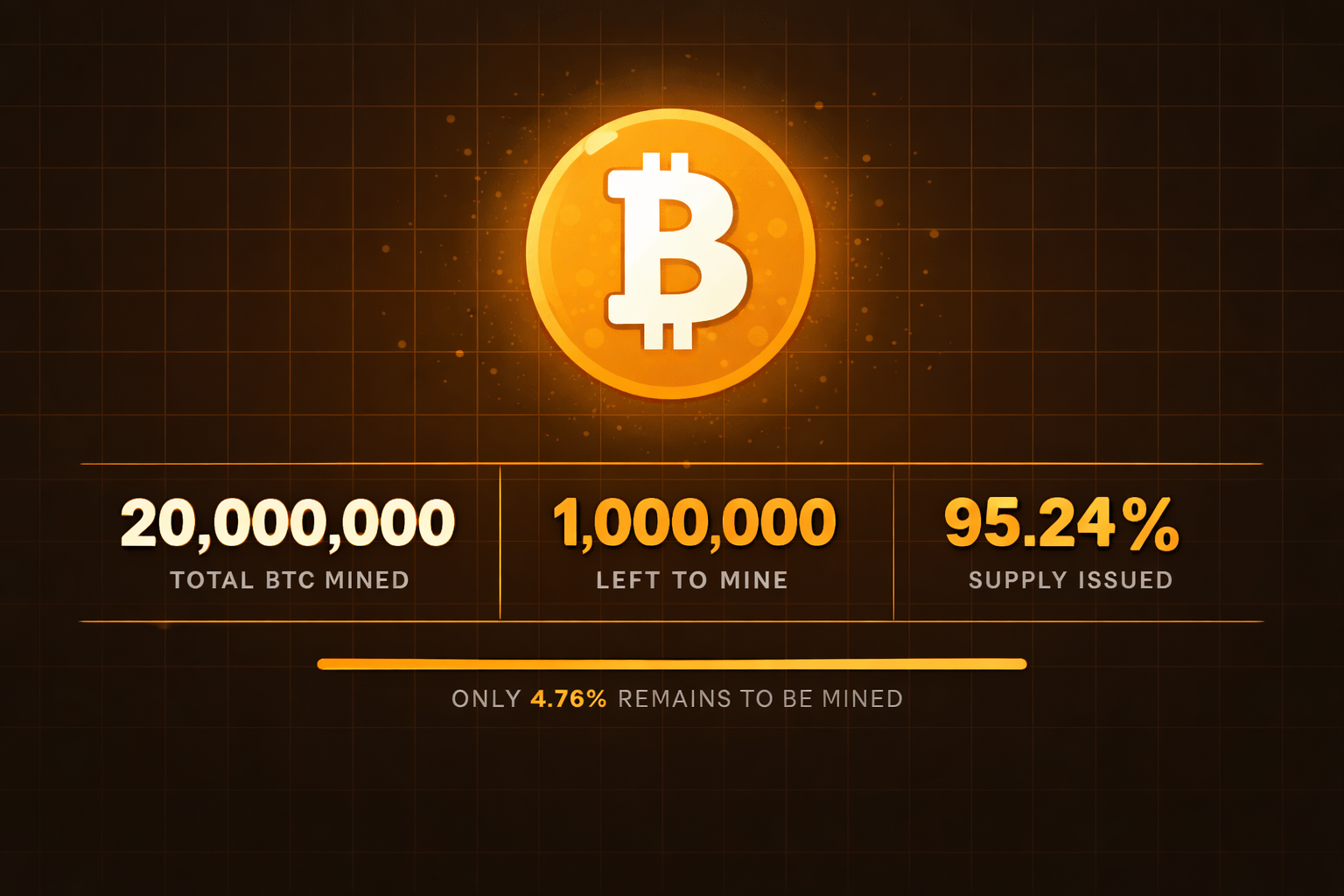
95% of all Bitcoin that will ever exist already does. The supply shock narrative that has underpinned Bitcoin's investment thesis for years is no longer theoretical, it is structural and accelerating. New issuance is now so marginal that the market's supply dynamics are increasingly dictated not by miners, but by holders. As demand from institutions, ETFs, and sovereign level buyers continues to grow, the pool of newly available Bitcoin shrinks to near zero. The next century of Bitcoin mining will produce less new supply than a single month of BlackRock's IBIT inflows at peak. Future halvings will matter less and less as a price trigger, but that's precisely the point. Bitcoin no longer needs a catalyst. The math is already doing the work. Scarcity is no longer coming. It is already here.
Ripple seeking Australian Financial Service License
Ripple has announced plans to secure an Australian Financial Services Licence through the proposed acquisition of BC Payments Australia, further expanding its regulated presence across Asia Pacific. In simple terms, this licence allows Ripple to operate as a fully regulated payments business in Australia, meaning banks, fintechs, and enterprises can use Ripple's infrastructure to move money across borders faster, cheaper, and with full regulatory oversight. Rather than clients needing to manage multiple intermediaries or understand the underlying blockchain technology themselves, Ripple handles the entire process end-to-end, from compliance and currency conversion through to final settlement. With APAC payments volume nearly doubling year-on-year in 2025 and over 75 regulatory licences globally, Ripple is quietly building the regulated infrastructure layer that traditional finance will rely on as it transitions to digital asset rails.

General information only. This article is for educational purposes and does not constitute financial, investment, legal or tax advice, nor a recommendation to buy, sell or hold any asset. Cryptocurrency is a high-risk asset and you should consider your own circumstances and seek independent advice before making any decision. Uptrade does not make price predictions.
Kane leads our international research division, delivering clear, actionable insights into crypto markets and emerging investment opportunities. A true “crypto native,” he has over seven years of hands-on experience, formal qualifications in finance and economics, and has worked across Web3 hedge funds, venture capital, and leading incubators.
View all articles by Kane