
Weekly Market Update: 08 April 2026


Two Week Peace Deal Brings Relief Rally
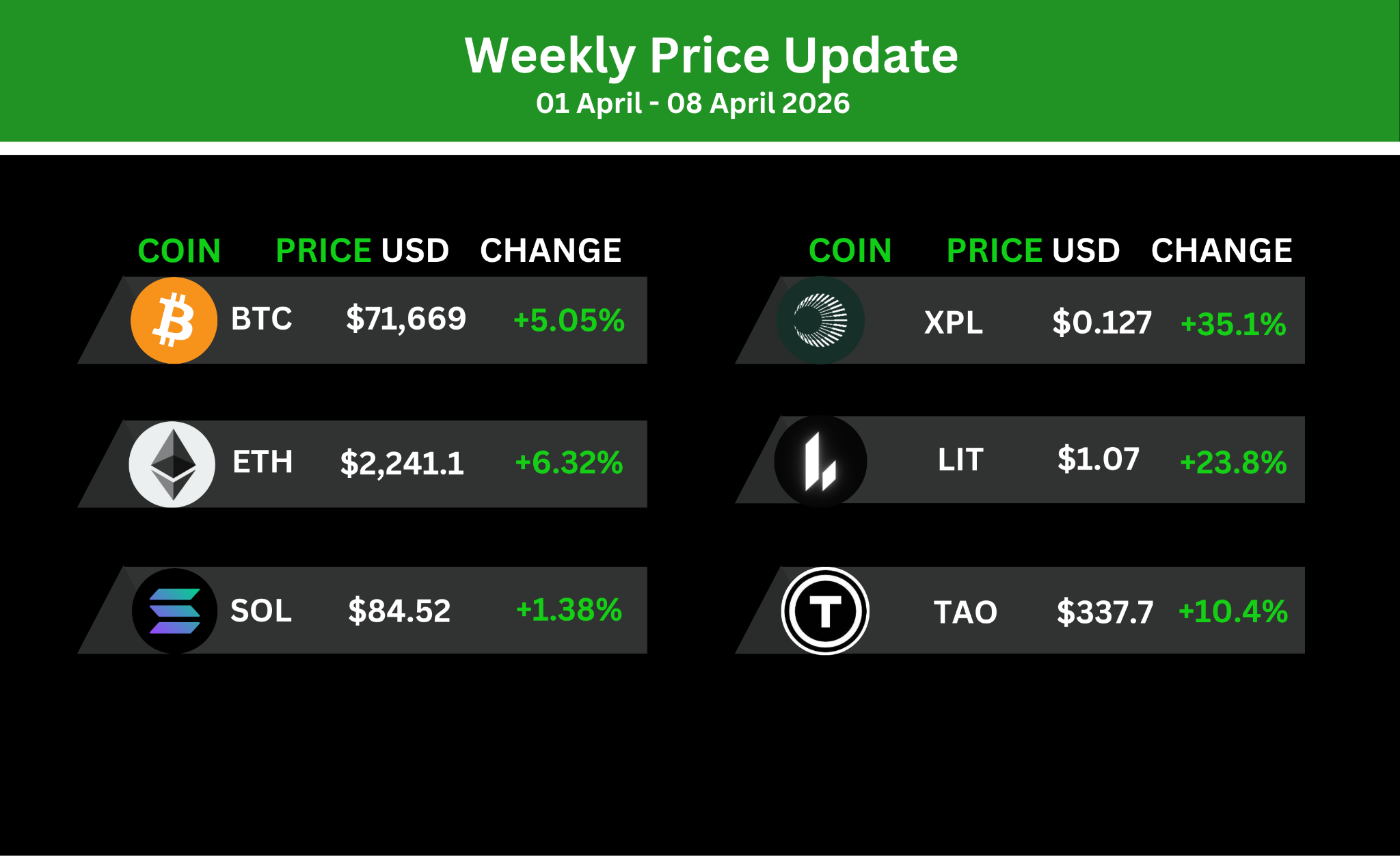
This week's price action has been almost entirely binary, driven by the state of the US-Iran conflict and whatever Trump posted on Truth Social that morning. Bitcoin has been ranging between $62,000 and $75,000 since early February, with BTC changing hands around $69,000 and ETH sitting near $2,100 for much of the week. The contrast with traditional safe havens has been worth noting. Bitcoin's correlation with the Nasdaq has been running notably high while its correlation with gold has weakened, suggesting that in the current environment institutional desks are increasingly treating BTC as a risk asset rather than a hedge. This is not a permanent verdict on Bitcoin's identity, but it does reflect how the market is positioning right now. When geopolitical fear spikes, capital has been rotating toward gold rather than crypto, and that pattern is worth watching as the war narrative continues to drive sentiment. Until Hormuz is resolved with something more durable than a two-week pause, every asset class is renting its direction from a social media notification.
US and Iran Settle for Two Weeks of Breathing Room.
The lead-up to this week's ceasefire was about as tense as it gets. Brent crude crawled above $110 per barrel, Bitcoin had slipped back toward $68,000, and the S&P 500 was swinging between modest gains and losses as Trump's deadline for Iran to reopen the Strait of Hormuz approached. Tuesday morning, Trump posted on Truth Social that "a whole civilization will die tonight, never to be brought back again," a statement that pushed risk assets further into defensive territory ahead of the 8pm deadline.
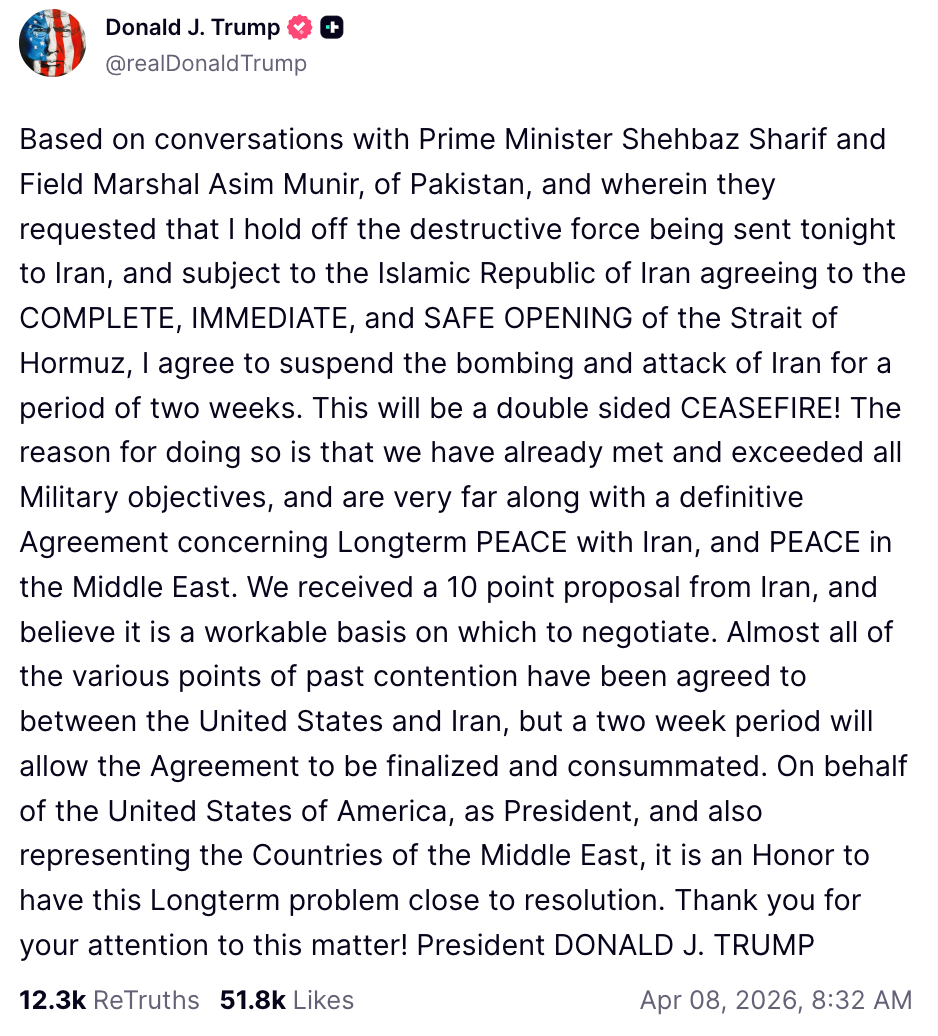
Then came the pivot. Less than two hours before that deadline, Trump posted on Truth Social that subject to Iran agreeing to the complete, immediate, and safe opening of the Strait of Hormuz, the US would suspend bombing and attacks on Iran for a period of two weeks, calling it a "double sided ceasefire." Pakistan's Prime Minister Shehbaz Sharif had brokered the off-ramp. Iran's foreign minister responded by confirming that for a period of two weeks, safe passage through the Strait of Hormuz would be possible via coordination with Iran's armed forces.
Markets moved instantly. S&P 500 futures rose ~1.50%, Nasdaq futures gained ~1.60%, and WTI crude futures fell more than 10% in a span of 15 minutes. Bitcoin touched $72,700 as the ceasefire eased fears over Middle East supply disruptions.
The relief is real but conditional. Even with Hormuz reopening, analysts warn it will take four to eight weeks for new oil shipments to reach refineries and end users, meaning the supply chain damage is likely to linger well into the second quarter regardless of what happens diplomatically. The two-week window buys time. Whether it converts into something durable remains the only question that matters.
DeFi Protocol Drift experiences hack exploit, $285 Million Gone in 12 Minutes
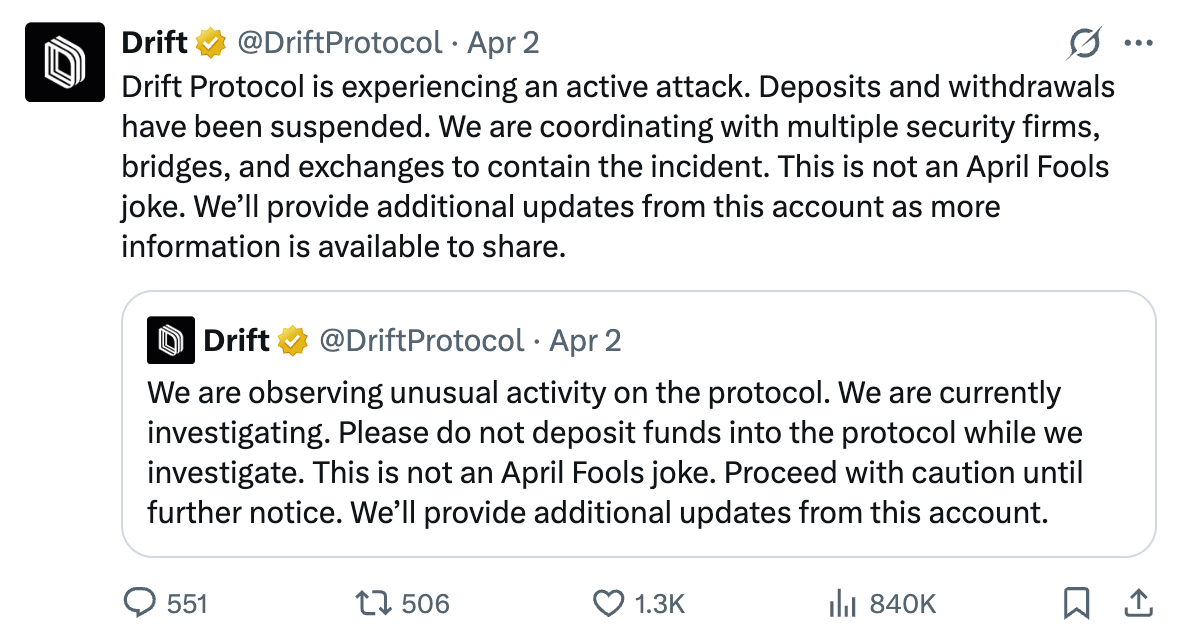
On April 1, 2026, attackers drained approximately $285 million in user assets from Drift Protocol, one of the largest decentralised perpetual futures exchange on Solana, in roughly 12 minutes, making it the largest DeFi hack of 2026 and the second-largest exploit in Solana's history. This event has been the major headline in the crypto space, calling into question the safety of customer funds despite it being a decentralised exchange.
What makes this hack particularly significant is how it was executed. The attack was not a brute-force hack or a traditional code exploit. It was a precision strike combining fake token creation, oracle manipulation, and a compromised admin key, each step enabling the next. Weeks before the attack, the attacker manufactured a fictitious asset called the CarbonVote Token with a few thousand dollars in seeded liquidity and wash trading, and Drift's oracles treated it as legitimate collateral worth hundreds of millions of dollars. Using a legitimate Solana feature called durable nonces, the attacker pre-signed administrative transfers weeks in advance by obtaining two misleading approvals from Drift's five-member Security Council multisig, then used them to seize protocol-level control in minutes. Security firms Elliptic and TRM Labs attributed the attack to North Korean state-sponsored actors, citing laundering patterns and on-chain timestamps consistent with the Lazarus Group.
The aftermath exposed a second failure. On-chain investigator ZachXBT accused Circle of failing to act while over $230 million in stolen USDC moved freely through its own cross-chain bridge for approximately six hours during US business hours with zero intervention, posting "Circle was asleep while many millions of USDC was swapped via CCTP from Solana to Ethereum for hours." The irony was sharp given that just days earlier, Circle had aggressively frozen 16 unrelated business hot wallets as part of a sealed civil case.
Much Needed Clarity Update
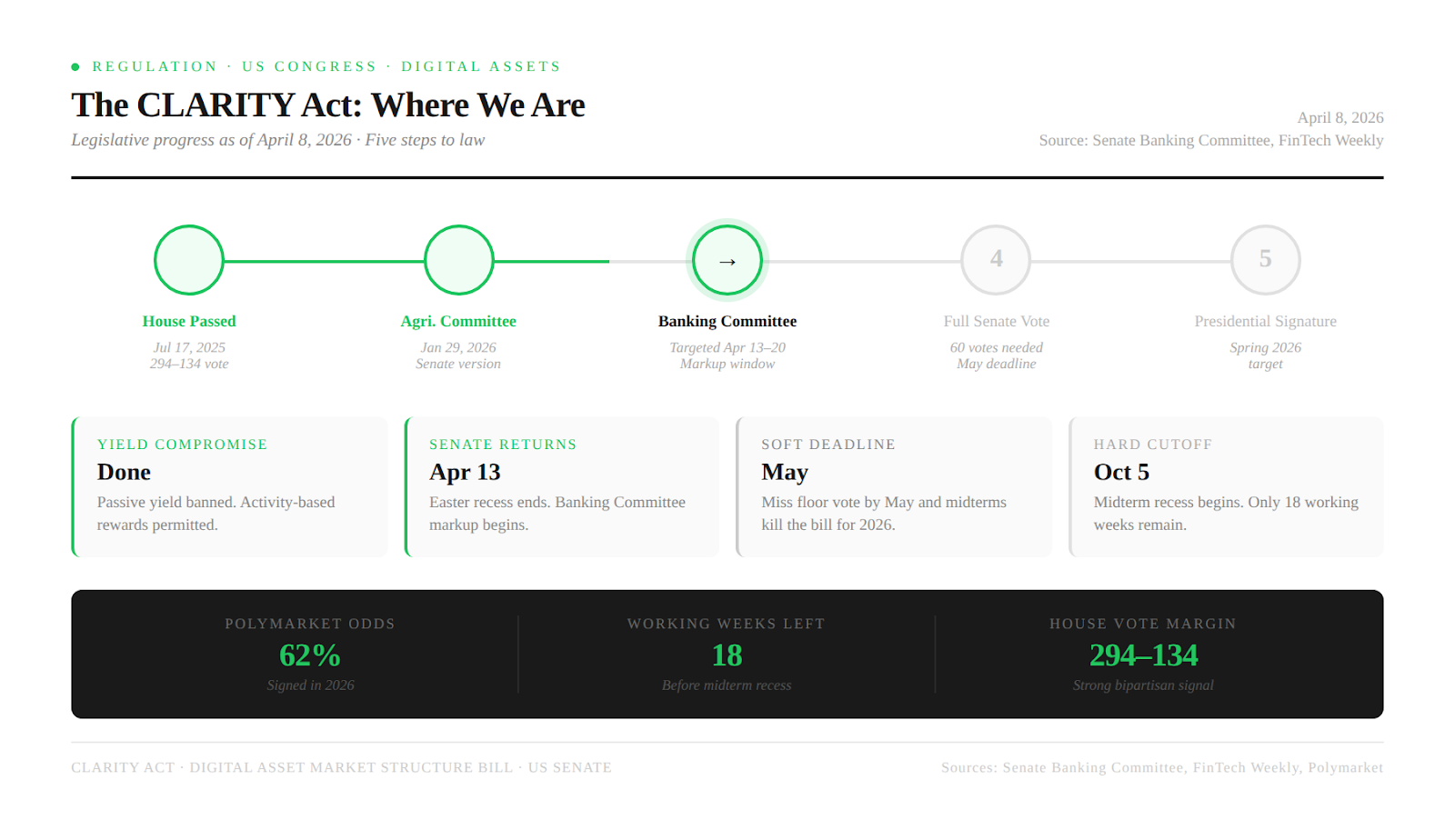
After months of stalling over a single contentious issue, the Clarity Act is finally moving. A bipartisan Senate deal resolved the stablecoin yield dispute, with the compromise banning passive yield on balances while permitting activity-based rewards. Senator Lummis has confirmed the Senate Banking Committee markup is targeted for the weeks of April 13 or April 20.
The timeline pressure is not procedural. It is existential. Senator Moreno has warned that failure to reach the full Senate floor by May effectively kills the bill for 2026, with midterm election dynamics consuming all remaining legislative bandwidth. Coinbase's chief legal officer described negotiations as "very close to a deal" on April 1.
The stakes extend well beyond compliance paperwork. JPMorgan has described passage as a positive catalyst for digital assets, citing regulatory clarity, institutional scaling, and tokenisation growth as the key drivers.
Real-Time Price Discovery When Everything Else Was Shut
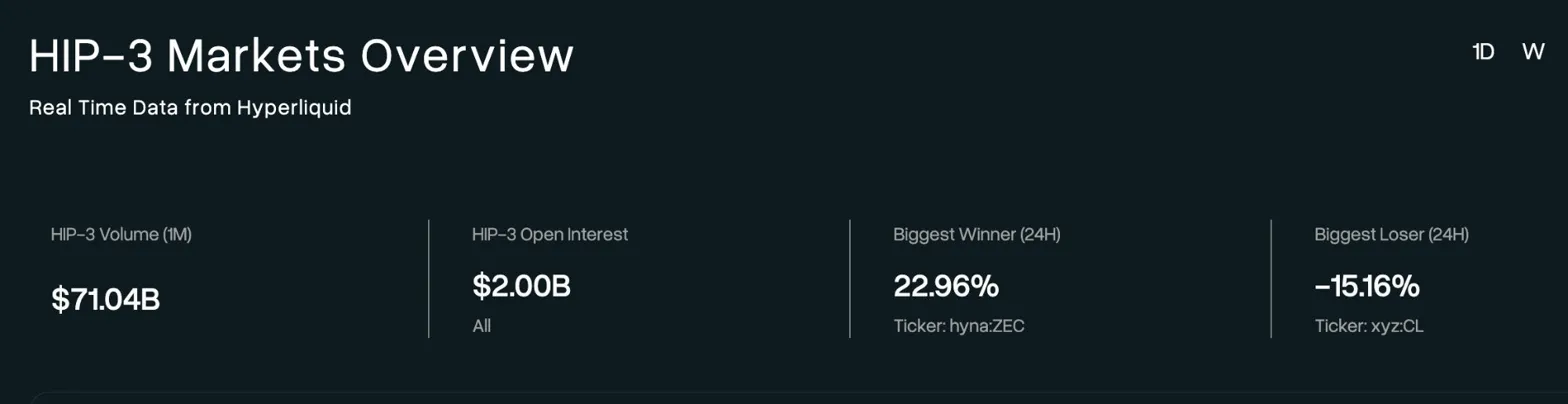
The US-Iran war has been the defining stress test for Hyperliquid's ambition to be a 24/7 global market, and the platform has passed it convincingly. The data from this week tells the story clearly. HIP-3 markets are currently running $71.04 billion in monthly volume with $2 billion in open interest across all contracts, numbers that would have been unthinkable for a decentralised venue eighteen months ago.
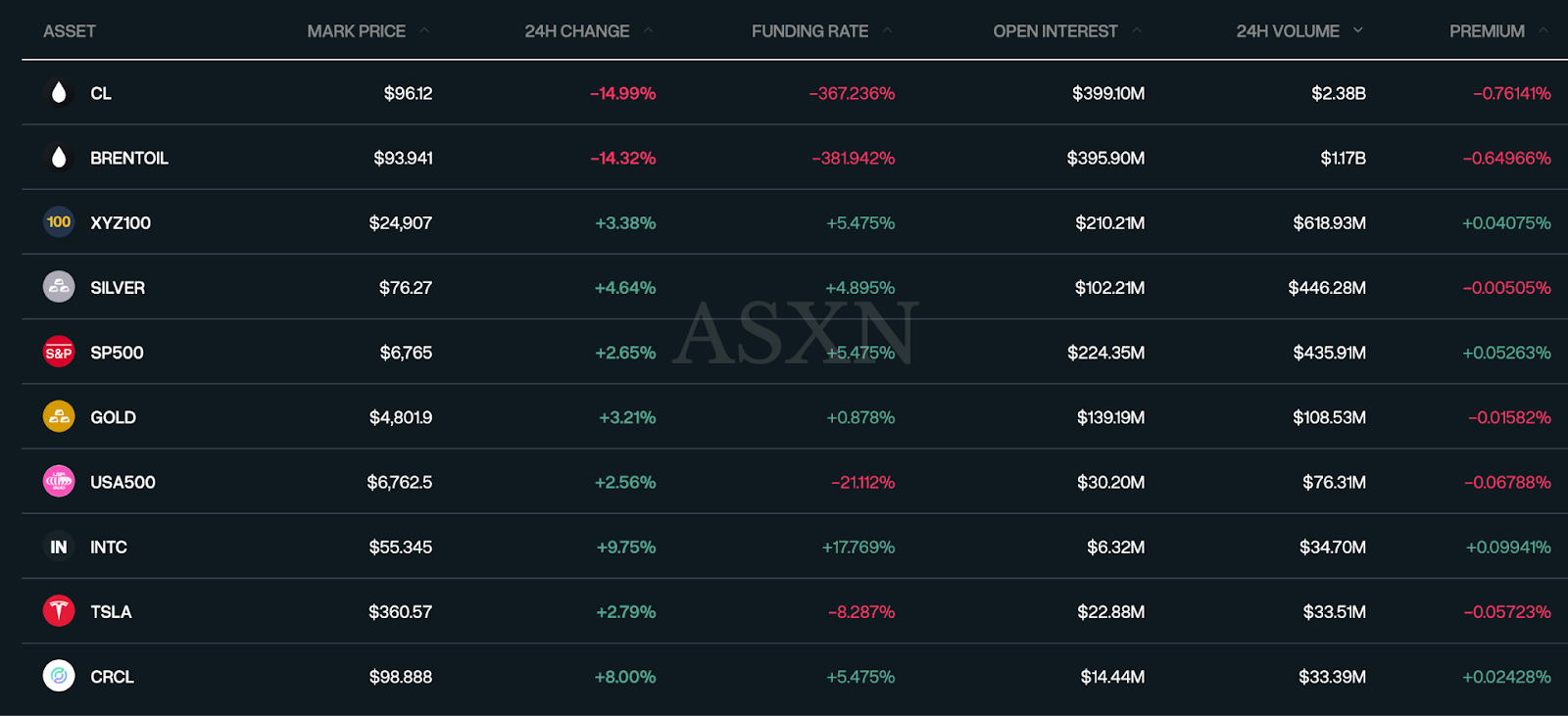
The real story is in the composition of that volume. The top markets by volume this week are not crypto pairs. WTI crude is running $2.37 billion in 24-hour volume with Brent close behind at $1.16 billion, both deep in negative funding as traders aggressively positioned short following the ceasefire announcement and oil's 15% collapse. The S&P 500 perpetual is trading at $6,769 with $430 million in daily volume. Gold at $4,818 and Silver both seeing active positioning as the geopolitical risk premium unwinds.
This is the point. When Trump posted the ceasefire on Truth Social on a Tuesday evening just before market close, traditional commodity exchanges were either closing or illiquid. Hyperliquid was not. Traders could express a view on oil, equities, and gold in real time, in the same interface, settled in stablecoins, with no brokerage account required. The platform did not just capture volume during this conflict. It demonstrated that the infrastructure for a genuinely borderless, always-open capital market already exists. NYSE and Nasdaq are still building toward that future. Hyperliquid is already living in it.
Schwab and Morgan Stanley Provides Access to Crypto
Charles Schwab confirmed it remains on track to launch spot cryptocurrency trading in the first half of 2026, starting with Bitcoin and Ethereum, through a dedicated Schwab Crypto account operated by its Charles Schwab Premier Bank subsidiary. A waitlist is already live. With $12.22 trillion in client assets and 38.9 million active brokerage accounts, Schwab's entry represents the largest potential distribution channel for direct crypto ownership in traditional finance. The significance here is access. For the tens of millions of retail investors who manage their portfolios through Schwab but have never opened a separate crypto exchange account, this removes the friction entirely. Crypto sitting alongside stocks and bonds in a single view is a different proposition to crypto requiring a separate platform.
Morgan Stanley is moving on a parallel track. The Morgan Stanley Bitcoin Trust, trading under the ticker MSBT, launching on NYSE Arca on April 8. With roughly 16,000 financial advisors overseeing $6.2 trillion in client assets, the distribution potential extends well beyond a single product launch. The infrastructure of mainstream finance is now actively pulling crypto toward the centre of the portfolio, not treating it as a peripheral allocation.

General information only. This article is for educational purposes and does not constitute financial, investment, legal or tax advice, nor a recommendation to buy, sell or hold any asset. Cryptocurrency is a high-risk asset and you should consider your own circumstances and seek independent advice before making any decision. Uptrade does not make price predictions.
Kane leads our international research division, delivering clear, actionable insights into crypto markets and emerging investment opportunities. A true “crypto native,” he has over seven years of hands-on experience, formal qualifications in finance and economics, and has worked across Web3 hedge funds, venture capital, and leading incubators.
View all articles by Kane