
Weekly Market Update: 04 March 2026


Markets Bounce Despite Peak Geopolitical Fear
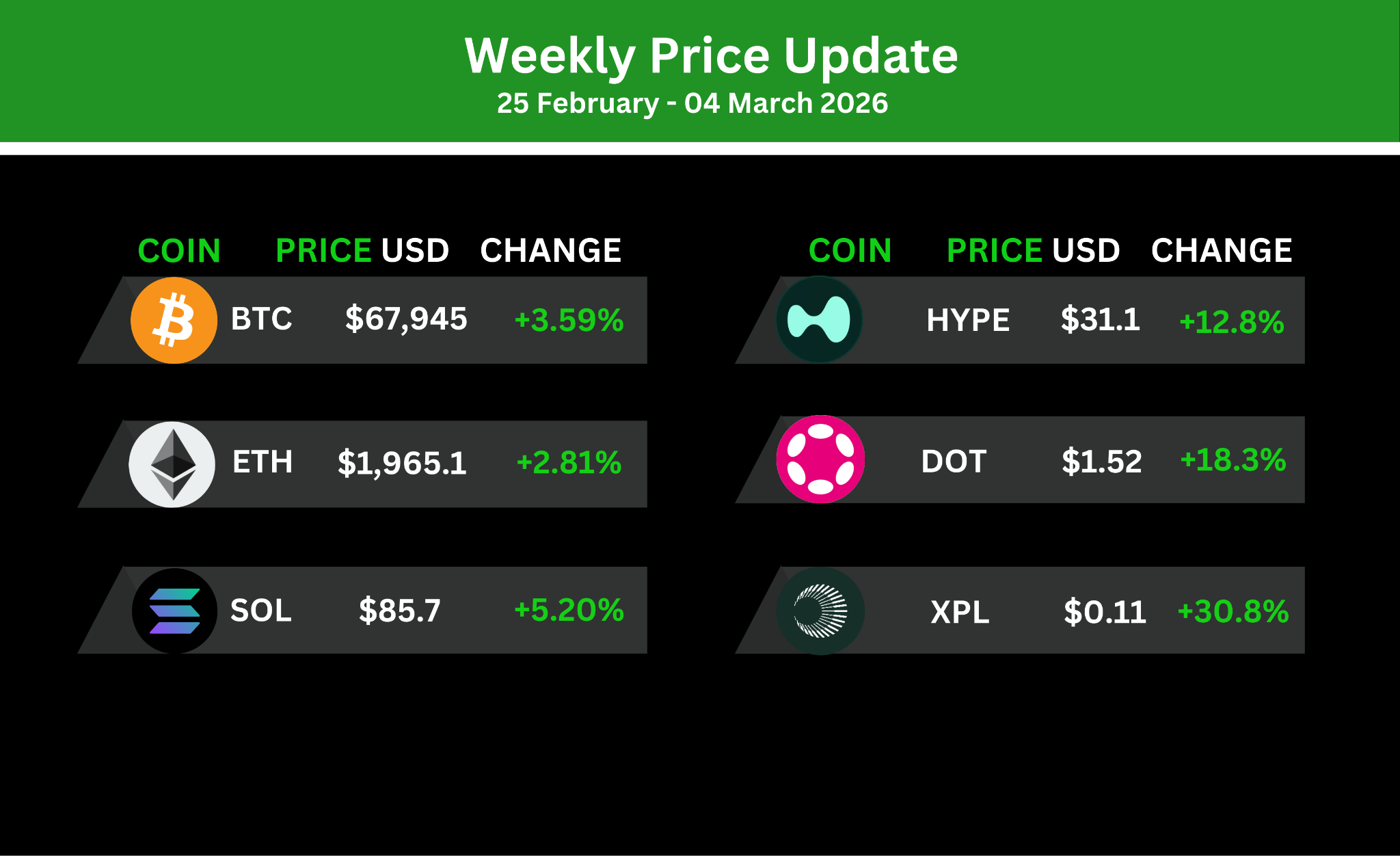
As geopolitical tensions reached a critical inflection point following the US-Iran strikes, the crypto market defied expectations. Rather than capitulating, Bitcoin bounced from a low of $63k on invasion day to $69k just days later, finishing the week up 3.5%, with other major assets also closing slightly green. Perhaps the worst may already be priced in? However the more telling story wasn't in Bitcoin, it was in what led the recovery. While the broader market limped higher, real revenue-generating tokens broke away from the pack entirely, posting outsized gains in a week where speculation remained firmly out of favour. The market is sending a clear message, in 2026, cash flow is the main narrative that matters.
Solana's Head of Product Joins Uptrade Alpha
This Friday, we sit down with Catherine Gu, Head of Product at the Solana Foundation, in what promises to be one of our most insightful episodes to date. Catherine brings a rare blend of traditional finance pedigree and crypto native expertise, having previously held roles at J.P. Morgan and Visa before becoming one of the most important figures shaping Solana's product direction. The conversation covers the current state of the Solana ecosystem in 2026, key developments across DeFi, payments, and infrastructure, the evolution of institutional adoption and real-world asset integration, and where the Foundation sees its biggest opportunities ahead, don't miss it.
.png)
RevenueFi Outperforms the Entire Market
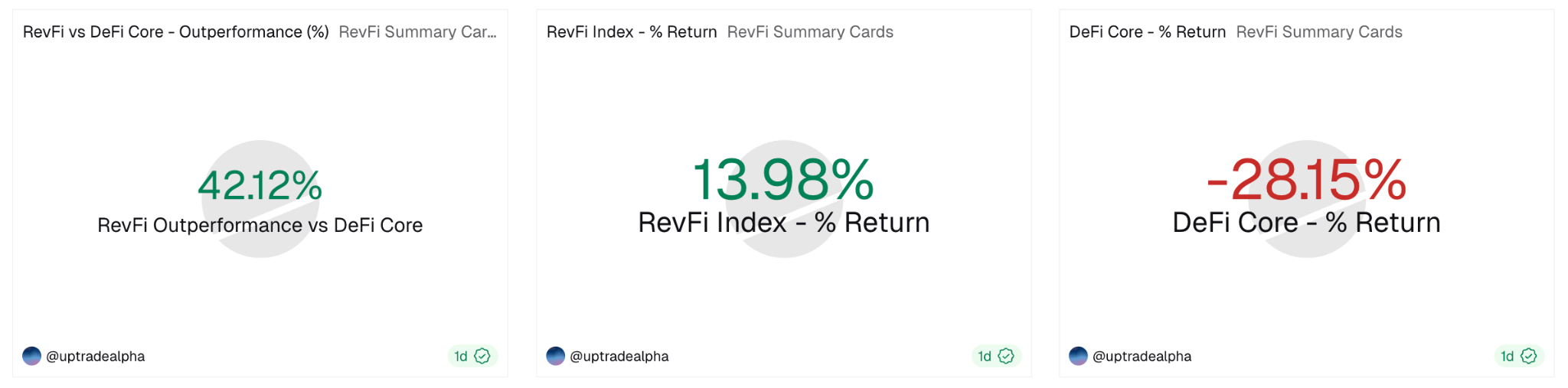
While the broader crypto market has been punished in 2026, L2s down over 50%, L1s down ~36%, and BTC down ~27% — our Alpha RevenueFi Index has demonstrated exactly why we built it. The index tracks a basket of seven tokens selected specifically for their ability to generate real on-chain revenue/fees: SYRUP, AAVE, MORPHO, SKY, AERO, PUMP, and HYPE. Benchmarked against BTC, the DeFi Core Index, the L1 Index, and the L2 Index since January 1, the outperformance has been striking, protocols with genuine cash flows have provided a meaningful floor during this risk-off environment, absorbing far less downside than the broader market. The thesis is simple, and the data is proving it out, in a market that has stopped rewarding speculation, real revenue matters.
The US-Iran Conflict Proves the Need for 24/7 Decentralised Exchanges
On Saturday, following the US-Iran strikes, oil spiked and gold surged. The NYSE was closed. The CME was closed. Traditional brokers were offline. This is what happens when 20th century market infrastructure meets 21st century geopolitics. Market close times are a structural problem that compounds with every major macro event, geopolitical developments do not follow exchange hours, and when markets eventually reopen, every participant rushes through the same narrow window simultaneously, creating violent price gaps, blown stop losses, and deeply inefficient price discovery. Institutions pre-position through OTC desks. Retail absorbs the damage on Monday morning.

While traditional exchanges sat dark, both crypto and traditional traders flooded to Hyperliquid, the only venue processing real price discovery in real time. Oil perps rose over 5%, gold and silver gained 1.3% and 2% respectively, providing the clearest available signal of where commodity markets would open come Monday. Hyperliquid's HIP-3 framework, a permissionless system allowing perpetual futures on any asset with a reliable public price feed, hit a record $1B in open interest, with silver perps alone generating over $300M in 24-hour volume. Across all of February, HIP-3 markets generated $4.4B in weekend-only volume while the CME and Nasdaq were closed, with the broader platform earning approximately $1M in protocol fees in a single 24-hour period. The Hyperliquid Assistance Fund has used that revenue to repurchase over 41.5 million HYPE tokens at a cost of approximately $1B, representing over 4% of total supply. Nasdaq, NYSE, and Cboe have all announced moves toward extended and 24/5 trading, with the DTCC scheduling nonstop clearing by year end. Traditional finance is finally acknowledging the bottleneck, but Hyperliquid already has the first mover advantage, capturing the volume, fees, and institutional attention that closed exchanges leave on the table every single weekend.
Clarity Act Delayed, But Odds Rise
The GENIUS Act handled stablecoins. The Clarity Act is the bigger one: a sweeping framework that decides which tokens fall under the SEC, which fall under the CFTC, and how exchanges, brokers, and custodians operate in the US. JPMorgan has called it the single biggest potential catalyst for crypto in the second half of 2026.
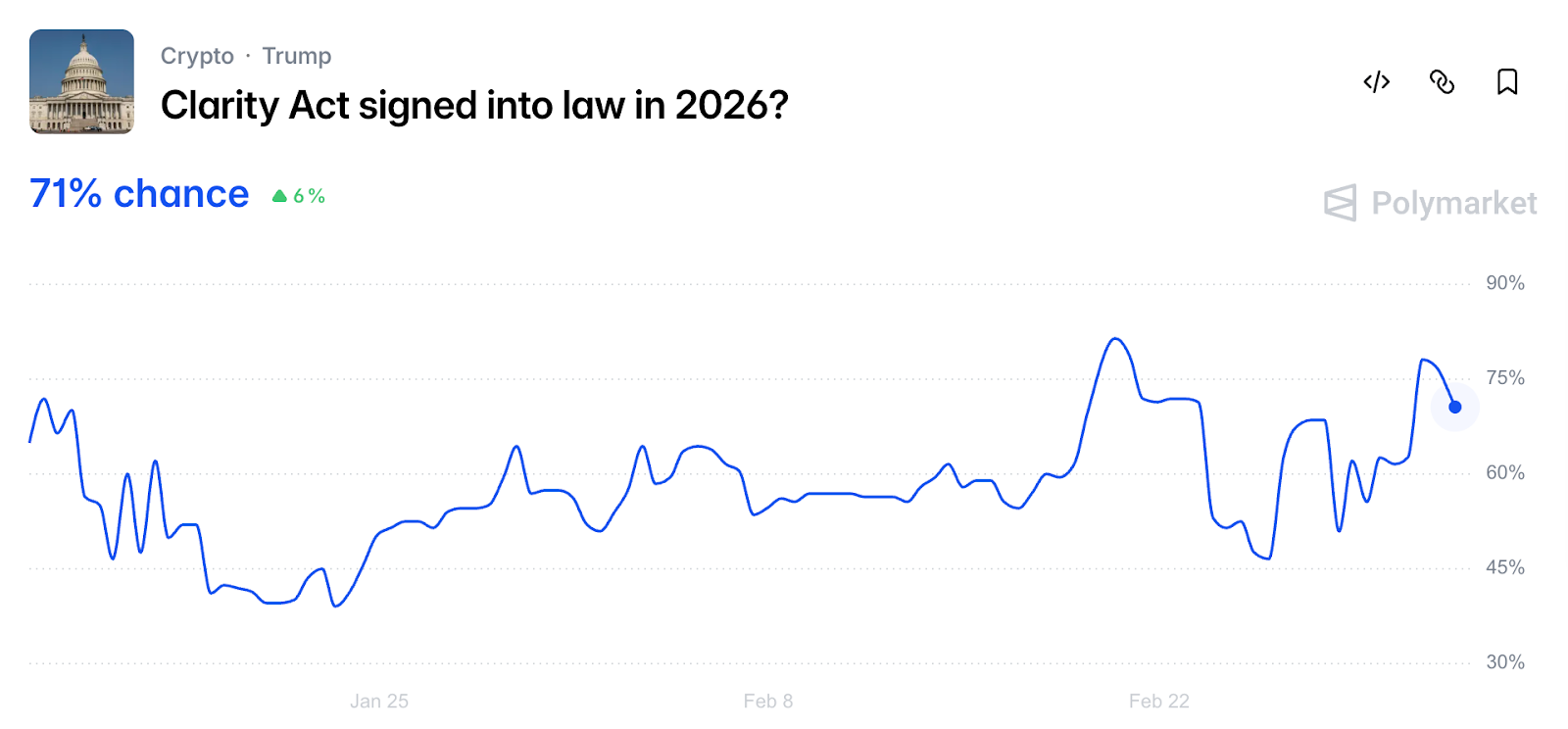
The sticking point is narrow but expensive. Banks want stablecoin yield banned outright, arguing that any product paying interest on holdings is functionally a deposit and should be regulated like one. Crypto firms, led by Coinbase, say yield is core to their business model and pulled their support from the Senate draft in January when that clause appeared. That withdrawal spooked enough senators to delay the markup indefinitely, and Polymarket odds collapsed from 72% to 42% almost overnight.
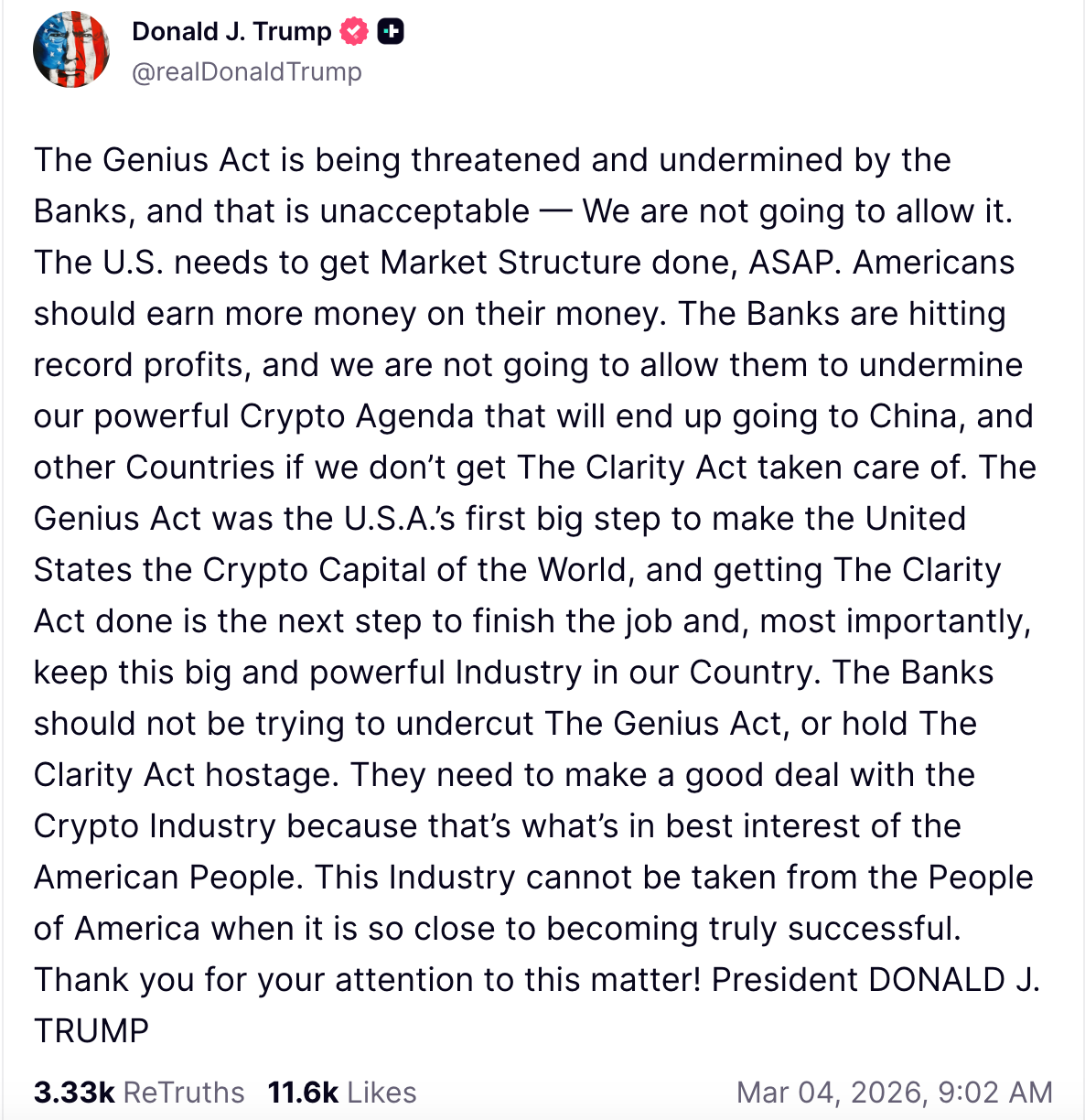
Since then, the pendulum has swung back hard. Coinbase CEO Brian Armstrong publicly called for a 90% chance of passage by the end of April. The White House set a March 1 internal deadline to force a deal. Odds climbed back to 90% before settling around 70% today. Then on Tuesday, Trump posted directly on Truth Social, accusing banks of holding the bill "hostage" and warning that inaction sends the industry to China. Senator Cynthia Lummis reposted immediately: "America can't afford to wait."
No stock is pricing in Clarity Act passage more aggressively than Circle (CRCL). The company bottomed at $49.90 on February 5 and has recovered above $103 this week, driven partly by a genuine earnings beat: revenue up 77% to $770 million and USDC circulation hitting $75.3 billion. But the earnings don't fully explain the move from the lows. The speculative bid is the Clarity Act. Circle's entire business scales with stablecoin adoption, and passage would be the single biggest unlock in the company's history: it legitimises yield-bearing stablecoins federally, gives institutional players a clean compliance framework to integrate USDC at scale, and expands the addressable market from crypto-native firms to every corporate treasury and payments desk that currently finds the legal grey zone too uncomfortable to touch. If it passes, Circle stops being a crypto company. It becomes financial infrastructure.
Institutions Bought the War Peak Fear
The US-Iran strikes landed on Saturday, February 28th, and crypto was the first market to feel it. Bitcoin fell over 3.5% on strike day, sliding below $63,000 as investors rotated to the dollar and gold. The conflict had real teeth, Iranian counterstrikes hit Israel, Qatar, the UAE, and Bahrain, the Strait of Hormuz closure was on the table, and oil spiked toward $90. Over $327 million in leveraged positions were liquidated within 24 hours, with over 75% of those longs.
The recovery was faster than anyone expected. When Iran confirmed Khamenei had been killed, the market shifted. Bitcoin reversed sharply from $63,000 back to $68,000 by Sunday morning. By the time US equity markets opened Monday, the damage was already priced.
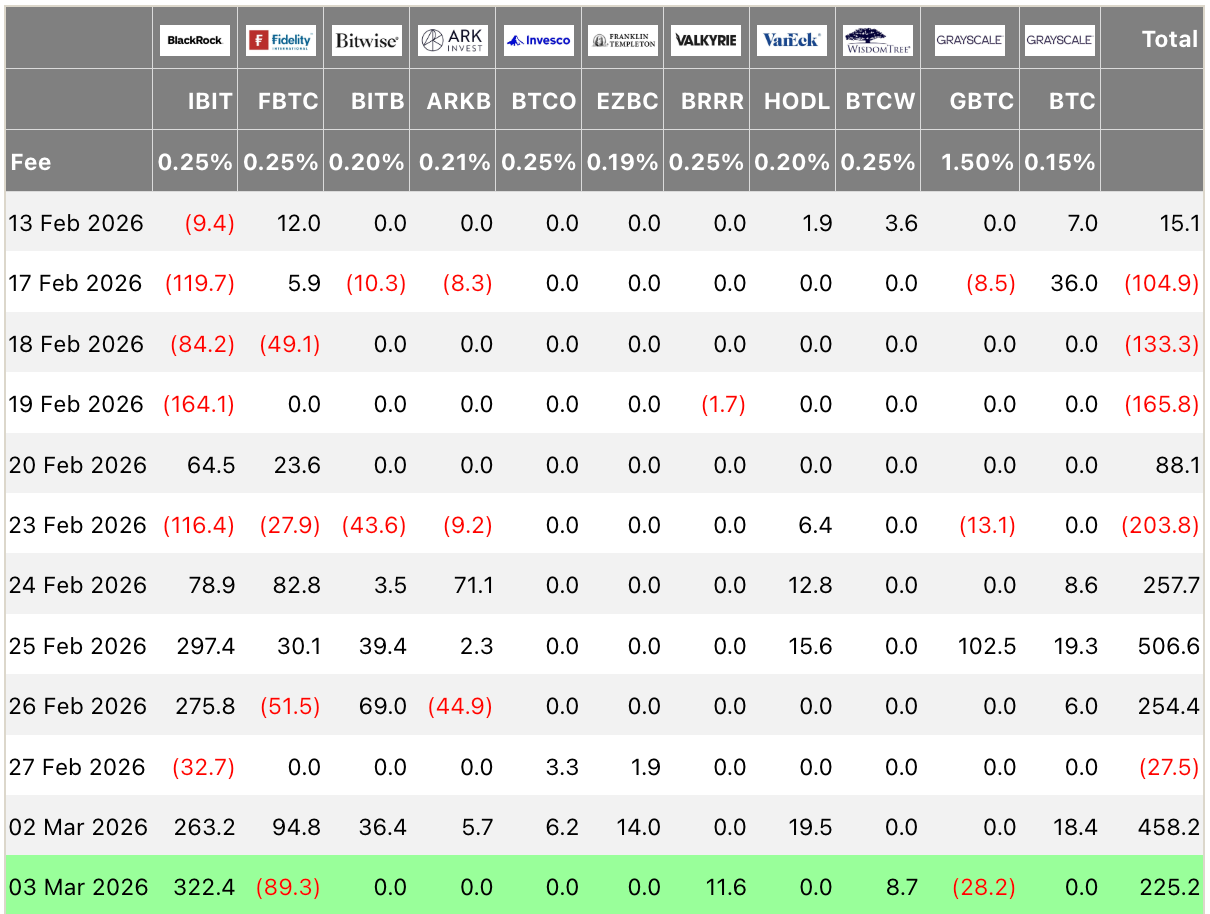
What those markets reopened to was institutional buying. Crypto ETFs recorded $1 billion in net inflows last week, ending a five week outflow streak that had bled over $4 billion year-to-date. Monday March 2nd delivered the single largest daily BTC ETF inflow in over five months, $458 million, with BlackRock's IBIT alone absorbing $263 million. Large players treated peak fear as an entry point. That is a fundamentally different market than the one that spent all of February heading for the exit.
X Closes the Door on Crypto's Wild West
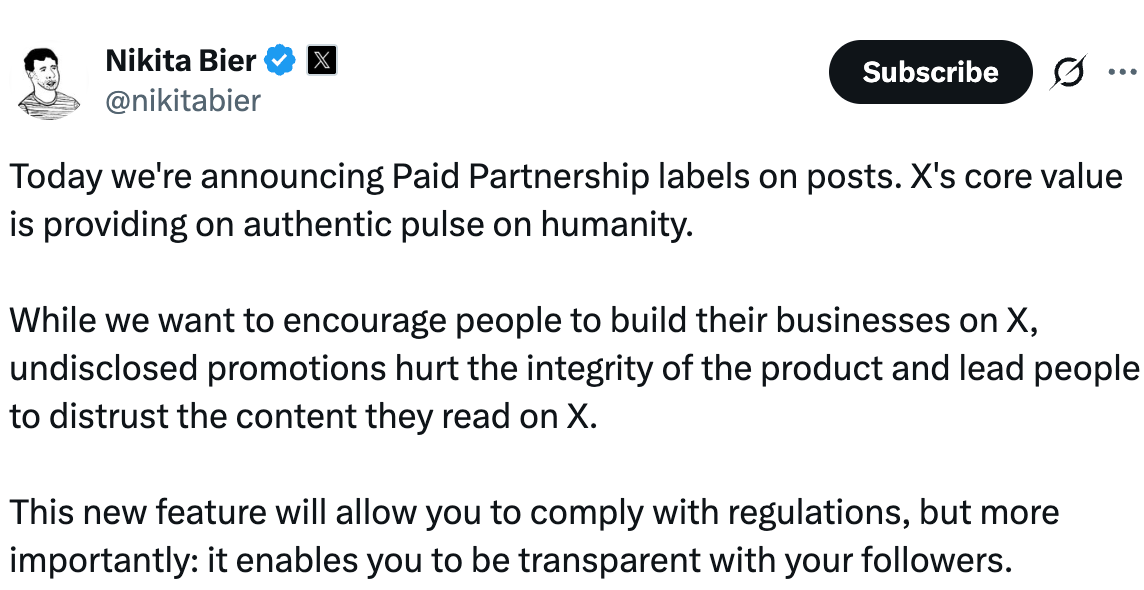
X has lifted its global ban on paid crypto promotions, introducing mandatory "Paid Partnership" disclosures for sponsored content. The EU, UK, and Australia are carved out entirely, reflecting the considerably stricter financial promotion frameworks in those regions. The more important signal here isn't the rule itself, it's what it represents. Mandatory disclosure and platform-level enforcement are the infrastructure that separates a maturing asset class from a Wild West, and the conditions that allowed anonymous shills and undisclosed promotions to thrive are quietly being dismantled.
General information only. This article is for educational purposes and does not constitute financial, investment, legal or tax advice, nor a recommendation to buy, sell or hold any asset. Cryptocurrency is a high-risk asset and you should consider your own circumstances and seek independent advice before making any decision. Uptrade does not make price predictions.
Kane leads our international research division, delivering clear, actionable insights into crypto markets and emerging investment opportunities. A true “crypto native,” he has over seven years of hands-on experience, formal qualifications in finance and economics, and has worked across Web3 hedge funds, venture capital, and leading incubators.
View all articles by Kane