
Weekly Market Update: 22 April 2026


US Equities Hit All-Time Highs, Bitcoin Reaches 77-Day Peak
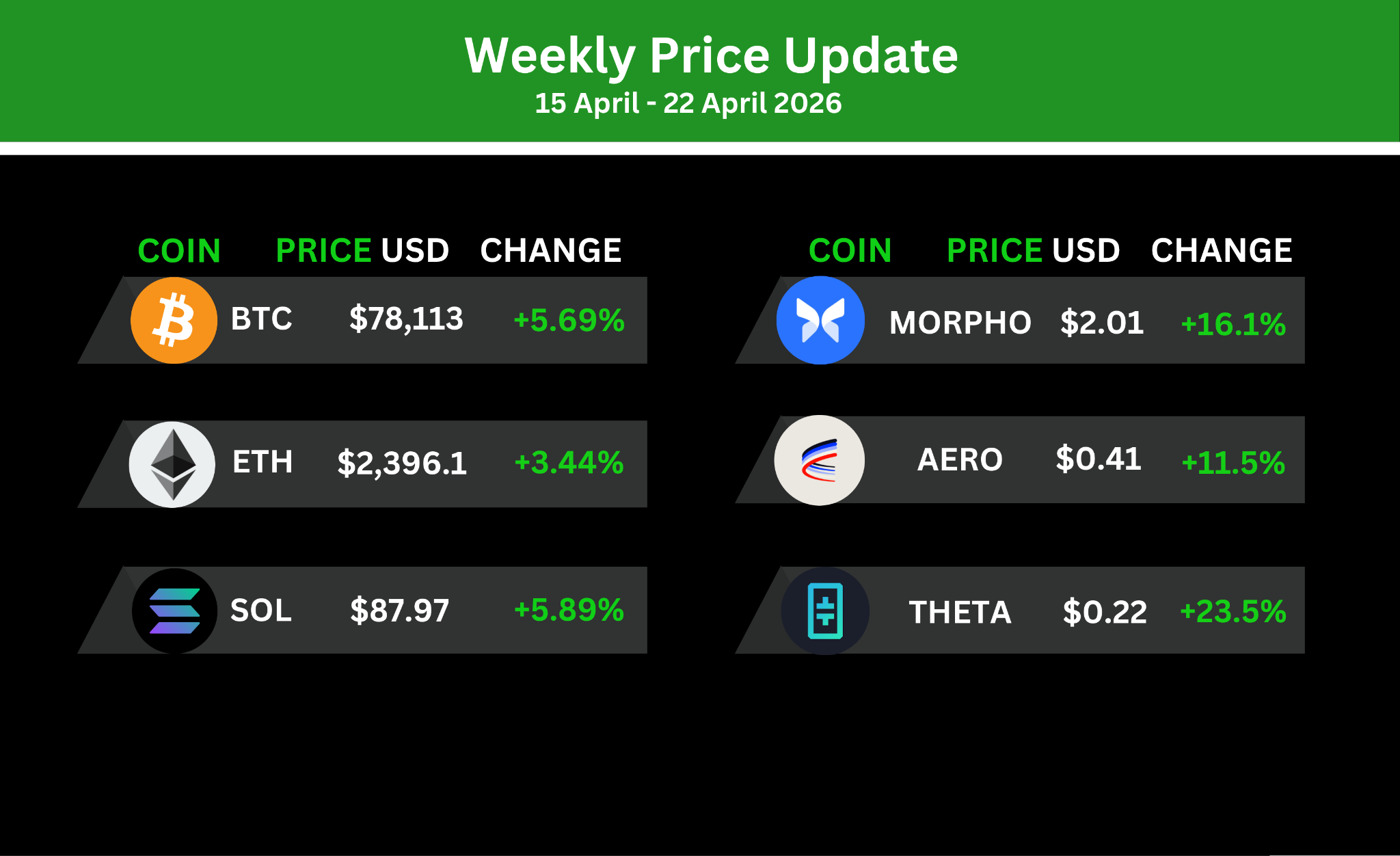
Markets were broadly green this week as headline noise faded and US equities hit record highs, with the momentum filtering into crypto. The majors posted solid gains and strong alts saw double digit moves. Bitcoin climbed to $78K, its highest price in 77 days, driven by a confluence of institutional conviction as Saylor deployed $2.5 billion, BTC ETFs recorded six consecutive days of positive flows, and Morgan Stanley crossed $150 million in Bitcoin purchased for clients in just the first ten days of trading their own ETF. The smart money is not waiting for clarity. It is buying into it.
Bitcoin & The Bull Market Support Band
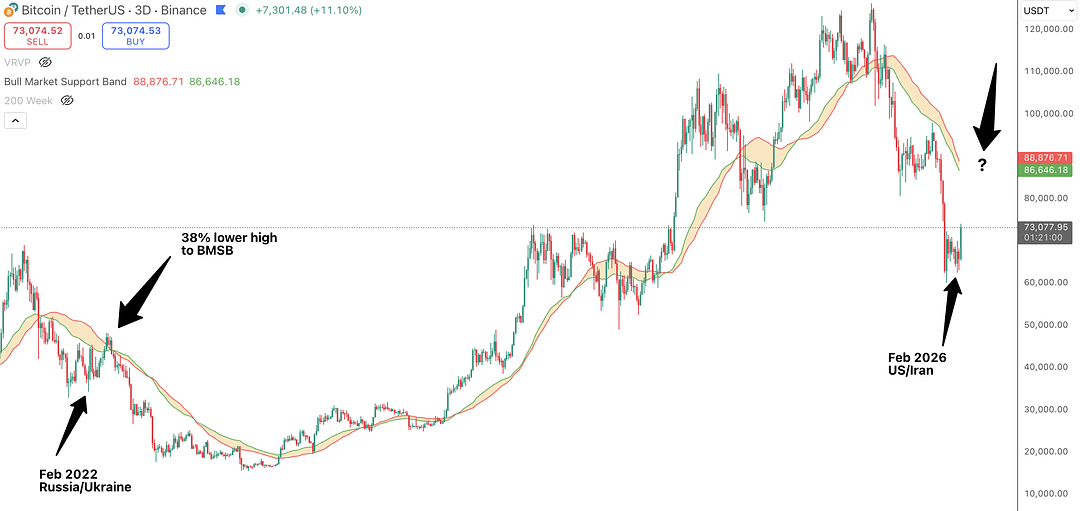
Back in early March we flagged a scenario that Bitcoin's structure was rhyming closely with the 2022 Russia/Ukraine bounce, where price ran hard before finding resistance at the Bull Market Support Band and rolling over in the mid-term. The BMSB at the time sat in the high $70Ks and we outlined it as the key level to watch if the relief rally extended.
This week, that scenario has played out. Bitcoin pushed into the $77,000 to $78,400 range directly into the Bull Market Support Band and is currently facing resistance, currently trading around $76,000. The band, which sits at $77,659 and $78,404, has acted as resistance rather than support, which is a meaningful technical signal worth understanding.
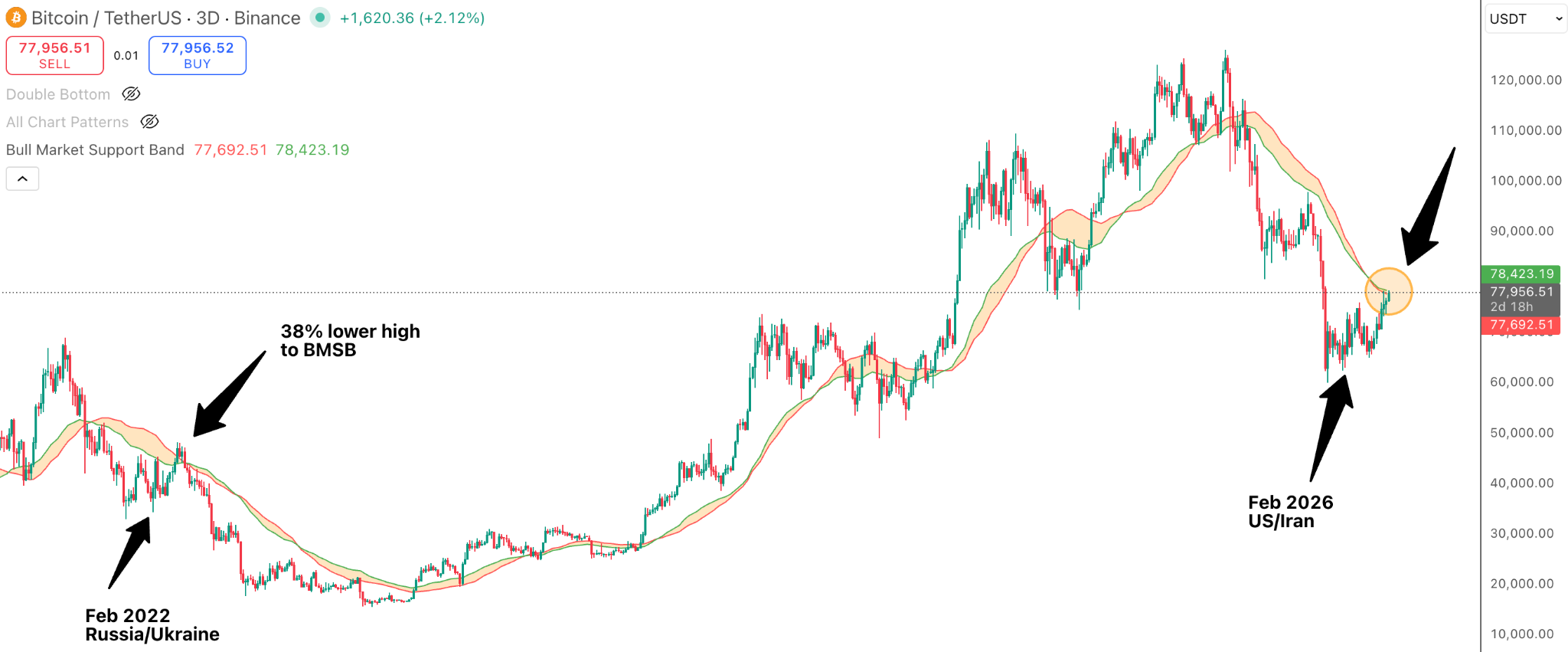
Historically the BMSB acts as a dynamic support level during bull markets, price bounces off it and uses it as a floor. When price is trading below the band and then rallies into it from underneath, it often acts as resistance instead. That is the current situation. A clean reclaim and close above the band on a weekly candle would be a significant bullish development. Until that happens, the band remains the ceiling that needs to be broken for broader market confidence to return.
Revenue Is The Narrative
The market has been quietly shifting the way it values crypto, moving away from narrative and speculation toward something more fundamental, real revenue and who benefits from it. Protocols that generate genuine cash flow and return it to holders, through buybacks or direct distributions, are not just surviving, they are pulling away from the field. Hyperliquid is the clearest proof point, buying back 4.34% of its total supply using real trading revenue while most altcoins sit 70-90% below their highs. Our RevFi 7 basket — seven revenue-generating protocols tracked against the broader market, is up while everything else is deeply red, through a war, a bear market, and some of the most volatile headlines of this cycle. We wrote a full breakdown of the thesis, the data, and what it means for capital allocation going forward. Read it at uptradealpha.com.

Uptrade Alpha Winning at Paris Blockchain Week
We are proud to share that UpTrade Alpha was named Best Research Platform of 2026 at Paris Blockchain Week this week, with Jeff on the ground in Paris to accept the award on behalf of the team. When we started building, the goal was simple — institutional quality research shouldn't be reserved for institutions. Seeing that recognised on a global stage tells us we're on the right track, and we're more motivated than ever to keep building. If you haven't been inside the platform recently, now is the time.

$292M Exploit. Billions Locked. What Happened with KelpDAO.
On April 18, an attacker exploited a flaw in KelpDAO's cross-chain bridge to mint 116,500 rsETH tokens worth approximately $292 million without depositing any real assets. Think of rsETH as a receipt token for staked ETH, the attacker forged the receipt, used it as collateral on Aave, the largest DeFi lending protocol, and borrowed over $200 million in real ETH before the protocol could freeze the markets. It is now the largest DeFi exploit of 2026, surpassing the $285 million Drift hack from earlier this month.
What followed was arguably worse than the exploit itself. Large investors pulled billions simultaneously, and Aave's core lending pools hit 100% utilisation, meaning every dollar deposited had been borrowed out with nothing remaining for withdrawals. $3 billion in USDT and $2 billion in USDC were effectively locked. Ordinary depositors who had done nothing wrong found themselves unable to access their own funds. Justin Sun removed $154 million in a single transaction. AAVE's token fell 16% and Aave's TVL collapsed from $26.4 billion to $17.9 billion in 48 hours. Total DeFi TVL across all chains fell $13.2 billion in the same period.
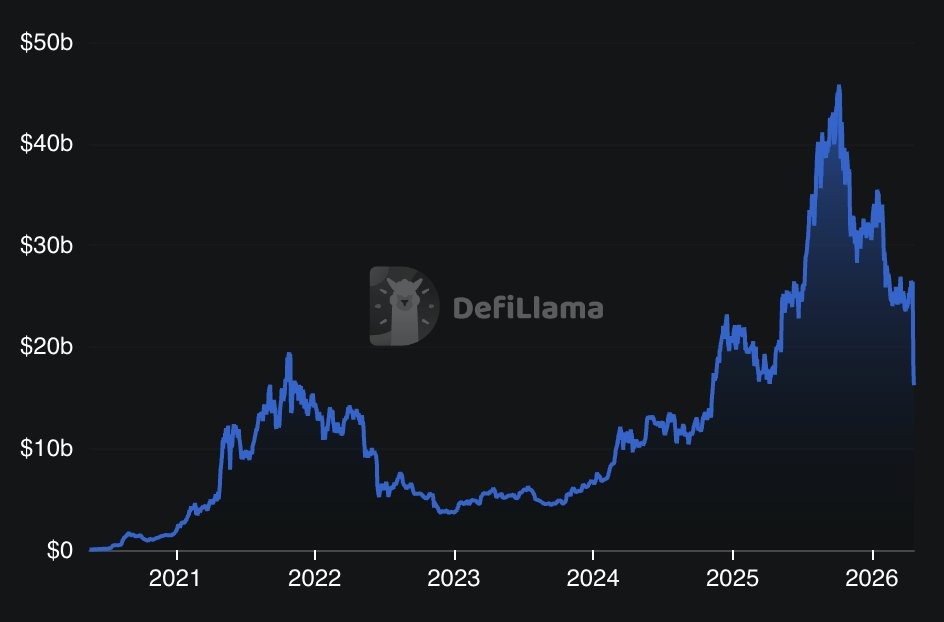
This exposes something structural about DeFi that does not get discussed enough. A protocol's risk is not limited to its own code, it extends to every asset it accepts as collateral, every bridge those assets cross, and every chain they operate on. Aave did nothing wrong and still absorbed the consequences.
It always raises concerns of the risks vs outcomes for DeFi, with US Treasuries currently yielding 4-5% risk free. DeFi is offering similar yields, but with the very real possibility of losing access to your funds overnight through no fault of your own. Most platforms promoting DeFi yields do not disclose which protocols they are routing through or what the underlying risks actually are. Retail investors are unknowingly taking on smart contract risk, liquidity risk, and counterparty risk simultaneously.
Polymarket Launches Perps
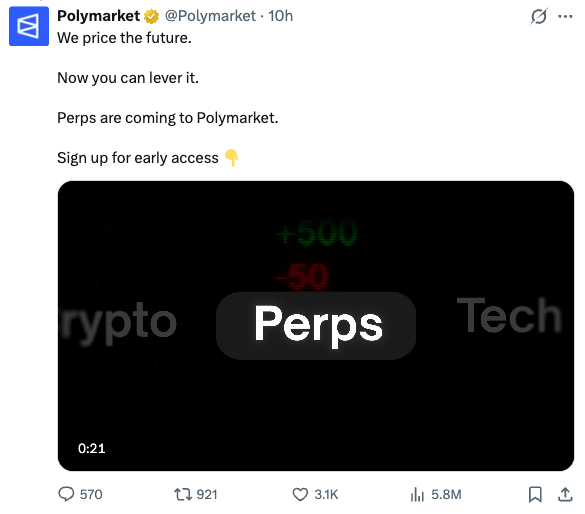
Polymarket is launching perpetual futures with up to 10x leverage across Bitcoin, Nvidia and gold, with a waitlist now open for early access. The announcement landed hours after rival Kalshi revealed its own perps product dropping April 27. Both have CFTC approval to operate in the US, putting them in direct competition with Coinbase, which spent $2.9 billion acquiring Deribit last year to build out its derivatives business. Last year, top centralised exchanges recorded $86.2 trillion in perps volume, a 47% increase year on year. That's the market everyone is now chasing.
None of this happens in a vacuum. Hyperliquid spent the past year proving that decentralised perps can operate at institutional scale, billions in daily volume across crypto and real-world assets, no centralised intermediary, 24/7. The Iran war made that case more powerfully than any marketing campaign could have. Polymarket and Kalshi entering this space is traditional finance, finally acknowledging what Hyperliquid already showed the market wanted. The question is whether regulated onshore platforms can pull that demand away from the protocol that built the infrastructure first.
The Ceasefire That Isn't
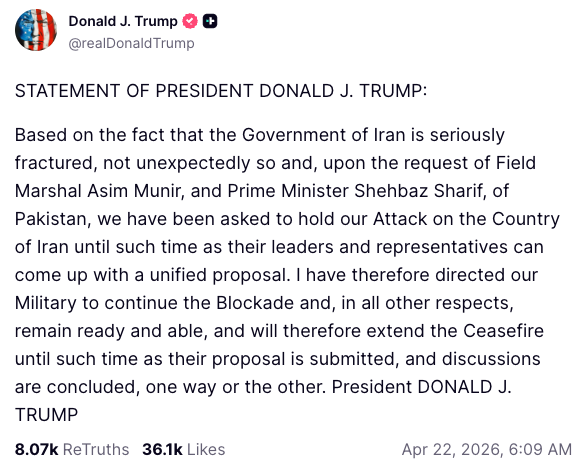
Trump extended the US-Iran ceasefire overnight with no end date after Tehran went silent on US deal points and Vance's Pakistan trip was cancelled. Iran called it "means nothing." The oil reaction said the same, Brent and WTI barely moved compared to prior ceasefire headlines, which tells you markets are now pricing a prolonged standoff, not a resolution. Hormuz is still flowing at 3.8 million barrels per day against a pre-war rate above 20 million. The blockade remains.
For crypto, the read through is nuanced. Risk assets have broadly tracked oil volatility during this conflict, when Hormuz headlines hit, BTC and ETH have sold off alongside equities, and when ceasefire announcements land, crypto bounces with everything else. But the diminishing market reaction to each new extension is actually a constructive signal. If macro participants are beginning to price in a prolonged but contained standoff rather than escalation, that removes the tail risk that has been suppressing risk appetite. A stable but unresolved Iran situation is better for crypto than an unpredictable one. The bigger near-term driver for digital assets remains rate expectations and USD strength, both of which are being complicated by the oil-driven inflation pressure this conflict is adding to an already uncertain macro backdrop.
General information only. This article is for educational purposes and does not constitute financial, investment, legal or tax advice, nor a recommendation to buy, sell or hold any asset. Cryptocurrency is a high-risk asset and you should consider your own circumstances and seek independent advice before making any decision. Uptrade does not make price predictions.
Kane leads our international research division, delivering clear, actionable insights into crypto markets and emerging investment opportunities. A true “crypto native,” he has over seven years of hands-on experience, formal qualifications in finance and economics, and has worked across Web3 hedge funds, venture capital, and leading incubators.
View all articles