
Weekly Market Update: 18 February 2026


Stability Returns, But Tensions Linger
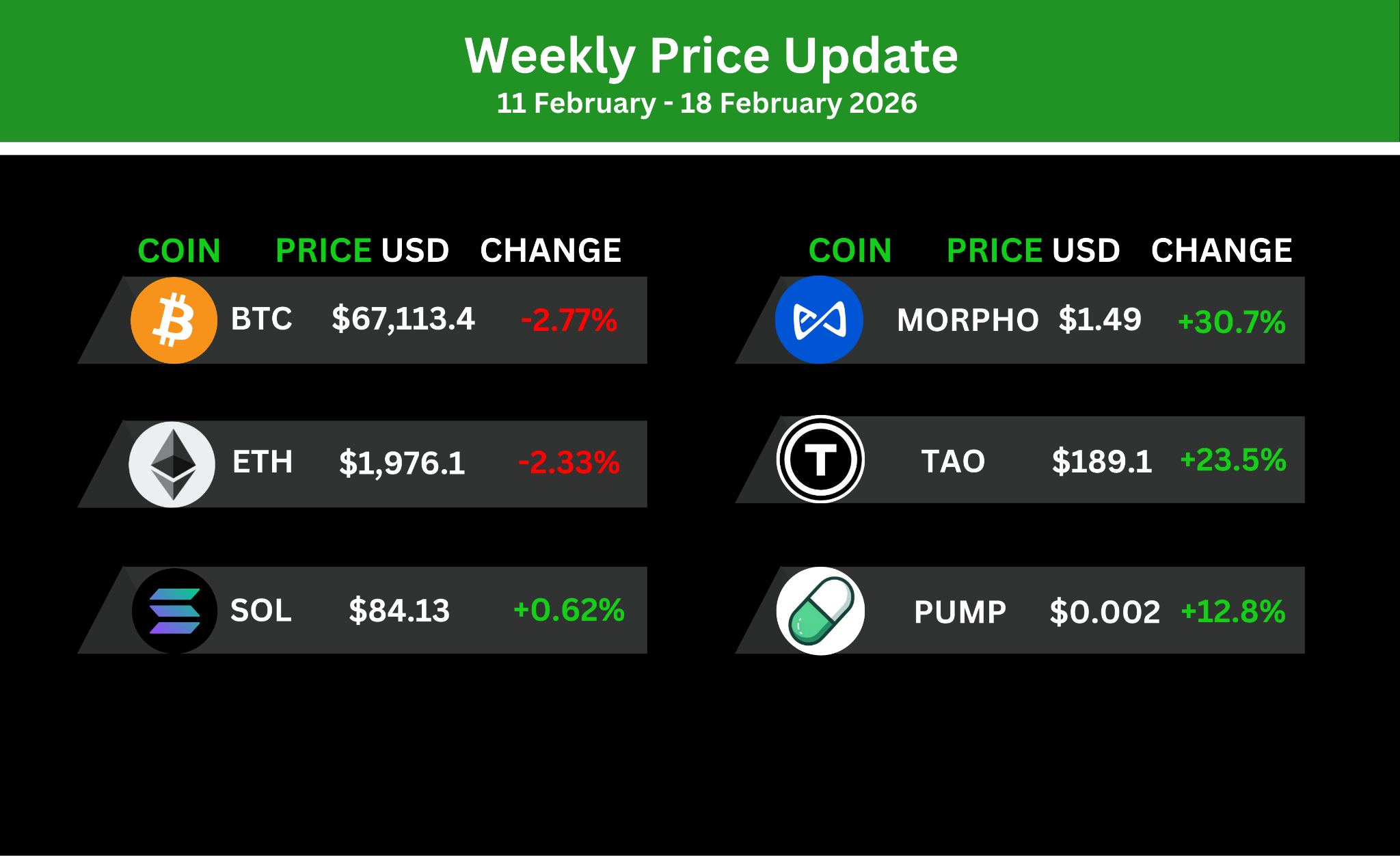
Markets stabilised this week in what feels like a much needed break after several weeks of elevated volatility. Bitcoin continued consolidating in the mid-$60K region, holding structure as forced selling pressure subsides and spot flows begin to normalise. On the week, BTC finished -2.86%, while Ethereum moved -2.42%, reflecting a more measured tone across majors compared to the sharp drawdowns seen earlier in the month.
On the macro front, recent U.S. data painted a mixed but stabilising picture. Unemployment and inflation prints suggest conditions are cooling gradually rather than re-accelerating, while the newly announced U.S.–Japan trade agreement adds a constructive geopolitical backdrop. However, rate cut expectations for March remain low, with policymakers signalling patience. For now, liquidity conditions are steady rather than easing, meaning risk assets are stabilising without yet receiving a clear policy tailwind.
Blackrock Enters DeFi
BlackRock has taken another step toward on-chain finance, bringing its tokenised Treasury product, BUIDL, onto Uniswap. BUIDL is BlackRock’s blockchain based money market fund backed by U.S. Treasuries, designed to give institutions yield with instant on-chain settlement. Until now, it operated through traditional rails and whitelisted platforms. Moving onto Uniswap, the largest decentralised exchange, signals growing institutional comfort with decentralised trading infrastructure. BlackRock also acquired UNI tokens as part of the integration.
Access remains limited to qualified purchasers, but the broader implication is clear. The world’s largest asset manager is now using DeFi rails for real financial products. Today it’s tokenised Treasuries. Over time, this model could expand into broader asset classes, positioning decentralised exchanges as part of mainstream capital markets infrastructure rather than a parallel system.

Aave Proposes “Will Win Framework” to Strengthen Token Alignment
Aave has introduced a new governance proposal titled the “Aave Will Win Framework,” aimed at increasing the link between protocol revenue and token holders. While the Aave DAO already receives 100% of core lending and borrowing fees, additional revenue streams, such as swap fees from the official interface and certain Aave Labs products, have historically remained with Aave Labs to fund operations. The new proposal would redirect 100% of those product-related revenues back to the DAO treasury, meaning all income generated under the Aave brand flows directly to the protocol and its governing $AAVE token holders.
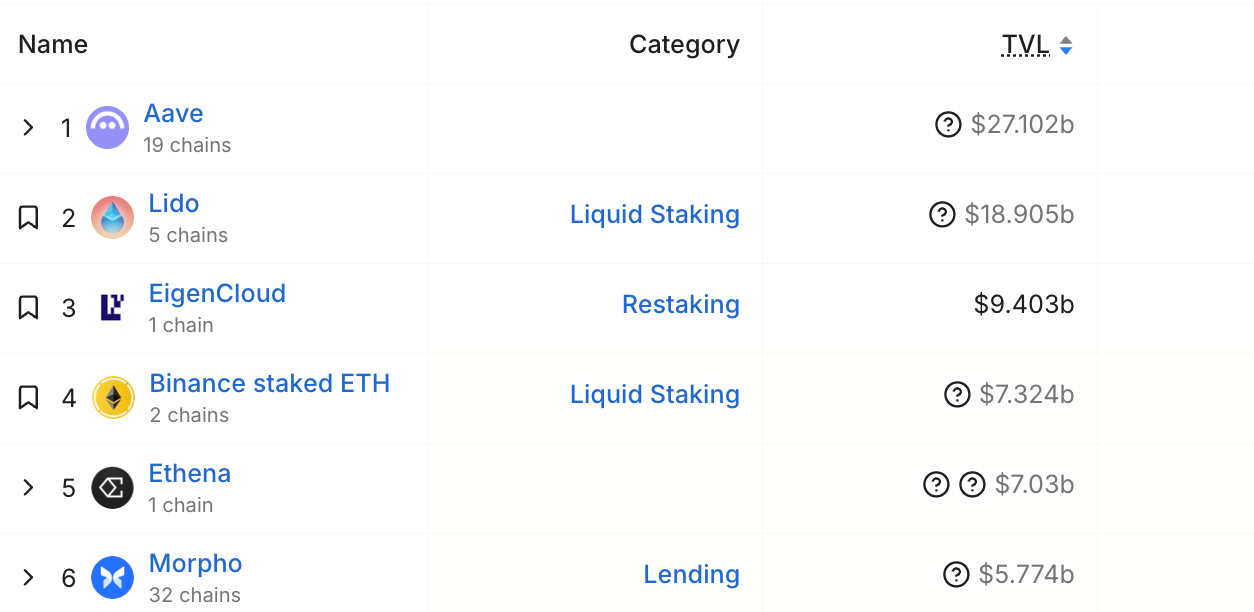
Aave is currently generating roughly $1–2M in weekly revenue (~$135M annualised) and remains the largest DeFi lending protocol with approximately $27B in TVL. If passed, the framework would strengthen token value alignment and reinforce Aave’s positioning as institutional capital gradually re-enters DeFi. The proposal is still in early discussion, but it marks another step toward clearer decentralisation and revenue transparency.
Top DeFi TVL
UpTrade Alpha: Upcoming Guests
UpTrade Alpha has an exciting lineup of guest sessions scheduled over the coming month, continuing to expand the depth of insight available to members. We’ll be joined by Catherine Gu, Head of Product at Solana, for a focused discussion on ecosystem development and product direction. Jeff, CEO of Uptrade will also be returning to share his perspective on navigating bear markets and identifying structural bottoms, drawing on real cycle experience. In addition, Pratik, Head of Research at Apollo Capital, will be back to provide institutional insights across crypto and macro. These sessions are designed to give members direct access to operators and allocators actively shaping the space.
Harvard Rotates From Bitcoin to Ethereum
Harvard made a notable adjustment to its crypto exposure in Q4 2025, trimming its position in BlackRock’s iShares Bitcoin Trust (IBIT) by roughly 21%. The fund sold approximately 1.5 million shares, leaving a remaining stake valued at ~$265.8M. At the same time, Harvard initiated its first publicly disclosed Ethereum allocation, purchasing nearly 3.9 million shares of BlackRock’s iShares Ethereum Trust (ETHA), worth approximately $86.8M.
The move suggests a strategic rotation rather than an exit from digital assets. While Bitcoin continues to serve primarily as a macro hedge and store of value allocation, Ethereum offers a more dynamic exposure profile. Ongoing protocol upgrades, staking yield, and the expanding DeFi and on-chain application ecosystem provide additional drivers. Whether this proves to be tactical or structural remains to be seen, but it reinforces a broader theme, institutions are increasingly differentiating between Bitcoin and Ethereum, rather than treating “crypto” as a single trade.

Five Red Months. Is Bitcoin Nearing a Turning Point?
Bitcoin is currently on pace for its longest stretch of consecutive monthly losses since the 2018 bear market. With BTC down roughly 14% so far in February 2026, a lower monthly close would mark five straight red months, extending the four-month skid seen in late 2025 and approaching the six-month streak recorded during the 2018 cycle low.
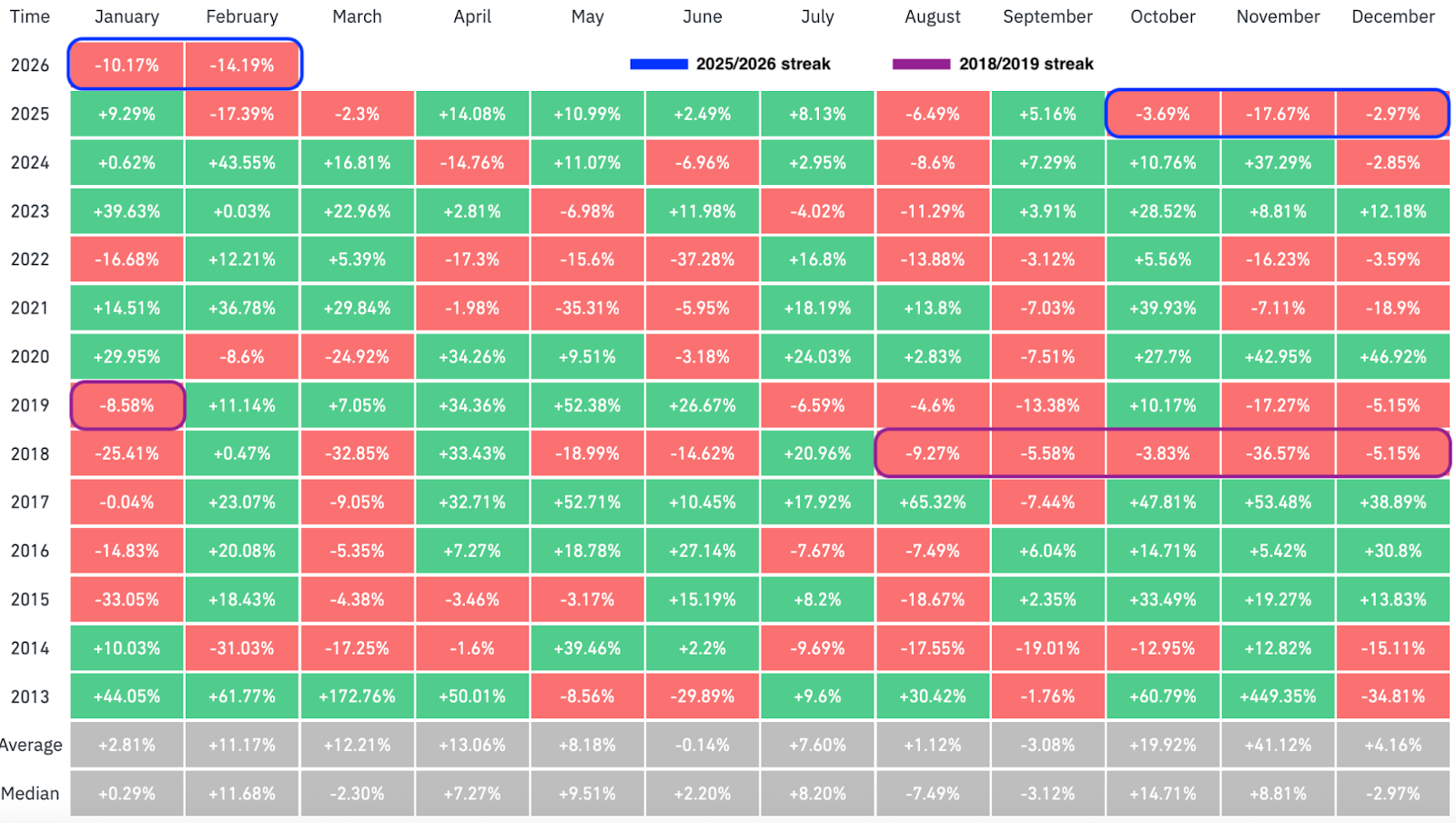
From the October 2025 high near $125,000, Bitcoin has now retraced over 50%, driven by a combination of risk-off macro conditions, heavy deleveraging (including a $2.5B+ liquidation event in a single day last month), and sustained ETF outflows. The backdrop mirrors prior late-cycle unwind phases, where leverage resets and sentiment compress before structural stabilisation. While this does not confirm a bottom, extended monthly drawdowns of this magnitude have historically aligned more closely with capitulation phases than with early-cycle distribution.
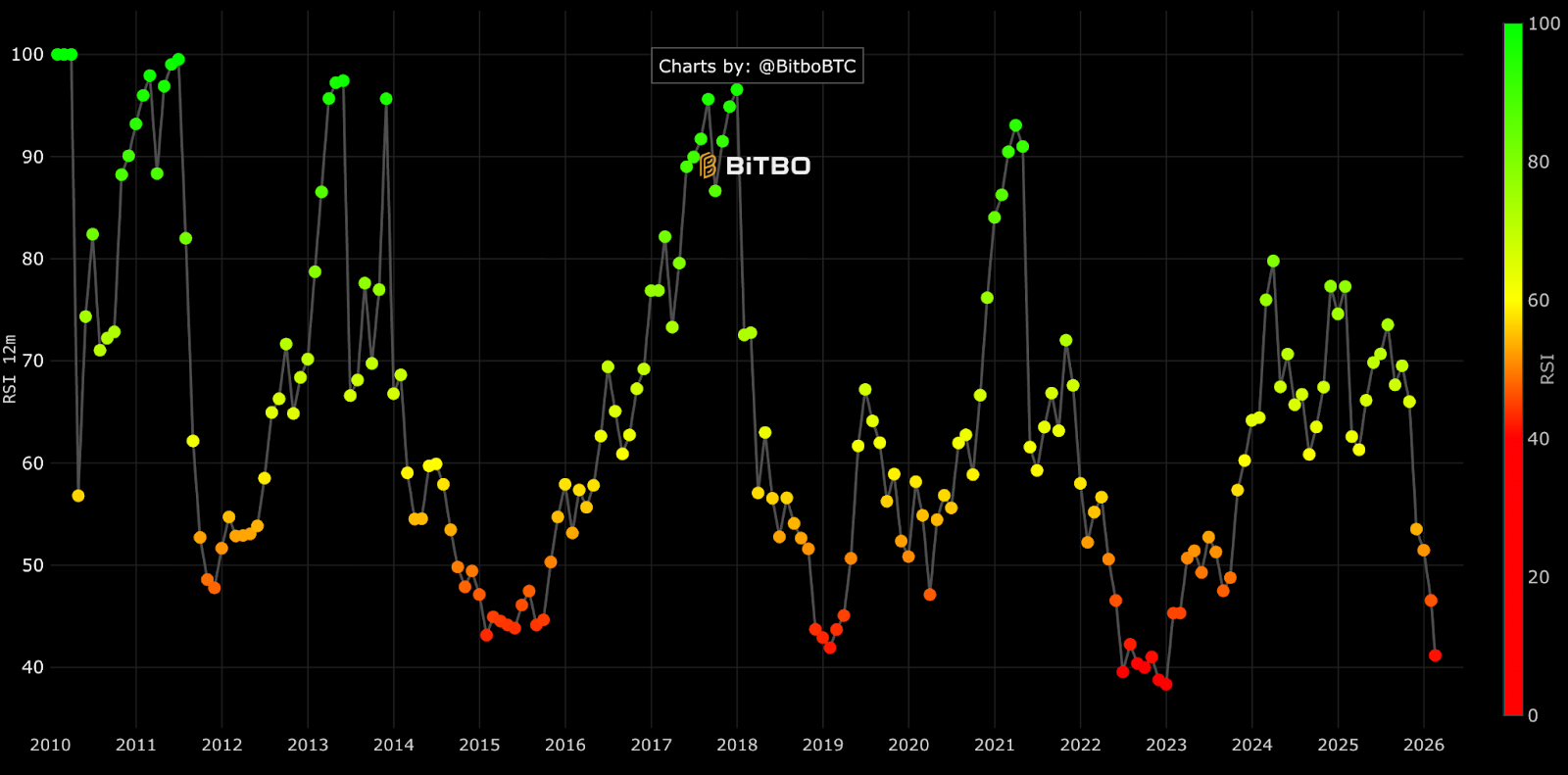
On a higher timeframe basis, the month RSI has now fallen into the low-40s, levels historically associated with late bear-cycle compression rather than euphoric topping conditions. In prior cycles (2015, 2018/2019, and 2022), similar RSI readings emerged during structural reset phases where downside momentum was still dominant but approaching exhaustion.
Importantly, RSI in this range does not signal a confirmed bottom. In prior cycles, monthly RSI remained compressed in the low-40s for several months before a durable base formed and momentum gradually rebuilt. With RSI only recently entering this zone, this could mark the early stages of a broader basing process similar to previous cycle resets.
The Convergence of AI Agents and Crypto
We are in the early innings of one of the most significant infrastructure shifts in finance. The explosion of LLMs has given rise to a new category of software and productivity: autonomous AI agents, systems that don't just advise, but act. They can book travel, execute trades, manage workflows, and increasingly, they need to pay for things. Today, most agents are forced to cobble together workarounds using virtual cards, delegated API access to services like Stripe or PayPal, or borrowed human credentials. It functions at a small scale, but the entire system assumes a person is ultimately accountable, spending limits are rigid, cross-border payments get flagged, and reconciliation becomes a nightmare as agent activity scales. The friction between AI agents and legacy financial infrastructure makes it difficult for any smooth, autonomous operation at scale, and it's a fundamental mismatch, not a bug to be patched.
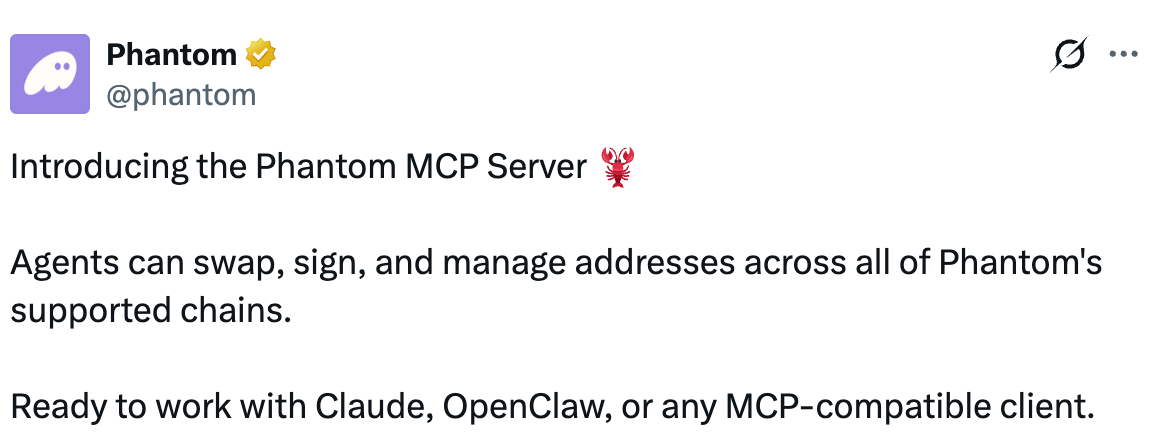
Crypto, by contrast, was almost accidentally designed for exactly this use case. Near-zero fees, sub-second finality, API-native architecture, and no intermediary gatekeeping or bottlenecks with autonomous transactions. The product-market fit here isn't speculative, it's structural. And the infrastructure is being built in real time. Coinbase launched "Agentic Wallets," purpose-built infrastructure enabling AI agents to independently hold funds, send payments, trade tokens, and earn yield on-chain on top of their x402 protocol, which has already processed 50 million transactions since launching. On the consumer side, Phantom launched Phantom Cash, a stablecoin-powered payments product, with Stripe executives explicitly framing it as part of a push into "agentic commerce," where AI agents transact on behalf of users. And just this week, Phantom went a step further with the launch of the Phantom MCP Server, allowing AI agents to swap, sign, and manage addresses across all of Phantom's supported chains, with native compatibility for Claude, OpenClaw, and any MCP-compatible client. This is perhaps the clearest signal yet: the wallet is no longer just a tool for humans. It's becoming infrastructure for machines. The race to own the payment rails of the agentic economy is already underway, and crypto is emerging as the clear foundation.
Underpinning all of this is stablecoins. Commerce merchants can't operate effectively on volatile assets, so dollar-pegged stablecoins become the actual money layer that makes agentic commerce functional. This is a key reason why the GENIUS Act, stablecoin legislation currently moving through Congress, matters well beyond the crypto industry. A clear regulatory framework for stablecoins doesn't just benefit crypto natives, it lays the legal groundwork for an entirely new category of autonomous machine-to-machine commerce. The race to own the payment rails of the agentic economy is already underway, and crypto is emerging and cross pollinating as a possible foundation for this.
General information only. This article is for educational purposes and does not constitute financial, investment, legal or tax advice, nor a recommendation to buy, sell or hold any asset. Cryptocurrency is a high-risk asset and you should consider your own circumstances and seek independent advice before making any decision. Uptrade does not make price predictions.
Kane leads our international research division, delivering clear, actionable insights into crypto markets and emerging investment opportunities. A true “crypto native,” he has over seven years of hands-on experience, formal qualifications in finance and economics, and has worked across Web3 hedge funds, venture capital, and leading incubators.
View all articles