
Weekly Market Update: 10 December 2025


Crypto Stabilises Ahead of the FOMC Decision
Crypto traded in a relatively stable range this week as the market began to regain its footing ahead of tomorrow’s FOMC meeting. Bitcoin moved between $89K and $94K, while Ethereum led major assets with an ~8% move from $3.1K to $3.3K. Volatility has been contained, but price action continues to show signs of gradual stabilisation after several weeks of heavy macro driven swings.
Despite a steady stream of positive developments over the past fortnight, the market has yet to translate those catalysts into meaningful price movements. That may reflect positioning ahead of the Fed rather than a lack of conviction. With expectations for policy now shifting quickly, tomorrow’s FOMC meeting could serve as a clearer inflection point for how this stage of the cycle unfolds. More on this below.
Fed Cut and What This Means for Crypto Markets
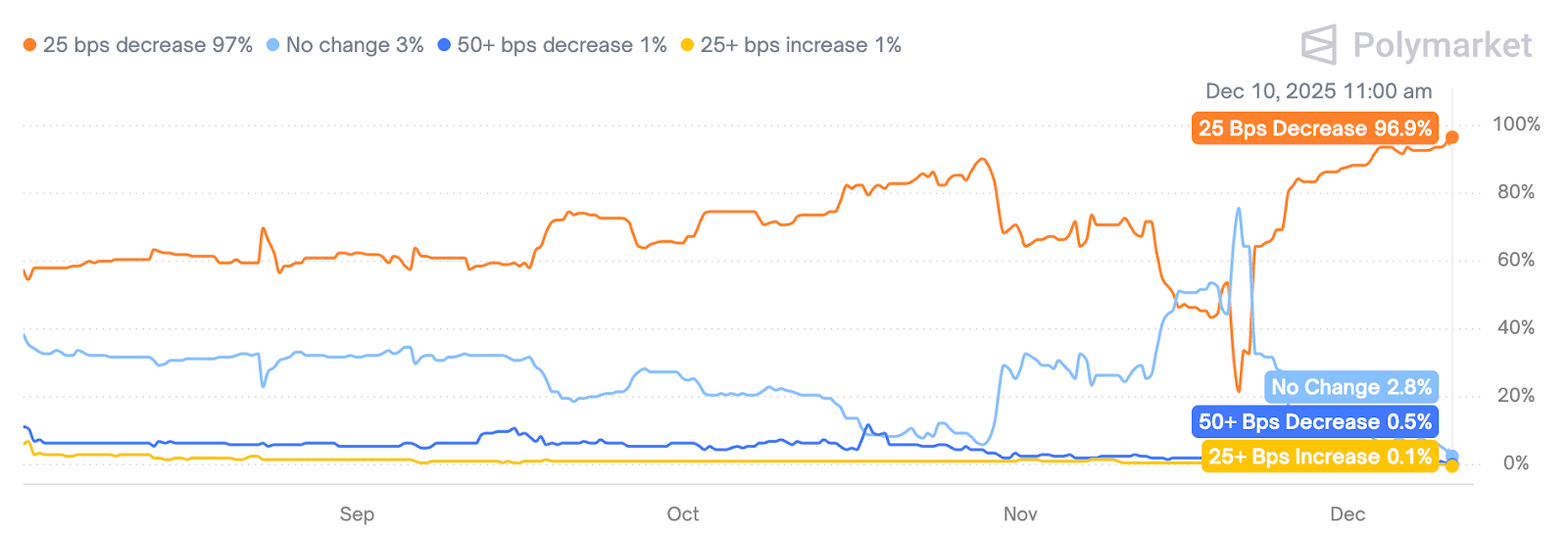
Prediction markets such as Polymarket now assign over a 95% probability to a 25bps cut at the December 10 FOMC meeting. With Bitcoin and Ethereum consolidating after the recent pullback, the focus is less on the cut itself, which is broadly expected and more on the tone the Fed sets for 2026.
From a market structure standpoint, two broad scenarios matter :
A more dovish tone — signalling openness to further cuts, acknowledging softer inflation trends, or showing comfort with easier financial conditions would point toward a more supportive liquidity backdrop. Historically, this environment aligns with stronger risk appetite across asset classes.
A more hawkish tone — suggesting limited cuts ahead, highlighting inflation uncertainty, or leaning toward a higher for longer stance would indicate a slower path toward easing. Markets typically adjust quickly in these situations, which can translate into short-term volatility.
A single cut doesn’t define the cycle, the market is looking for clarity on the broader liquidity path into 2026. Today’s communication will shape expectations on that front and help determine how the next phase of this macro environment develops.
Fusaka Upgrade and What It Means for Ethereum
Ethereum completed its “Fusaka” upgrade this week, the second major update of the year, and it brings meaningful improvements to how the network handles data from Layer-2s. The biggest change is PeerDAS, a new system that lets validators check only a small portion of L2 data instead of processing everything themselves. In simple terms, Ethereum can now handle far more activity from Layer-2 networks, roughly an eightfold increase which supports lower fees and smoother throughput. The upgrade also added native support for modern authentication tools like Face ID, Touch ID, and hardware security keys, allowing users to approve transactions without seed phrases while remaining fully self-custodial.
Other updates include raising the gas limit from ~45M to 150M per block and introducing new rules that let developers scale L2 data capacity without full hard forks. Fee changes were also added to keep costs more stable when the network is busy. Together, these improvements increase Ethereum’s bandwidth and make the L2 ecosystem easier and cheaper to use.
Market reaction was positive. ETH reclaimed $3,000 ahead of the upgrade, a ~10% bounce off the $2.7K support area with trading volumes rising into activation. Institutions also responded: Bitmine, the largest corporate holder of ETH, added another $150M to its treasury the day after the upgrade, bringing its total holdings to 3.5 million ETH. It’s not predictive on its own, but it reflects confidence in Ethereum’s long-term infrastructure roadmap.

Treasury Activity and What It Signals Beneath the Surface
Despite elevated fear in the crypto market, the two largest corporate treasuries, Strategy for Bitcoin and BitMine for Ethereum continued to increase their holdings through the recent pullback. Their behaviour provides a useful read on institutional positioning during periods of stress.
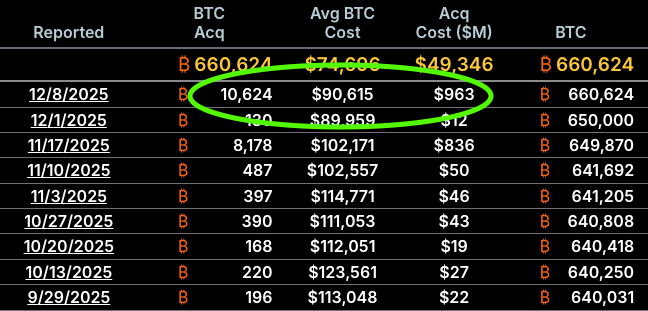
MicroStrategy remains under scrutiny as its share premium has compressed and concerns circulate about its market net asset value (mNAV) potentially falling below 1, which would imply the company is trading below the value of its underlying BTC. The firm currently sits near 1.15 mNAV. To stabilise its balance sheet, MicroStrategy raised $1.44B in cash through equity issuance, covering roughly two years of dividend and interest obligations. With that buffer in place, the company added another 10,624 BTC this week (~$963M), continuing its accumulation strategy during the recent drawdown.
BitMine, the largest Ethereum treasury, has taken a similar stance on the ETH side. The company added 138,000 ETH last week (~$435M), pushing its holdings to more than 3.2% of circulating supply. Ethereum’s ability to generate staking yield typically around 3–5% APR adds an additional layer to the long-term treasury case, and BitMine is preparing to launch its staking program in Q1 2026. The firm also retains roughly $1B in deployable capital for further accumulation. While not predictive on its own, this corporate activity highlights how large treasuries are navigating volatility and reinforces the growing institutional footprint across both assets.
BlackRock Staking ETF and What It Signals for Ethereum
BlackRock has added to the Ethereum narrative this week, filing a new S-1 for the iShares Staked Ethereum Trust (ETHB) on December 5. Unlike earlier proposals that tried to incorporate staking into its existing spot ETF, this is a standalone product designed to stake the majority of its ETH holdings, targeting 70–90% participation and distribute staking rewards directly to shareholders. This is notable because it formalises ETH’s yield component within a regulated ETF wrapper, something large allocators have historically lacked access to.
The filing reinforces a trend that major issuers are increasingly treating Ethereum not just as an asset, but as a yield-bearing part of digital infrastructure. The ability to earn native staking rewards through a compliant ETF structure may prove appealing for institutions that have been unable or unwilling to participate in on-chain staking directly.

ETH/BTC Strength and What It Suggests
The ETH/BTC chart remains one of the cleaner structural setups in the market. After breaking its multi-month downtrend, the pair has retested the breakout level and held a constructive signal and one of the clearer signs of relative strength we’ve seen from ETH in recent months. From a market structure standpoint, this type of behaviour often appears during early transition phases, when leadership begins to broaden beyond Bitcoin.
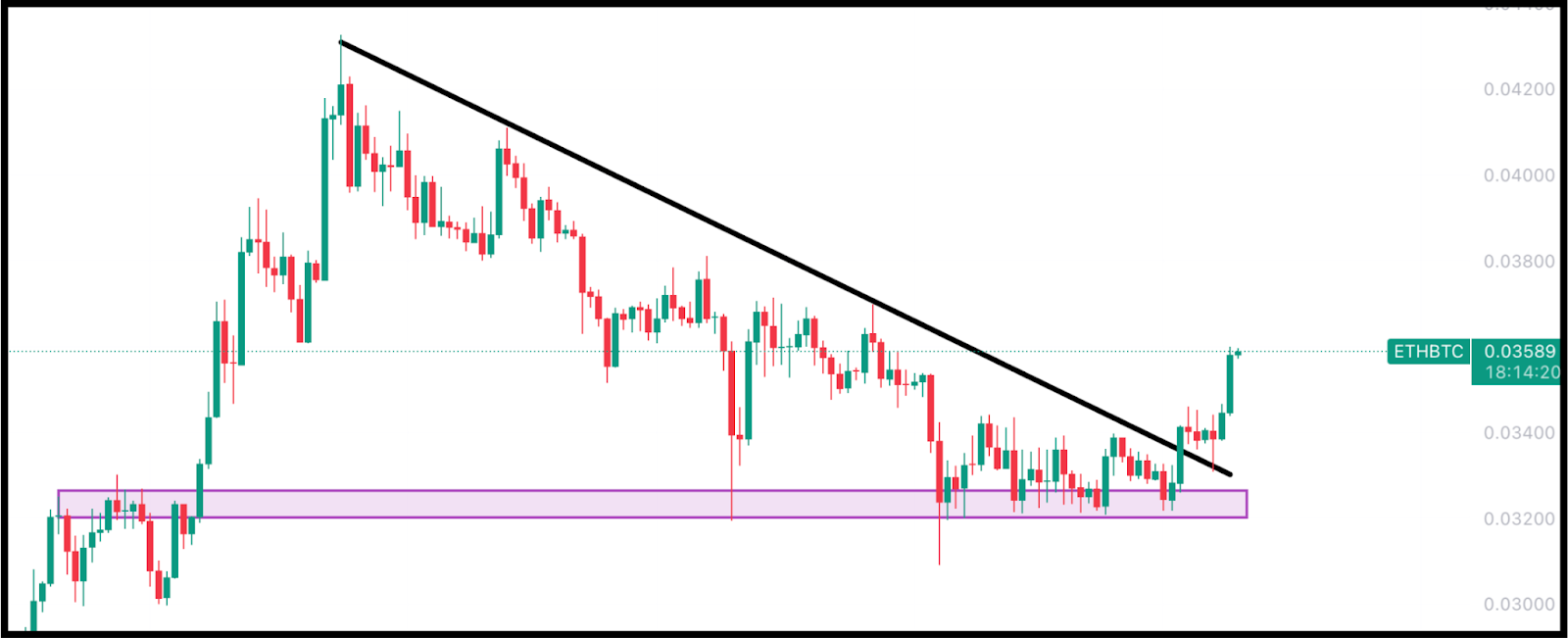
While still early, the current pattern is notable because improvements in ETH/BTC have historically aligned with shifts in how capital moves across the ecosystem. A sustained period of relative strength here would simply indicate that market participation is becoming less BTC-centric and more diversified. It doesn’t guarantee outcomes, but it does make ETH/BTC an important chart to monitor for understanding how risk appetite is evolving beneath the surface.
General information only. This article is for educational purposes and does not constitute financial, investment, legal or tax advice, nor a recommendation to buy, sell or hold any asset. Cryptocurrency is a high-risk asset and you should consider your own circumstances and seek independent advice before making any decision. Uptrade does not make price predictions.
Kane leads our international research division, delivering clear, actionable insights into crypto markets and emerging investment opportunities. A true “crypto native,” he has over seven years of hands-on experience, formal qualifications in finance and economics, and has worked across Web3 hedge funds, venture capital, and leading incubators.
View all articles