The main types of cryptocurrency, from payment coins and stablecoins to utility tokens and meme coins, how each works, and what can go wrong.
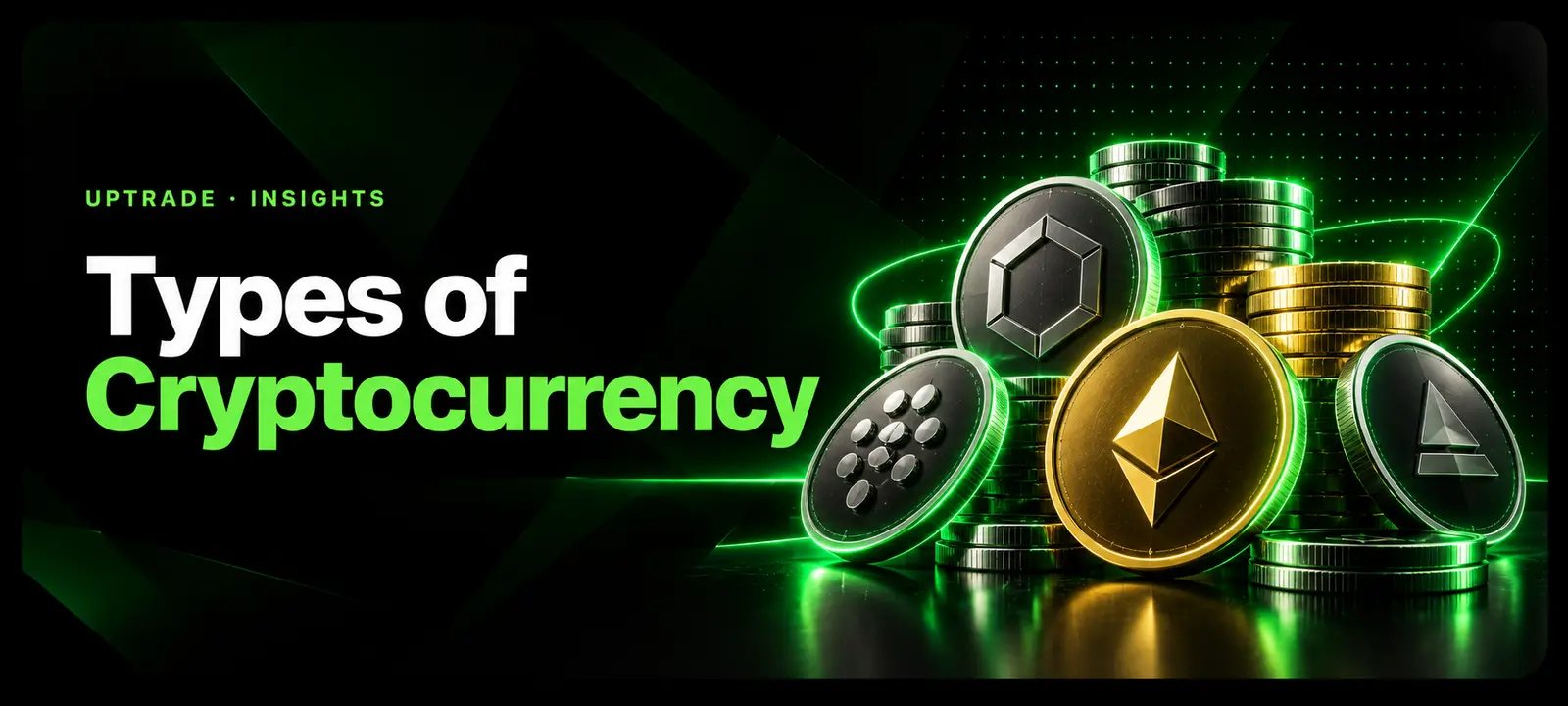
The main types of cryptocurrency are payment coins, smart-contract platform coins, stablecoins, utility and governance tokens, meme coins, privacy coins, tokenized real-world assets, and exchange tokens. Each type is defined by the job the asset does, and that job tells you what has to keep working for the asset to hold value: a network, an issuer's reserves, a company, or online attention.
With more than 22,000 assets listed on CoinGecko alone, labels only get you part of the way, because the people who assign them disagree. CoinGecko files Bitcoin under “Smart Contract Platform,” while the SEC treats Dogecoin, a meme coin by almost any description, as a digital commodity. Sorting assets by function, and by what each one depends on, holds up better than any single tag.
Sorted by function, cryptocurrency falls into eight main types. Payment, platform, and privacy coins run their own blockchains, while stablecoins, utility and governance tokens, meme coins, tokenized real-world assets, and exchange tokens usually live on an existing chain. What separates them is the source of value: network use, issuer reserves, a company, or attention.
| Type | What it does | Examples | What drives value | Main risk |
|---|---|---|---|---|
| Payment coins | Moves value between people without a bank | Bitcoin (BTC), Litecoin (LTC) | Network security and adoption | Large price swings |
| Smart-contract platform coins | Runs apps and tokens; pays network fees | Ether (ETH), Solana (SOL) | Demand for network space | Rival chains, outages, and bugs |
| Stablecoins | Holds a fixed value, usually one US dollar | USDT, USDC | Reserves held by the issuer | Losing the peg or issuer failure |
| Utility and governance tokens | Pays for a service or gives a vote over a protocol | Chainlink (LINK), Uniswap (UNI) | Use of the underlying service | No users; concentrated votes |
| Meme coins | Community and entertainment | Dogecoin (DOGE), Shiba Inu (SHIB) | Attention and speculation | Extreme volatility |
| Privacy coins | Hides the sender, receiver, or amount of a payment | Monero (XMR), Zcash (ZEC) | Demand for financial privacy | Delistings and tighter regulation |
| Tokenized real-world assets | Represents gold, a fund, or another off-chain asset | PAX Gold (PAXG), Tether Gold (XAUT) | Value of the underlying asset | Issuer, custodian, and legal claim |
| Exchange tokens | Fee discounts or perks on one platform | Issued by individual platforms | The issuing platform's business | Platform failure |
Apart from Bitcoin itself, every asset in the table can also be called an altcoin. For that term and its subtypes, see our guide to what altcoins are and how they differ from Bitcoin.
As of Q4 2026, CoinGecko, a major crypto data aggregator, listed 22,457 active cryptocurrencies. However large that count looks, value is concentrated at the top: Bitcoin alone made up about 59% of total crypto market value, and Bitcoin, Ether, USDT, and USDC together about 79%, so the other listings share roughly a fifth.
Those shares come from CoinGecko's global market data. Among its categories, stablecoins were worth about $298 billion (most of it in USDT and USDC), while meme coins came to about $30 billion. Counts differ between data sites, since each sets its own listing rules. CoinGecko also leaves wrapped and bridged tokens (copies of a coin issued on another blockchain) and staked tokens out of its global market value to avoid counting the same value twice.
A coin is the native asset of its own blockchain, such as BTC on Bitcoin or ETH on Ethereum, and it pays that network's fees. By contrast, a token is created by a smart contract (a program that runs on a blockchain) on an existing chain, so it relies on that chain's security.
On Ethereum, most tokens follow the ERC-20 standard, proposed in November 2015. As ethereum.org's documentation of the standard notes, tokens can represent almost anything, from reputation points to a fiat currency or an ounce of gold. Even so, every token transfer on Ethereum pays its fee in ETH.
In everyday language the line blurs, since “stablecoin” and “meme coin” usually describe tokens, while Dogecoin is a meme coin with its own blockchain. For an investor, the point is that a token carries the risks of its host chain and of its own contract.
The main types of crypto coins, meaning assets native to their own blockchain, are payment coins built to move value, smart-contract platform coins that pay for running applications, and privacy coins that hide transaction details. Because no issuer or reserve stands behind the coin, all three depend on their network staying secure and in use.
Built to send value directly between people, payment coins cut out the bank in the middle. Bitcoin, running since January 2009, was introduced in a white paper titled “Bitcoin: A Peer-to-Peer Electronic Cash System,” and its supply is capped at 21 million coins. Litecoin (launched in 2011) follows a similar design. Bitcoin is now more often discussed as a store of value than as a way to pay.
Beyond payments, smart-contract platform coins power blockchains that host applications and other tokens. On Ethereum, for example, gas fees have to be paid in Ether (ETH), so demand for the coin rises and falls with demand for space on the network.
Privacy coins hide some or all of the details that other blockchains make public. The Monero project explains that, by default, Monero hides the sender, receiver, and amount of every transaction, while Zcash lets users choose between shielded (private) and transparent transfers. For privacy coins, regulation is the main risk: from July 10, 2027, the EU's Anti-Money Laundering Regulation will prohibit crypto-asset service providers from keeping accounts that allow the anonymization of transactions, “including through anonymity-enhancing coins.”
The main types of crypto tokens are stablecoins, utility tokens, governance tokens, tokenized real-world assets, and exchange tokens, with meme tokens as a separate case. Since a token lives on another blockchain, its value rests on something outside the token itself, such as an issuer's reserves, a working service, a vault, or a company's business.
Stablecoins are tokens designed to hold a fixed value, usually one US dollar. Most are backed by cash and short-term government debt, although some use crypto collateral, gold, or (in algorithmic designs) code and incentives. A stablecoin is only as steady as its reserves and its issuer, and pegs have broken before, as when USDC fell as low as 86 cents in March 2023 before recovering.
Utility tokens pay for a specific service, and governance tokens give holders a vote on how a protocol changes. Chainlink's documentation describes LINK as the standard unit of payment for Chainlink services. Because holders can manage and upgrade the Uniswap protocol by voting, Uniswap's UNI is a governance token. For either kind, value depends on people actually using the service, and voting power can sit with a few large holders.
Tokenized real-world assets represent something held off the blockchain, such as gold, Treasury bills, or shares in a fund. Each PAX Gold token, Paxos says, represents one fine troy ounce of London Good Delivery gold held in vaults in London. Because the token tracks the underlying asset, the risks shift to the issuer, the custodian, and the strength of the holder's legal claim. Our explainer on what tokenization is and how it works covers those risks in more depth.
Issued by a crypto trading platform, exchange tokens usually give holders fee discounts or other perks there. If that one platform fails or changes its terms, most of the reason to hold the token goes with it.
Meme coins are crypto assets inspired by internet jokes, characters, or trends, and they typically have limited or no use beyond trading and community. In its March 2026 interpretation, the SEC described meme coins as a kind of digital collectible, typically acquired for artistic, entertainment, social, and cultural purposes, with value driven by supply and demand.
Under that interpretation, a typical meme coin is not itself a security unless it is sold with promises that turn the sale into an investment contract. With no reserve, revenue, or fee demand behind the price, a meme coin has nothing to slow a fall once attention moves elsewhere.
Of the roughly $30 billion in CoinGecko's meme category as of Q4 2026, about $12 billion sat in Dogecoin, a coin launched in 2013, so a single early project still accounts for around 40% of the group.
The chain, job, and backing check classifies any new cryptocurrency with three questions: does it run its own blockchain, what job does it do that someone would pay for, and what has to keep working for it to hold value? Together, the answers place an asset more reliably than its name, its marketing, or a data site's tag.
| Question | What to look for | What a weak answer looks like |
|---|---|---|
| Chain: does it run its own blockchain? | A coin with its own network, or a token on a named host chain | No clear answer on where it runs or who controls the contract |
| Job: what does it do that someone would pay for? | Paying fees, settling payments, voting, or representing an asset | Only trading, or a use promised for a future product |
| Backing: what has to keep working for it to hold value? | A secure network, audited reserves, a vault, or a service with real users | Attention, one company's goodwill, or nothing that can be named |
As a hypothetical example, take a new token launched on Ethereum that promises fee discounts on a single trading app. On the chain question, it is a token, so it carries Ethereum's risks and those of its own contract. The job question puts it among utility tokens, since its job is a discount. As for backing, its value depends on one company's app, so it behaves like an exchange token. Where the answers point to different types, weight the backing answer most heavily, since it describes how the asset would fail.
Labels overlap because one asset can do several jobs, and because every classifier draws its lines for its own purpose. As of Q4 2026, CoinGecko tracked 774 categories, and an asset can sit in many at once: its Smart Contract Platform category lists Bitcoin first, while its Real World Assets category includes Chainlink and Stellar alongside gold-backed tokens.
Regulators sort by legal rights instead: in a March 17, 2026, interpretation that the CFTC joined, the SEC set out five categories (digital commodities, digital collectibles, digital tools, stablecoins, and digital securities). Its digital commodity examples in the full release include Bitcoin, Ether, Chainlink, Dogecoin, and Shiba Inu, while the meme coin WIF counts as a digital collectible.
Beyond function, two technical labels describe the network underneath an asset. Consensus is either proof of work (computers compete to add blocks, as on Bitcoin) or proof of stake (holders stake coins to validate, as on Ethereum since 2022). A layer 1 is a base blockchain, and a layer 2 is built on top of one to make transactions cheaper and settles back to the base chain.
Every type of cryptocurrency carries price risk, but the failure that causes permanent loss differs by type. Coins fail when their network loses users or security, tokens fail when the issuer, contract, or service behind them fails, and meme coins fail when attention moves on, while custody and platform risk sit on top of every type.
Price volatility applies to every type except a stablecoin that holds its peg; even Bitcoin lost about 60% of its value in 2022, Reuters reported.
Custody risk applies to all of them, whether a platform, a third-party custodian, or your own wallet holds the asset, and assets on a platform that fails can be tied up in its insolvency, as our guide to managing risk when investing in crypto explains.
A popular four-way split names payment coins, tokens, stablecoins, and central bank digital currencies (CBDCs). It is a simplification, since CBDCs are issued by central banks and are not decentralized crypto, and “tokens” covers assets as different as governance tokens and tokenized gold.
Bitcoin is a coin, because BTC is the native asset of the Bitcoin blockchain and pays that network's transaction fees. Wrapped versions such as WBTC on Ethereum are tokens that represent BTC held by a third-party custodian, which adds custodian and smart-contract risk.
An altcoin is any cryptocurrency other than Bitcoin, so the word works as a catch-all label more than a type. It spans smart-contract platforms such as Ethereum, stablecoins, utility tokens, and meme coins, which carry very different risks, so the function-based types tell an investor more.
By market value, payment coins are the largest type, because Bitcoin alone made up about 59% of total crypto market value as of Q4 2026, CoinGecko data shows. Among tokens, stablecoins were worth about $298 billion, roughly ten times the $30 billion held in meme coins.
No type of cryptocurrency is safe in the way an insured bank deposit is. Stablecoins are built for a steady price but can lose their peg, Bitcoin still swings sharply, and every type carries custody risk. Comparing what each asset depends on is more useful than hunting for a safe category.
You can buy cryptocurrency through a broker or exchange, paying in dollars or another currency, then choose whether the platform, a third-party custodian, or your own wallet holds it. UpTrade's pages on how to buy Bitcoin and how to buy Ether walk through the broker-assisted steps.
Knowing what an asset depends on is half the decision, and the other half is how you buy it and where it is held, which is where a broker can help. UpTrade is a dedicated crypto brokerage built around real relationships, not a self-serve app you navigate alone.
Browse the full list of digital assets UpTrade supports, or see how custody and security work.
UpTrade is registered with AUSTRAC (registration DCE100856266-001). You can read more about registered providers at austrac.gov.au.
This article is for general informational purposes only and does not constitute financial, investment, or tax advice. It does not recommend any asset, allocation, or strategy. Cryptocurrency investments carry significant risk, including the possible loss of principal. Past performance is not indicative of future results. UpTrade does not make investment recommendations based on your personal financial circumstances. You should conduct your own research and seek independent financial advice before making any investment decisions.
General information only. This article is for educational purposes and does not constitute financial, investment, legal or tax advice, nor a recommendation to buy, sell or hold any asset. Cryptocurrency is a high-risk asset and you should consider your own circumstances and seek independent advice before making any decision. UpTrade does not make price predictions.

Market updates, new explainers and the occasional Alpha Pro report, sent once a week. Unsubscribe anytime.