A stablecoin is a crypto token pegged to an asset like the US dollar. How stablecoins work, USDT vs USDC, depeg risks, and the 2026 rules.
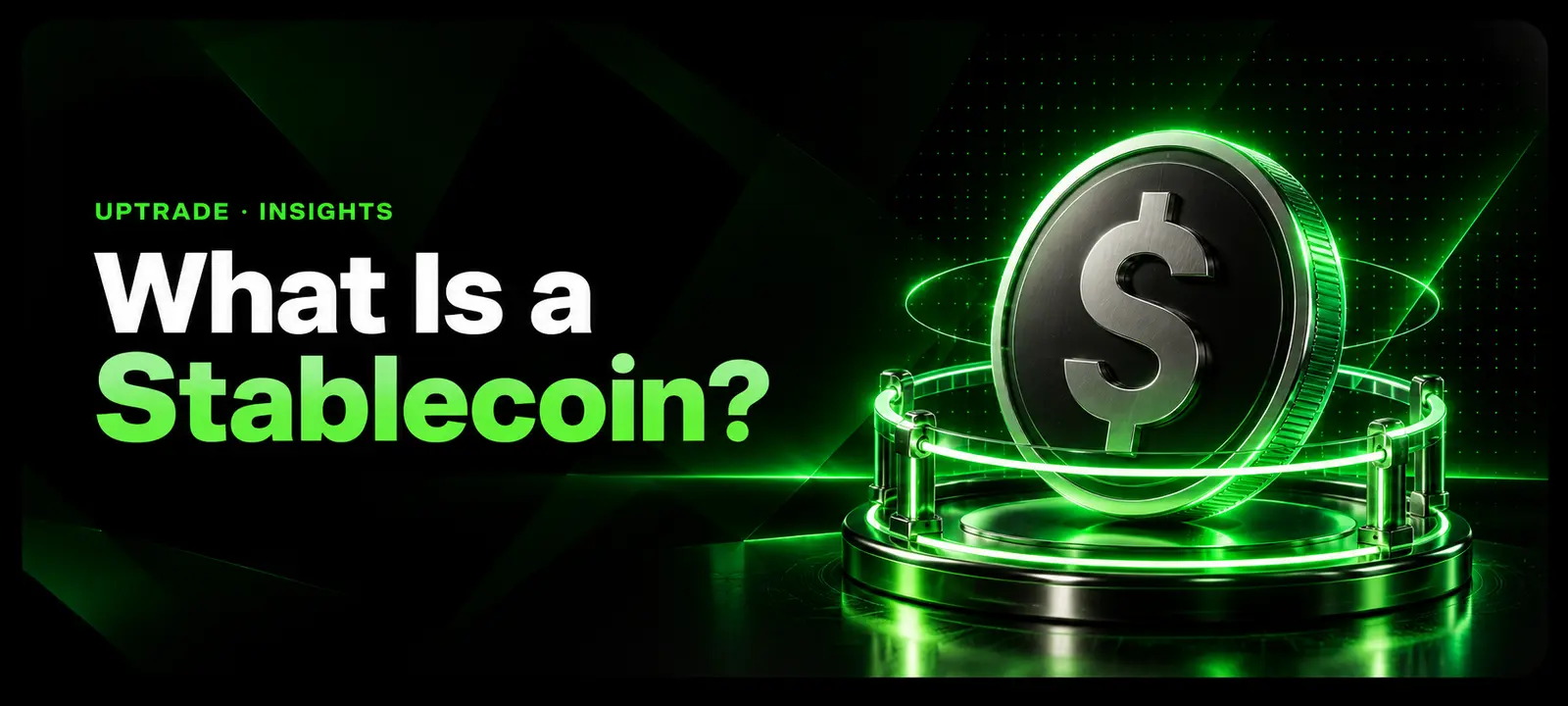
A stablecoin is a type of cryptocurrency designed to keep a steady price by tying its value to another asset, most often the US dollar. To support that link, known as the peg, the issuer holds reserves, and certain holders can swap the token back for the asset behind it.
For most holders, though, that dollar value is a market price, since issuers usually redeem directly only for large business customers. As a result, a stablecoin's stability rests on three things a price chart never shows: the reserves, who is allowed to redeem against them, and where your own tokens are held.
A stablecoin is a digital token, issued on a blockchain, whose price is pegged to a reference asset such as the US dollar, the euro, or gold. Where Bitcoin and Ether float freely with supply and demand, a stablecoin is engineered to trade at a fixed value and to be redeemable for that value.
As of Q4 2026, dollar-pegged stablecoins were worth roughly $300 billion combined, DefiLlama's stablecoin tracker shows, with Tether's USDT at about $182 billion (around 60%) and Circle's USDC at about $72 billion.
Stablecoins are used mainly to move dollar value around the crypto market without leaving the blockchain. Common uses include parking funds between trades, sending money across borders, and posting collateral in decentralized finance. Their appeal comes from pairing the steady value of a dollar with a token that can move at any hour.
Since many crypto markets quote prices against USDT or USDC, selling into a stablecoin is often the quickest way to lock in a position's dollar value. Across borders, a stablecoin transfer can settle in minutes at any hour, although turning the tokens back into local money still depends on a local exchange, broker, or bank.
In decentralized finance (DeFi), stablecoins are the base currency: a borrower might post Ether as collateral, borrow USDC against it, and have that Ether sold automatically if its price falls far enough.
Stablecoins work through redemption and arbitrage. When an approved customer deposits dollars, the issuer creates new tokens; when that customer redeems, the issuer destroys them. Whenever the market price slips below $1, traders who can redeem buy the cheap tokens and swap them back at full value, and that buying pushes the price back up.
With supply expanding and shrinking against real deposits (a process called minting and burning), every token in circulation should have a matching dollar, or a dollar-equivalent asset, sitting in reserve.
Direct redemption, however, is generally limited to verified business customers. Tether's published fee schedule sets a minimum redemption of 100,000 USD and requires account verification, and Circle handles minting and redemption through Circle Mint, an account built for institutional customers. For most individual investors, the exit runs through the secondary market instead (the exchanges and brokers that buy stablecoins back for cash).
Stablecoin issuers make most of their money from the reserves themselves. In exchange for their dollars, holders receive tokens that pay no interest, while the issuer invests those dollars in Treasury bills and similar assets and keeps the yield. Tether, for example, reported a net operating profit of about $1.5 billion for the second quarter of 2026.
Stablecoins fall into four broad types, defined by what backs the peg. Fiat-backed coins hold cash and short-term government debt. Crypto-backed coins lock up other cryptocurrencies as collateral, commodity-backed coins hold physical assets such as gold, and algorithmic coins rely on code and market incentives in place of full reserves.
| Type | What backs it | How the peg is held | Examples | Main weak point |
|---|---|---|---|---|
| Fiat-backed | Cash and Treasury bills | Issuer mints and redeems one-to-one | USDT, USDC | Reserve quality and trust in the issuer |
| Crypto-backed | Excess crypto collateral | Smart contracts sell collateral if it falls too far | DAI, USDS (Sky) | Collateral crashes and code bugs |
| Commodity-backed | Gold or another commodity in a vault | Redeemable for a set amount of the commodity | Tether Gold (XAUT), PAX Gold (PAXG) | Price moves with the commodity |
| Algorithmic | Little or no reserve; a companion token and code | Supply expands or contracts automatically | TerraUSD (UST), failed 2022 | A loss of confidence can feed on itself |
By a wide margin, fiat-backed stablecoins are the largest category. For each coin, the issuer holds reserves in cash and cash equivalents, such as short-term US Treasury bills, and publishes reports on those holdings, which is the model behind both USDT and USDC.
USDT and USDC both aim to hold exactly one US dollar, and they differ mainly in how often they report reserves, what those reserves hold, and where they are authorized. Of the two, USDT is larger and reports quarterly with a wider mix of assets, while USDC reports monthly and is authorized under the EU's MiCA rules.
| USDT | USDC | |
|---|---|---|
| Market value (DefiLlama, Q4 2026) | About $182 billion | About $72 billion |
| Reserve reporting | Quarterly attestation by an independent accounting firm (BDO) | Monthly attestation by a Big Four accounting firm |
| Reserve mix (issuer reports) | About three-quarters cash and equivalents (June 30, 2026), plus gold, secured loans, Bitcoin, and other investments | Bank deposits, short-dated US Treasuries, and overnight Treasury repos |
| EU status under MiCA | Not authorized | Authorized since July 2024 |
The reserve details come from Tether's June 2026 reserve report and Circle's transparency page.
Crypto-backed stablecoins lock other cryptocurrencies inside smart contracts (programs that run automatically on a blockchain). Because that collateral is volatile, these systems hold more of it than the value of stablecoins they issue, and the contract sells it automatically when its value drops too far. DAI, launched by MakerDAO in December 2017, is the longest-running example.
Commodity-backed stablecoins tie each token to a physical asset, usually one troy ounce of gold held in a vault, and Tether Gold and PAX Gold are the two largest by market value, CoinGecko's tokenized gold category shows. Their dollar price rises and falls with the metal, and the vault and redemption details are covered in our guide to tokenized gold.
Algorithmic stablecoins try to hold a peg with code in place of reserves, usually by minting and burning a companion token. Because that token only has value while people believe in the system, a run on the stablecoin also drains the asset meant to defend it.
A stablecoin is a private token issued by a company, a bank deposit is a claim on a regulated bank, and a central bank digital currency (CBDC) is digital money issued directly by a central bank. All three can represent a dollar, but who owes you the money, and what protection applies if something fails, differ sharply between them.
Of those differences, deposit insurance carries the biggest consequence, because a US bank account is covered by the FDIC up to $250,000 per depositor, per bank, for each account ownership category, while a stablecoin balance of any size is covered by nothing. If an issuer fails, the GENIUS Act gives holders priority claims on its reserves.
On the CBDC side, a January 2025 executive order prohibits US federal agencies from establishing a central bank digital currency, and the European Central Bank says no interest would be paid on digital euro holdings.
Stablecoins are not risk-free. The main risks are a depeg, when the token trades away from $1; a freeze, when the issuer blocks tokens at a flagged address; and custody failure, when the platform holding your tokens collapses. Recovery depends on the cause, since USDC returned to about $1 within days in 2023 while TerraUSD never recovered after May 2022.
A stablecoin loses its peg when holders doubt the reserves are sufficient or reachable, when backing collateral crashes, or when an algorithmic design runs out of buyers. In March 2023, Circle disclosed that $3.3 billion of USDC's reserves sat at Silicon Valley Bank, which regulators had just shut down, and USDC fell as low as 86 cents that weekend, CNBC reported. By Monday it was back near $1, because regulators had promised that all SVB depositors would be repaid.
TerraUSD (UST), then the largest algorithmic stablecoin, had no reserve to fall back on. Once heavy selling broke its peg in May 2022, the system minted ever more LUNA, its companion token, and both collapsed within days. In its later complaint against Terraform Labs, the SEC alleged that the scheme led to the loss of at least $40 billion in market value.
Yes, fiat-backed stablecoin issuers can freeze tokens. Under the GENIUS Act, US-permitted issuers must keep the technical ability to block, freeze, and reject transactions that violate the law, and they must be able to comply with lawful orders to seize or freeze tokens.
Custody risk is the chance that the place holding your tokens fails, even while the coin trades at exactly $1 elsewhere. If a platform fails, tokens on its own books can be tied up in its insolvency, so exposure depends on who controls the private keys (the codes that authorize transfers): the platform, a qualified third-party custodian, or you, in your own wallet.
Stablecoin regulation in 2026 centers on two frameworks. The US framework is the GENIUS Act, which became law on July 18, 2025, while in the European Union the stablecoin rules of the Markets in Crypto-Assets Regulation (MiCA) have applied since June 30, 2024. Both require issuers to be authorized and to back their tokens with reserve assets.
The Guiding and Establishing National Innovation for U.S. Stablecoins (GENIUS) Act limits payment stablecoin issuance to permitted issuers and sets four core requirements:
By its terms, the law takes effect on the earlier of January 18, 2027, or 120 days after regulators finalize their rules. On October 21, 2026, the Office of the Comptroller of the Currency (OCC) issued its final rule implementing the Act, effective January 18, 2027.
Under MiCA, a stablecoin pegged to a single currency is an e-money token that only an authorized credit institution or electronic money institution can issue, as the European Banking Authority's guidance on MiCA sets out. Circle has issued USDC in the EU through its French e-money institution since July 2024. USDT is not authorized under MiCA, and in October 2026 the European Securities and Markets Authority (ESMA) told EU-authorized platforms to wind down services that let customers trade or add to holdings of non-compliant stablecoins.
The four-question stablecoin check covers backing, redemption, verification, and custody: what backs each token, who can redeem it and on what terms, who checks the reserves, and where your tokens will be held. Taken together, the answers show what would have to go wrong for the peg, or your access to it, to break.
| Check | Question to ask | What a weak answer looks like |
|---|---|---|
| Backing | What backs each token? | Assets that are hard to sell quickly, or an algorithm in place of reserves |
| Redemption | Who can redeem directly, and on what terms? | Only large, verified customers, with high minimums or slow processing |
| Verification | Who checks the reserves, and how often? | Occasional statements the issuer publishes about itself, with no named accounting firm |
| Custody | Where will your tokens be held? | A platform that cannot explain whether client assets are kept separate from its own |
Cash and short-term Treasuries can be sold quickly at close to face value, while crypto collateral can drop sharply in a day, so the latest reserve report tells you more than the issuer's homepage. If only large customers can redeem directly, your exit runs through the secondary market, where the price on a bad day depends on who else is selling.
For custody, the options are a trading platform's own books, a qualified third-party custodian, or a wallet you control, and our comparison of self-custody vs custodial storage covers the trade-offs.
Yes. USDT, issued by Tether, is a fiat-backed stablecoin designed to hold one US dollar, and it is the largest, at about $182 billion as of Q4 2026. Tether's June 30, 2026 reserve report showed about three-quarters of reserves in cash and cash equivalents.
Usually, buyers get stablecoins through a crypto broker or exchange, paying in dollars or another currency, and then decide where to hold them: on the platform, with a third-party custodian, or in their own wallet. UpTrade's guides on how to buy Tether (USDT) and how to buy USDC walk through the broker-assisted process.
Payment stablecoins such as USDT and USDC do not pay holders interest, and the GENIUS Act bars US-permitted issuers from doing so. Some tokens marketed as yield-bearing dollars do pass through returns, but they are not payment stablecoins under the Act, and returns offered by third-party platforms come from lending or other activities with their own risks.
No. Bitcoin has no peg and no reserve behind it, so its price moves freely with supply and demand. By contrast, a stablecoin is built to hold a fixed value against an asset like the US dollar. Investors often sell Bitcoin into a stablecoin to keep dollar value on the blockchain.
Yes. A stablecoin can lose its peg, as USDC briefly did in March 2023 and TerraUSD did permanently in 2022. Separately, you can lose tokens if the platform holding them fails or if you send them to the wrong address. Even when the peg holds, a dollar-pegged token loses purchasing power to inflation.
Stablecoins are built to keep a steady price, so if everything works as intended there are no capital gains to collect. They are mainly used to hold or settle dollar value. None of this is a recommendation to hold or avoid any stablecoin.
Where your stablecoins sit decides how easily you can reach them on a bad day, and a broker can help you weigh that before you buy. UpTrade is a dedicated crypto brokerage built around real relationships, not a self-serve app you navigate alone.
See how custody and security work at UpTrade, or browse the full list of digital assets.
UpTrade is registered with AUSTRAC (registration DCE100856266-001). You can read more about registered providers at austrac.gov.au.
This article is for general informational purposes only and does not constitute financial, investment, or tax advice. It does not recommend any asset, allocation, or strategy. Cryptocurrency investments carry significant risk, including the possible loss of principal. Past performance is not indicative of future results. UpTrade does not make investment recommendations based on your personal financial circumstances. You should conduct your own research and seek independent financial advice before making any investment decisions.
General information only. This article is for educational purposes and does not constitute financial, investment, legal or tax advice, nor a recommendation to buy, sell or hold any asset. Cryptocurrency is a high-risk asset and you should consider your own circumstances and seek independent advice before making any decision. UpTrade does not make price predictions.

Market updates, new explainers and the occasional Alpha Pro report, sent once a week. Unsubscribe anytime.