Self-custody vs custodial crypto wallets: who holds the keys, the risks and benefits of each, and the third option most guides miss.
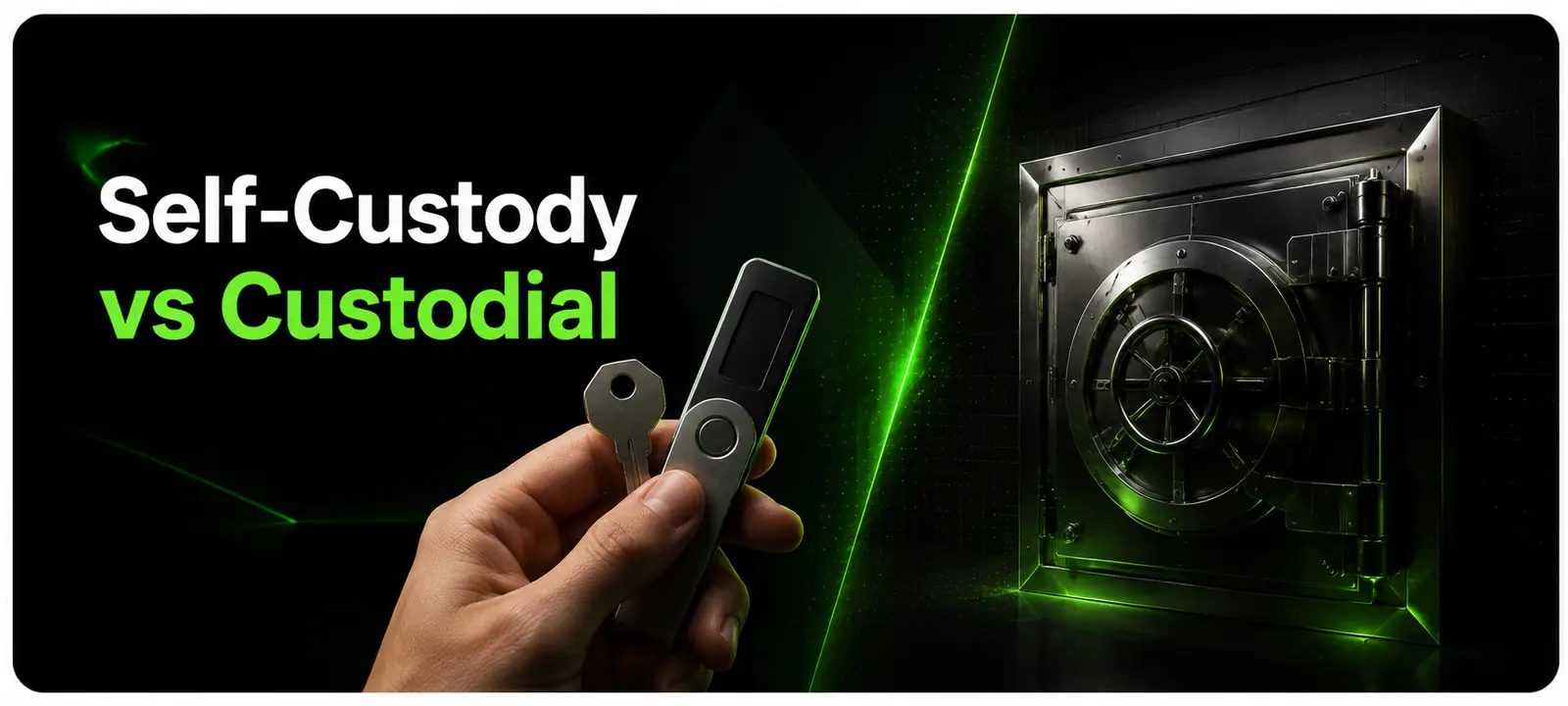
The difference between self-custody and custodial crypto storage is who holds the private keys. With a custodial wallet, a provider holds them and you hold a claim on your assets. With a self-custody wallet, you hold the keys yourself, so no company can freeze, lose, or restore access to your crypto.
Everything else, the security trade-offs, the recovery options, and what happens when something goes wrong, follows from that one answer.
This guide explains what custodial and self-custody wallets are, the real benefits and risks of each, a third option that most comparisons leave out, and the questions that usually decide which is appropriate. It does not tell you which to choose, since that depends on your circumstances. This is education, not advice.
A custodial wallet is one where a third party holds your private keys and manages access on your behalf. A self-custody wallet, also called non-custodial, is one where you hold the keys yourself. Whoever controls the keys controls the crypto, which is why this single distinction determines everything else.
It helps to know what a wallet actually holds. Your crypto exists on the blockchain, not inside any wallet. What a wallet stores is the private key, the piece of information that authorises transactions from your address. So the question is never really where your crypto is. It is who holds the key that can move it.
A custodial wallet is one where a provider, usually an exchange, holds the private keys for you. If you buy crypto on a platform and leave it there, you are using a custodial wallet. You can log in with an email and password, and the provider can reset your access, because they control the keys.
Convenience is the main one. There are no keys to manage, no recovery phrase to protect, and forgetting a password is an inconvenience rather than a catastrophe, since support can restore access. For anyone actively trading, holding assets on the platform also makes transacting simpler. Regulated providers may also apply safeguards to how client assets are held.
You hold a claim rather than the asset. If the provider fails, is hacked, or restricts withdrawals, your access depends entirely on them and on whatever recovery process follows. When Mt. Gox filed for bankruptcy in February 2014 it disclosed roughly 850,000 missing bitcoin, around 750,000 of which belonged to customers, as reported at the time. About 200,000 were later recovered, and creditors waited more than ten years for repayments to start. FTX's collapse in 2022 followed a similar course. People holding their own keys were unaffected in both cases.
This is the origin of the phrase not your keys, not your coins. It overstates the case a little, since not all custodians are equivalent, and it points at something real: custodial holdings carry the provider's risk in addition to the asset's. Assessing that provider, including its regulatory registration and how it holds client assets, is part of the decision.
A self-custody wallet is one where you generate and hold your own private keys, usually secured by a recovery phrase. No company can access, freeze, or lose your assets, and no company can help you recover them either. Self-custody wallets range from mobile apps to hardware devices kept offline.
Control is the point. Your holdings do not depend on any company remaining solvent or honest, they cannot be frozen, and no platform failure can reach them. For assets intended to be held for years, removing that dependency is the main argument, and it is a strong one.
The responsibility transfers entirely to you. Lose the recovery phrase with no backup and the assets are gone permanently, with no support line and no reset. Self-custody is also only as strong as your own security habits, since phishing, malware, and a compromised device all remain possible. Our guide to cold storage covers how offline storage reduces some of these risks.
There is a less obvious risk too. If nobody else can access your holdings and something happens to you, the assets may be unrecoverable by anyone. Self-custody over long horizons needs a documented plan for how holdings would be found and recovered, which is a conversation to have with a legal professional.
Neither option is safer in every respect, and the honest framing is that each removes one risk by accepting another. Custodial holdings trade control for convenience and a recovery process. Self-custody trades convenience for control and accepts that mistakes are permanent.
| Feature | Custodial | Self-custody |
|---|---|---|
| Who holds the keys | The provider | You |
| What you own | A claim on your assets | The assets directly |
| If you lose access | Support can usually restore it | Permanent loss with no backup |
| If the provider fails | Your holdings are at risk | Unaffected |
| Can holdings be frozen | Yes | No |
| Responsibility for security | Shared with the provider | Entirely yours |
| Ease of use | Higher | Requires more care |
Most comparisons present this as a binary, and it is closer to three options. Between leaving assets on a trading platform and managing keys yourself sits qualified custody, where a specialist custodian holds assets using institutional security infrastructure, separate from any trading business.
The distinction matters. Leaving crypto on an exchange means it sits with a business whose main activity is trading. Qualified custody means assets are held by a provider whose purpose is safekeeping, typically using approaches such as multi-party computation, where no single party ever holds a complete key. UpTrade offers institutional-grade custody through Fireblocks at no extra cost, for people who want neither exchange risk nor sole responsibility for keys.
It is still custody, so counterparty considerations do not disappear entirely. What changes is who is holding the assets, what they are built to do, and what safeguards apply. For anyone who finds self-custody daunting and exchange balances uncomfortable, it is the option that gets overlooked.
The right answer depends on how much you hold, how long you intend to hold it, how often you transact, and how confident you are managing security. Rather than a rule, these questions tend to decide it. Many people use more than one approach at once.
A common approach is to split by purpose: keeping working balances where trading happens, and moving longer-term holdings into self-custody or qualified custody. That way convenience applies where it matters and protection applies where the exposure is largest.
A self-custody wallet is a crypto wallet where you hold your own private keys, usually secured by a recovery phrase, so no company can access or control your assets. It is also called a non-custodial wallet. You are solely responsible for security and recovery, since no provider can restore access if it is lost.
It means whoever controls the private keys effectively controls the crypto. If a provider holds the keys, you hold a claim on your assets rather than the assets themselves, and that claim depends on the provider staying solvent and accessible. The phrase became common after exchange collapses left customers unable to withdraw.
It removes different risks rather than being safer overall. Self-custody eliminates the risk of a provider failing or freezing your assets, and it introduces the risk of permanent loss through lost keys or your own security mistakes. Which risk is more acceptable depends on the holder.
Yes. If you lose your recovery phrase and have no backup, the assets are unrecoverable, since no company holds a copy and no reset process exists. Assets can also be lost to phishing, malware, or a compromised device. Durable backups in more than one location are the standard protection.
Generally yes. If you can log in with an email and password and the provider can reset your access, they hold the keys, which makes it custodial. Most wallets provided by mainstream exchanges work this way. Some exchanges also offer separate self-custody wallet products where you hold the keys instead.
No, and many people do not. A common pattern is keeping a working balance on a platform for transacting while holding longer-term assets in self-custody or with a qualified custodian. Splitting by purpose means the convenience applies where it is useful and the protection applies where the exposure is greatest.
Deciding how to hold crypto is easier with someone to talk it through with. UpTrade is a dedicated crypto brokerage built around real relationships, not a self-serve app you navigate alone.
Read more about our custody approach. UpTrade is an AUSTRAC-registered digital currency exchange provider (DCE100856266-001). You can verify registered providers at austrac.gov.au.
General information only. This article is for educational purposes and does not constitute financial, investment, legal or tax advice, nor a recommendation to buy, sell or hold any asset. Cryptocurrency is a high-risk asset and you should consider your own circumstances and seek independent advice before making any decision. UpTrade does not make price predictions.

Market updates, new explainers and the occasional Alpha Pro report, sent once a week. Unsubscribe anytime.